
Kaspa (KAS) has built a reputation for doing something most crypto projects talk about but struggle to execute: scaling proof-of-work without turning decentralization into a marketing slogan. If Bitcoin is the tank and Solana is the sports car, Kaspa is trying to be the dirt-bike—fast, lightweight, and built to handle rough terrain.
That said, price doesn’t move on tech alone. KAS has its own rhythm—driven by mining economics, exchange access, macro cycles, and that very specific “PoW believers + speed addicts” community energy. So this guide isn’t going to sell you a fantasy. It’s a scenario-based Kaspa price prediction for 2026–2030 grounded in:
- January 2026 live market stats (price, market cap, volume)
- On-chain and mining indicators (hashrate, block time, emissions)
- Kaspa’s core tech roadmap (BlockDAG, GHOSTDAG, and upgrades like Crescendo/10 BPS and DAGKnight)
- Market psychology (Fear & Greed sentiment context)
Not financial advice. Crypto is volatile. Treat predictions as ranges, not promises.
What Is Kaspa (KAS)?
Kaspa is a proof-of-work cryptocurrency that implements the GHOSTDAG protocol and organizes blocks in a BlockDAG rather than a traditional single-chain structure. In Kaspa’s own description, parallel blocks aren’t “orphaned” the way they are in classic blockchains—Kaspa allows them to coexist and then orders them in consensus.
That one design choice is the engine behind most of Kaspa’s claims: faster confirmations, higher throughput, and PoW security that still feels “Bitcoin-ish” at its core.
BlockDAG Technology and GHOSTDAG Protocol Explained
Traditional blockchains behave like a single-lane road: only one block “wins” at a time, and blocks found in parallel often get orphaned (wasted). Kaspa flips that into something closer to a multi-lane highway.
- BlockDAG: Instead of a single linear chain, the ledger is a directed acyclic graph where multiple blocks can be produced and referenced in parallel.
- GHOSTDAG: Kaspa’s consensus mechanism that orders blocks securely even when many are produced at the same time. Kaspa explains that GhostDAG improves block rates “by orders of magnitude” while maintaining the theoretical security guarantees associated with Bitcoin’s PoW model.
A helpful mental model: Bitcoin is “one block at a time,” Kaspa is “many blocks at a time—then agree on the order.” That’s how Kaspa aims for speed without giving up PoW’s security assumptions.
Kaspa also openly discusses the limits of GHOSTDAG and why DAGKnight exists as an upgrade path (e.g., responsiveness to network latency).
Key Advantages: High TPS, Fair Launch, and PoW Security
Kaspa’s bullish case is basically three pillars:
- High throughput / fast confirmation
Kaspa’s official materials emphasize multiple blocks per second and fast confirmations (they frame it as fully confirmed transactions in ~10 seconds).
Kaspa Explorer analytics also lists an average block time of 0.1s (consistent with the 10 BPS era). - Fair launch narrative
Kaspa highlights “no pre-mine, no ICO, no pre-sales, and no coin allocations,” with a fair launch date of Nov 7, 2021. - Proof-of-work security
Kaspa stays PoW, which matters for investors who value battle-tested security models and miners as the enforcement layer. The project’s tokenomics page also emphasizes PoW, decentralization, and community management.
None of this guarantees price appreciation—but it explains why Kaspa has a loyal base: it’s “PoW ethos + speed.”
Kaspa vs Traditional Blockchains (Bitcoin, Ethereum, Solana)
Let’s keep this comparison practical:
- Kaspa vs Bitcoin
Bitcoin is the benchmark for PoW security, but it’s intentionally conservative and slow-changing. Kaspa tries to preserve PoW principles while dramatically increasing block production and confirmation speed. - Kaspa vs Ethereum
Ethereum is a smart contract platform with massive network effects and liquidity. Kaspa is not trying to be “Ethereum-but-faster” with an L1 DeFi empire (at least not yet); it’s trying to be a fast PoW settlement layer with scalable block production. - Kaspa vs Solana
Solana is high-throughput but uses PoS and a different security model. Kaspa’s pitch is “high throughput on PoW,” aiming to keep decentralization and miner-driven security while still feeling modern in user experience.
Kaspa Price History and Major Milestones
Kaspa’s price history is basically a story of “quiet build → discovery → explosion → cooling period.” KAS had its loudest mainstream moment in 2024, then moved into a long digestion phase.
From 2021 Launch to 2024 All-Time High
Kaspa launched in November 2021 (fair launch date is widely cited by Kaspa itself).
By mid-2024, Kaspa hit its most notable peak. TradingView data lists Kaspa’s highest price around $0.207813 on July 31, 2024 (with nearby sources citing ~Aug 1, 2024 depending on feed).
That ATH matters for two reasons:
- It sets a psychological “return to ATH” target that traders watch forever.
- It tells you KAS can attract massive liquidity when the narrative lines up.
Key Events: Exchange Listings, Network Upgrades, and Mining Growth
A few events that shaped Kaspa’s visibility and fundamentals:
- KuCoin listing (May 2023)
KuCoin’s own announcement confirms Kaspa (KAS) listing and the start of trading on May 6, 2023. - Crescendo / 10 BPS era
Kaspa’s official “updates to Crescendo and 10BPS” post discusses moving from 1 block per second to 10 blocks per second as a major throughput jump.
The GitHub release notes for the Crescendo hardfork also describe the same transition (1 BPS → 10 BPS). - Mining ecosystem growth
Kaspa’s 10 BPS design also impacts mining decentralization. Kaspa’s features page explains that very high block rates can reduce barriers and allow smaller mining operations to see steadier revenue compared to a chain with few blocks per day.
These “plumbing” upgrades don’t always pump price immediately—but they shape long-term survivability.
Kaspa Current Price and Market Overview (January 2026)
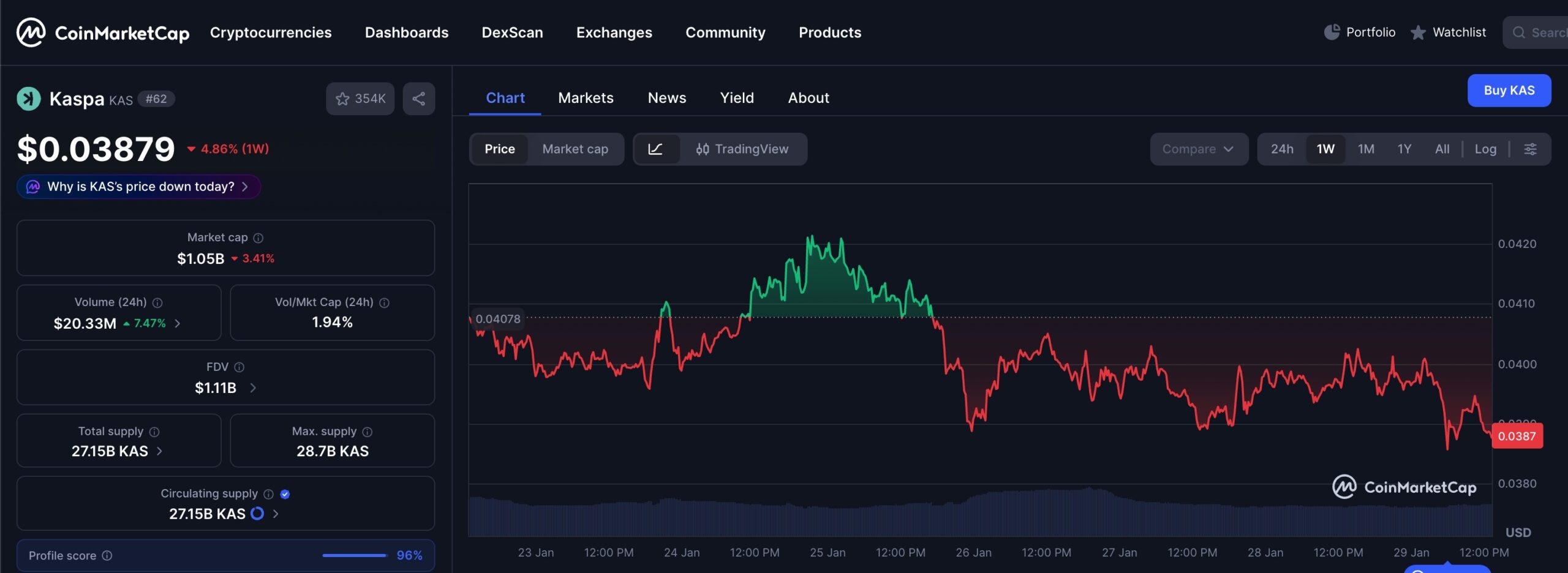
Source: Coinmarketcap
This is where we anchor the forecast. A kas crypto price prediction without current stats is basically astrology.
Live KAS Price, Market Cap, and Trading Volume
As of late January 2026, CoinMarketCap lists:
- KAS price: about $0.0389
- Market cap: about $1.056B
- 24h volume: about $20.7M
- Circulating supply: about 27.16B KAS (max ~28.70B)
CoinGecko’s historical table around Jan 27–29, 2026 shows a similar market cap around ~$1.06B and daily volume generally in the ~$18M–$28M band, reinforcing the same ballpark.
So: KAS in January 2026 is a mid-cap asset with decent liquidity—but far below its 2024 peak.
On-Chain Metrics: Hashrate, Transactions, and Mining Activity
For a PoW coin, hashrate is a big deal: it’s both security and miner conviction.
- Network hashrate: multiple mining dashboards show Kaspa in the ~430–470 PH/s range recently. 2Miners provides a current estimate and explains how it’s calculated.
AsicMinerValue shows comparable numbers and also displays difficulty, block reward, and block time. - Block time / block production: Kaspa Explorer lists average block time around 0.1s, aligning with the post-Crescendo high-frequency block production model.
- Emissions and supply: Kaspa’s tokenomics page confirms max supply 28.7B and explains the smooth emission reduction model (monthly reductions that approximate an annual halving cadence).
In plain English: Kaspa’s mining economics change gradually, not via one dramatic “halving day,” which can reduce sudden miner shocks—but still tightens scarcity over time. Read more on PC Mining in 2026.
Current Sentiment and Fear & Greed Index
Crypto is a mood-driven market, and Kaspa is not immune.
- Fear & Greed Index definition: CoinMarketCap describes a 0–100 scale where low values indicate fear and high values indicate greed.
- Current reading (late January 2026): Binance’s Fear & Greed widget shows 38 (Fear) (with nearby readings also in “Fear”).
When the market sits in “Fear,” memes die, leverage fades, and “boring fundamentals” start to matter again. It’s not bullish by itself—but it can mark a period where smart money accumulates while retail is cautious.
Kaspa (KAS) Short-Term Price Prediction 2026
Short-term prediction is where people get wrecked by overconfidence. So we’ll do this the safer way: ranges + catalysts.
KAS Price Forecast for Q1–Q2 2026
With KAS around $0.039 in late January 2026, here are realistic ranges for H1 2026:
- Bear case: $0.020–$0.035
If macro goes risk-off, miners sell into weakness, and liquidity drains from mid-caps. - Base case: $0.035–$0.060
Sideways consolidation with relief rallies, especially if Bitcoin stays stable and alts stop bleeding. - Bull case: $0.060–$0.120
Requires strong sentiment recovery, meaningful exchange/market access improvements, or a broader “PoW narrative” rotation.
Think of this as your KAS price prediction “range map,” not a guarantee.
Q3–Q4 2026 Outlook and Near-Term Catalysts
For the second half of 2026, KAS typically needs a story plus volume. Possible catalysts:
- Upgrade narratives: CoinMarketCap explicitly references a “2026 roadmap” and highlights the DAGKnight upgrade in its Kaspa page snippet.
- Mining growth and hashrate stability: Sustained hashrate in the hundreds of PH/s suggests the network remains heavily secured.
- Macro & Bitcoin correlation: In practice, KAS tends to be highly influenced by broader market cycles (especially BTC price dominance). Even great alts struggle if BTC is dumping.
Ranges for Q3–Q4 2026:
- Bear: $0.015–$0.040
- Base: $0.040–$0.090
- Bull: $0.090–$0.180
Kaspa Price Prediction 2026–2030 Table
Below is the year-by-year table readers actually want. This is the clearest “at a glance” version of the kaspa crypto price prediction outlook.
| Year | Bear Case | Base Case | Bull Case | What Would Need to Be True |
| 2026 | $0.015–$0.040 | $0.040–$0.100 | $0.100–$0.250 | Market recovers + Kaspa liquidity improves + upgrades fuel attention |
| 2027 | $0.020–$0.060 | $0.080–$0.200 | $0.250–$0.600 | More exchange access + stronger ecosystem + PoW narrative tailwinds |
| 2028 | $0.030–$0.080 | $0.120–$0.350 | $0.600–$1.25 | Bull cycle returns + Kaspa becomes a “default fast PoW” choice |
| 2029 | $0.040–$0.120 | $0.200–$0.600 | $1.25–$2.50 | Peak-cycle conditions + major adoption narrative (payments/settlement) |
| 2030 | $0.050–$0.180 | $0.350–$1.00 | $2.50–$5.00 | Strong long-run adoption + liquidity + scarcity narrative holds |
Kaspa Price Prediction 2026
Base case (most likely): KAS spends much of 2026 building a long consolidation range, with spikes on upgrade hype or short alt rotations.
- If KAS keeps a ~$1B market cap and maintains steady volume (currently ~$20M/day range), that’s a sign it remains tradable and relevant.
- If hashrate remains robust (hundreds of PH/s), security confidence stays high.
2026 realistic targets:
- Base: $0.04–$0.10
- Bull: $0.10–$0.25
- Bear: $0.015–$0.04
This aligns with a conservative kaspa prediction that assumes no instant return to 2024 mania.
Kaspa Price Prediction 2027
2027 is where “Kaspa the tech” must turn into “Kaspa the habit.”
Bullish conditions include:
- DAGKnight progress becoming more concrete (market loves tangible milestones).
- Greater exchange access and deeper liquidity (mid-caps pump harder when liquidity is easy).
- A growing on-chain usage footprint that isn’t just hype.
2027 targets:
- Base: $0.08–$0.20
- Bull: $0.25–$0.60
- Bear: $0.02–$0.06
Kaspa Price Prediction 2028
2028 is typically a cycle-sensitive year because the market starts positioning around the Bitcoin halving era again (timing varies, but cycle psychology is real). If broader crypto is bullish, Kaspa’s “fast PoW” narrative can shine.
Also, Kaspa’s emission schedule continues tightening smoothly over time, which can feed a scarcity narrative without the drama of a cliff-halving event.
2028 targets:
- Base: $0.12–$0.35
- Bull: $0.60–$1.25
- Bear: $0.03–$0.08
This is where the “$1 KAS” conversation becomes plausible—but only if markets are broadly risk-on.
Kaspa Price Prediction 2029
If 2028 is the spark, 2029 is often the bonfire. In a true bull cycle, strong narrative coins can overshoot.
Kaspa’s bull case in 2029 depends on:
- sustained hashrate and mining decentralization advantages,
- market recognizing Kaspa as a legitimate settlement layer,
- and “speed + PoW” becoming a mainstream differentiator.
2029 targets:
- Base: $0.20–$0.60
- Bull: $1.25–$2.50
- Bear: $0.04–$0.12
Kaspa Price Prediction 2030
A sober view:
- Base case: $0.35–$1.00
- Bull case: $2.50–$5.00
- Bear case: $0.05–$0.18
That bull range is also your kaspa coin price prediction 2030 scenario—where Kaspa becomes “default fast PoW,” not just a cult favorite.
Long-Term Kaspa Forecast 2035–2040
Long-term forecasting is less about candles and more about survival + relevance.
- If Kaspa becomes a widely used PoW settlement layer (payments, commerce, tokenized transfer rails), multi-dollar KAS prices are possible long term.
- If it stays niche, it may remain a high-quality mid-cap that pumps in cycles but struggles to hold premium valuations.
A kaspa price prediction 2040 should always be scenario-based. In “best case adoption,” $5–$15+ isn’t insane. In “meh adoption,” you could be staring at <$2 for a long time.
Kaspa prognose and Kaspa coin prognose are ultimately tied to adoption and miner economics more than any single indicator.
Technical Analysis: Key Indicators for KAS
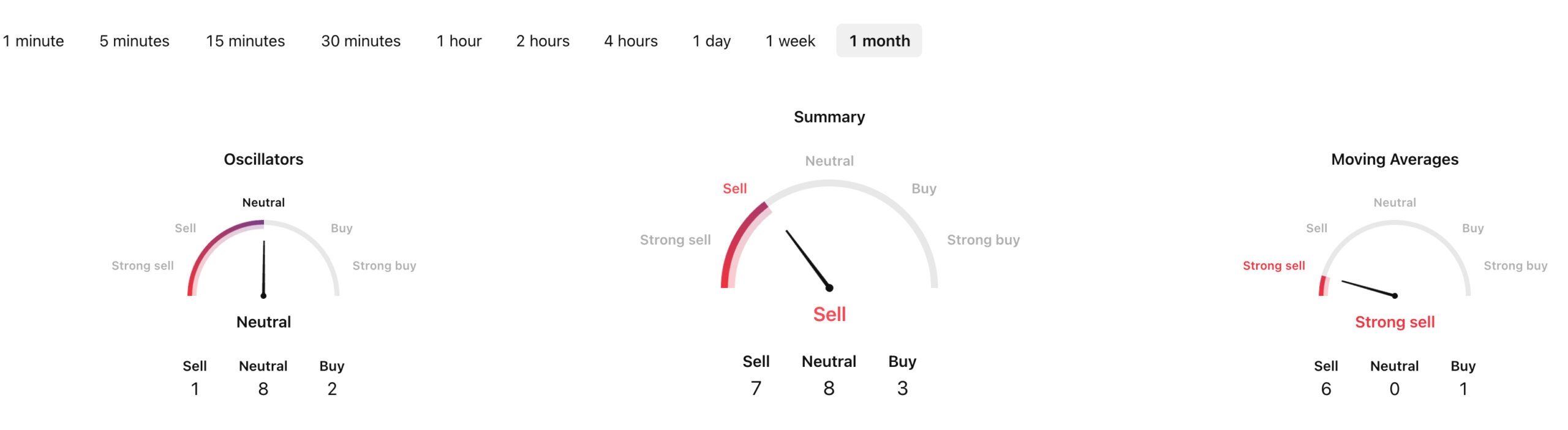
Source: Tradingview
Technical analysis won’t magically predict the future, but it does help you stop buying green candles like a moth flying into a bug zapper.
Moving Averages, RSI, and Momentum Indicators
For KAS, the most useful indicators are classic:
- 200-day moving average (200D MA): often the “bull/bear bias” line.
- 50-day moving average (50D MA): trend guide for swing moves.
- RSI (Relative Strength Index): helps identify overheating or exhaustion.
- Momentum indicators (MACD, rate of change): useful when KAS breaks out of long ranges.
In practice, KAS tends to respect major moving averages during trend phases—but can chop aggressively when the market is indecisive (as it often is during “Fear” regimes).
Support/Resistance Levels and Chart Patterns
With KAS around ~$0.039 in late Jan 2026, notable zones:
Support zones (buyers historically defend):
- $0.030–$0.035 (psychological + consolidation region)
- $0.020 (deep bear support / “capitulation” zone)
Resistance zones (sell pressure clusters):
- $0.060–$0.070 (common breakout gate)
- $0.10 (major psychological barrier)
- $0.20–$0.21 (ATH zone from 2024)
Common KAS patterns to watch:
- Long base → breakout on volume
- Breakout → retest → continuation
- Fakeout wicks around round numbers ($0.05, $0.10)
On-Chain and Mining Metrics (Hashrate Trends, Block Production)
Kaspa is one of those coins where on-chain/mining metrics actually matter:
- Hashrate trend: rising hashrate can signal miner confidence and network security; sudden drops can reflect energy curtailment, miner capitulation, or temporary outages. Current dashboards show Kaspa around hundreds of PH/s.
- Block production and block time: Kaspa’s high-frequency block production (0.1s average block time shown on Kaspa Explorer) supports fast confirmations.
- Emission schedule: smooth monthly reduction (factor of (1/2)^(1/12)) reduces shock events, but steadily tightens new supply.
If you’re building a real kaspa coin prediction, you want to watch mining economics the way ETH investors watch gas fees.
Bullish Factors Driving Kaspa Price Potential
This is the “why KAS could surprise people” section.
Scalability Edge with BlockDAG and Future Upgrades
Kaspa’s core advantage is structural: it’s built for parallel blocks, not one-at-a-time settlement. Kaspa’s own docs emphasize that GHOSTDAG avoids orphaning parallel blocks and orders them securely.
Upgrades also matter:
- The Crescendo/10BPS shift is positioned as a major throughput expansion.
- DAGKnight is framed as a future improvement path beyond GHOSTDAG’s limitations.
If these upgrades land smoothly and developers build on top, Kaspa’s speed advantage becomes less theoretical and more “felt.”
Growing Mining Ecosystem and Community Adoption
Kaspa’s PoW model creates a natural ecosystem: miners, pools, hardware, and infrastructure providers. The tokenomics and features pages emphasize the relationship between high block rate and mining decentralization, including how high block rates can reduce barriers for smaller miners.
Also, the “no pre-mine, no ICO” identity is a strong social glue in crypto. Kaspa leans hard into that fairness narrative, which attracts a specific kind of long-term holder.
Institutional Interest and Broader Market Cycles
Even if you love Kaspa, the market still trades like… the market.
- In risk-on cycles, high-quality narratives outperform.
- In risk-off cycles, everything bleeds together (yes, even the “best tech”).
Kaspa’s “Bitcoin-ish ethos, but faster” positioning can help during PoW rotations—but KAS remains highly sensitive to BTC liquidity and sentiment, especially when Fear & Greed is low.
Risks and Bearish Scenarios for KAS
Now the “don’t get married to your bags” section.
Competition from Layer-1 Rivals and Scalability Alternatives
Kaspa competes in a brutal landscape:
- fast PoS L1s (Solana-style),
- modular ecosystems (Ethereum L2s),
- and newer PoW experiments trying to reinvent mining economics.
Kaspa’s edge is “fast PoW settlement,” but it still needs developer traction and user habits to sustain premium valuations.
Volatility, Regulatory Risks, and Emission Schedule Concerns
- Volatility: KAS has historically shown large swings (ATH ~$0.2078 in 2024 to ~$0.039 in Jan 2026).
- Regulation: broad crypto regulation can choke liquidity, particularly for mid-caps.
- Emission schedule misunderstandings: Kaspa’s emission is smooth (monthly reductions approximating annual halving), which is good for stability—but investors sometimes misread it as “no halving catalyst.” In reality, it’s just less dramatic.
Macro Factors and Potential Network Centralization
Kaspa is PoW, so mining concentration matters.
Risks include:
- ASIC dominance reducing hobbyist participation over time,
- pool concentration (hashrate distribution skew),
- energy cost shocks impacting miner profitability.
Even with high block rates helping smaller miners, centralization risk never fully disappears in PoW systems—so monitoring pool distribution is smart.
Is Kaspa (KAS) a Good Investment in 2026?
This depends on what you mean by “investment.” If you mean “safe retirement plan,” no. If you mean “high-risk asymmetric bet,” maybe.
Bull Case: Path to $1–$5 with Mass Adoption
This is the dream scenario—and yes, it’s possible over time.
For KAS to reach $1–$5, several things likely need to happen:
- KAS becomes a widely recognized fast settlement layer
- liquidity expands meaningfully (more big venues, more access)
- Kaspa’s upgrades deliver and boost developer interest
- the broader market enters a sustained bull phase
That’s the “high adoption” version of a kaspa crypto prediction.
Bear Case: Stagnation or Decline in Bear Markets
The bear case is not dramatic—it’s boring:
- broader market stays muted,
- KAS remains a niche PoW chain,
- liquidity doesn’t expand,
- price drifts or chops for years.
In that case, even a solid project can underperform.
Our Prediction Methodology
This kaspa coin price prediction uses a blended model:
- Market baseline: price, market cap, volume (Jan 2026 anchor).
- Network health: hashrate, block time, mining security.
- Tokenomics: max supply + smooth emission reductions.
- Tech roadmap: BlockDAG/GHOSTDAG + Crescendo/10BPS + DAGKnight narrative.
- Market sentiment: Fear & Greed as a positioning context.
- Scenario ranges: bear/base/bull to reflect uncertainty rather than pretending precision.
Where to Exchange, Mine, or Stake KAS?
Kaspa is PoW, so you don’t “stake” it in the classic PoS sense—you generally:
- buy/trade KASPA on exchanges
- swap via instant exchanges
- mine it (KHeavyHash ecosystem)
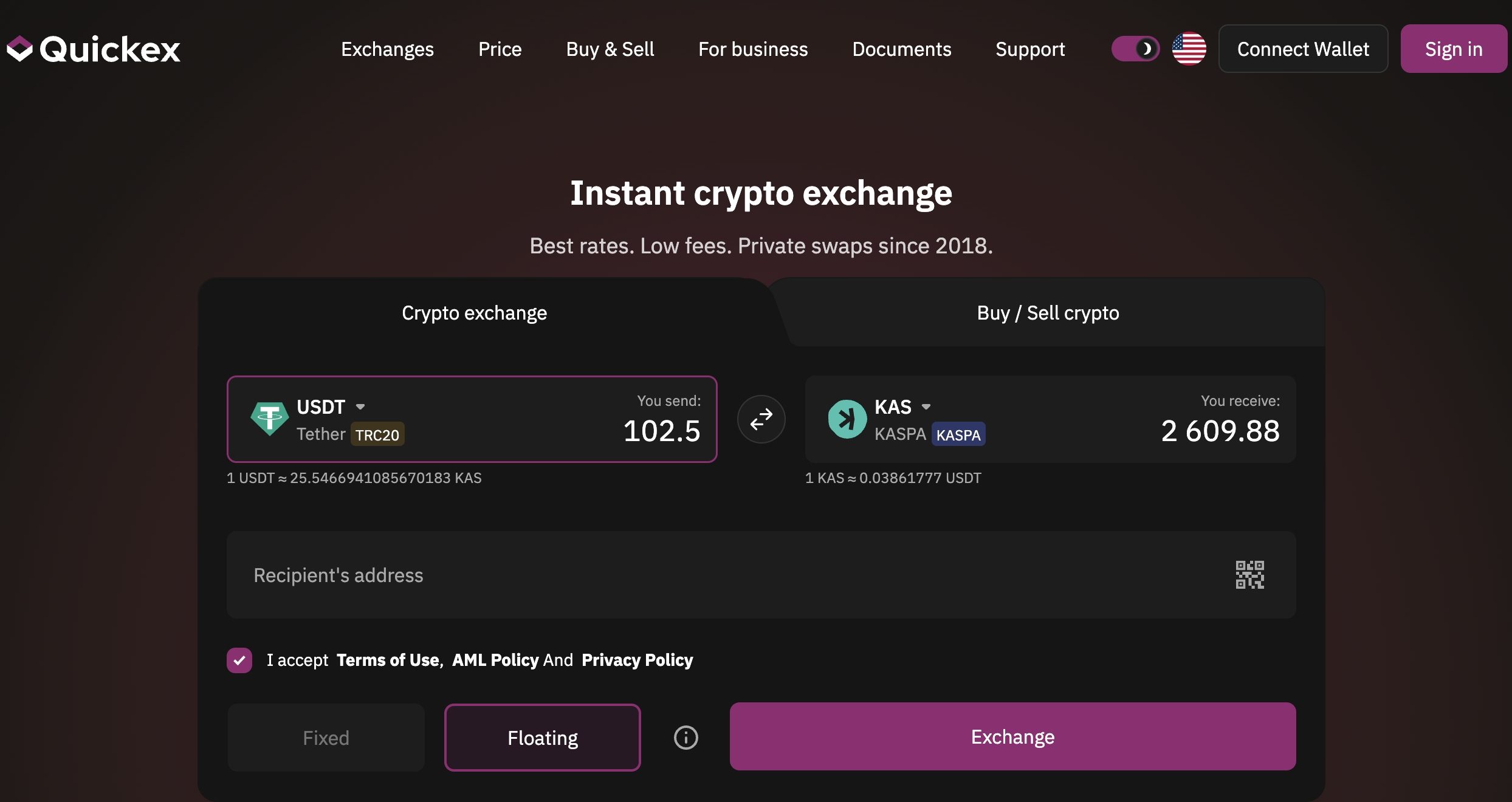
Quickex can be used as an example of an instant swap service; our pages describe fee structures (fixed vs floating) and the swap flow.
A safer reader-friendly takeaway:
- Use major reputable venues where possible.
- If using instant exchanges, check reputation, fees, and policies.
- For mining, track pool distribution and profitability metrics.
Frequently Asked Questions
What Is the Kaspa Price Prediction for 2026?
- Bear: $0.015–$0.040
- Base: $0.040–$0.100
- Bull: $0.100–$0.250
These ranges start from KAS trading around ~$0.039 in late Jan 2026.
Will KAS Reach $1 or Return to Its All-Time High?
Kaspa’s ATH is listed around $0.2078 on July 31, 2024 on TradingView (similar elsewhere around Aug 1 depending on feed).
- Return to ATH (~$0.20): plausible in a strong bull cycle if Kaspa regains attention and liquidity.
- Reach $1: possible, but it requires sustained adoption + major market expansion—this is more of a 2028–2030 bull-case outcome than a “soon” guarantee.
This directly ties to kaspa price prediction 2030 and kaspa coin price prediction 2030 scenarios.
Is Kaspa a Better Investment Than Bitcoin?
They’re different bets:
- Bitcoin is the “store-of-value” benchmark with global brand recognition.
- Kaspa is a higher-risk, higher-upside PoW scaling bet.
What Makes Kaspa Unique in Crypto Space?
Kaspa’s uniqueness is the combination of:
- BlockDAG architecture + GHOSTDAG consensus (parallel blocks, ordered securely)
- PoW security with fast confirmations
- Fair launch identity (no premine/ICO/allocations)
- Smooth emission reductions rather than dramatic halving shocks