

If you are researching a realistic Near Protocol price prediction, the first thing to understand is that Near is no longer being marketed as “just another fast Layer 1.” In early 2026, the project’s pitch is much broader: chain abstraction, multichain execution, confidential AI infrastructure, and a user experience that tries to hide wallets, bridges, and network switching altogether. That shift matters, because price tends to follow narratives only when those narratives become products people actually use. Official Near materials now emphasize Near.com, Near Intents, Chain Signatures, AI tooling, 600ms blocks, 1.2s finality, and even a benchmarked 1 million TPS milestone.
This article blends live market data with a practical forecast model. We are using current CoinMarketCap price/supply data, official Near documentation and blog posts, DeFiLlama chain dashboards, and public institutional filings such as Bitwise’s S-1 for a proposed Near ETF. That gives us a cleaner foundation for a serious Near price prediction, Near crypto price prediction, and long-range Near protocol prediction rather than a hype-only estimate.
Near Protocol in February 2026: The State of the Network
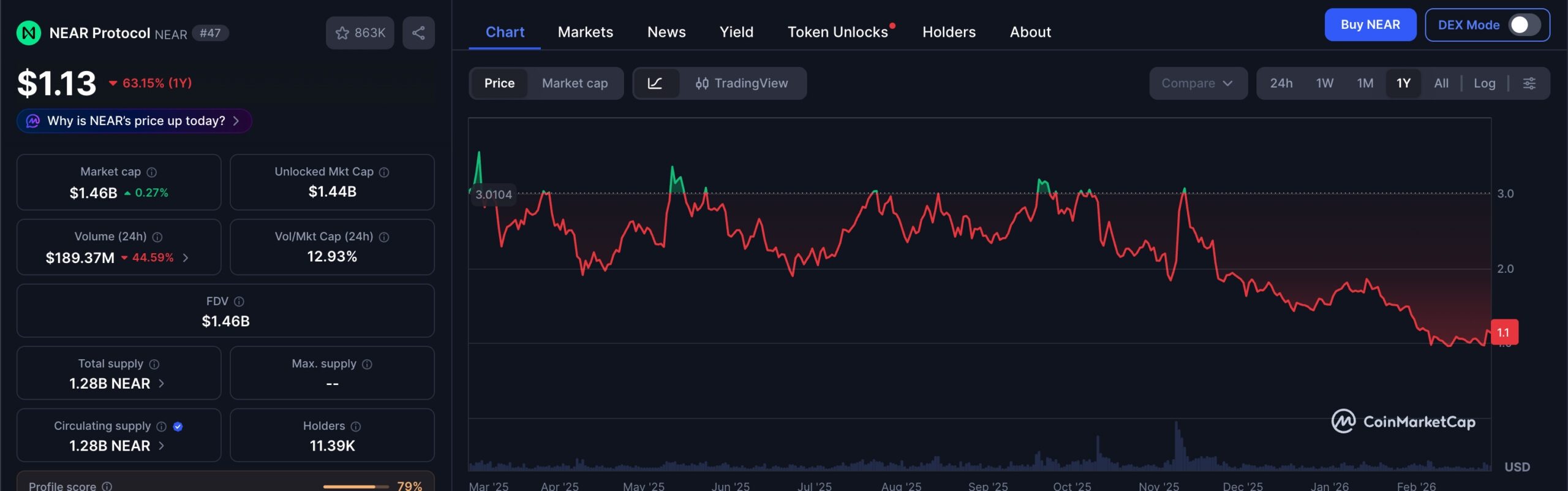
Current Market Performance: Reclaiming the $1.50 Support Zone
Source: Coinmarketcap
As of February 26, 2026, Near is trading around $1.13, with a market cap Near $1.46 billion, 24-hour volume around $345.8 million, and circulating supply of roughly 1.289 billion Near. CoinMarketCap also shows Near’s all-time high at $20.42 on January 16, 2022, meaning the token remains down more than 94% from its cycle peak.
That makes the “reclaiming $1.50” story more of a technical aspiration than a completed recovery. At current levels, $1.50 is not true support yet; it is the first zone bulls need to win back and hold. So the Near-term picture for any NEAR token price prediction is simple: Near Protocol has stabilized above its old macro lows, but it has not yet proven that a durable trend reversal is underway. The market is pricing in possibility, not certainty.
From 2025 Construction to 2026 Utility
What changed is the product story. Near’s 2025 milestone recap highlighted three themes: sharded scaling, cross-chain execution, and private AI. Meanwhile, the current Near homepage pitches a world where users do not deal with bridges or tokens directly because routing, signing, and execution happen in the background. That is a very different value proposition from “cheap transactions,” and it gives Near a chance to compete on interface and orchestration instead of raw TPS alone.
This is also why some investors still keep Near on their watchlist despite price weakness. Many Ethereum L2s are fighting over fee compression and value capture. Near is trying to become the coordination layer for cross-chain actions and AI-native apps. If that works, a future Near coin price prediction has to reflect not just Layer-1 usage, but protocol-level routing and multichain revenue capture as well. The fee-switch discussion becomes central here, because usage only matters for token holders if usage eventually flows back to the asset.
Key Stats: 30M+ Monthly Active Users
Source: Defillama
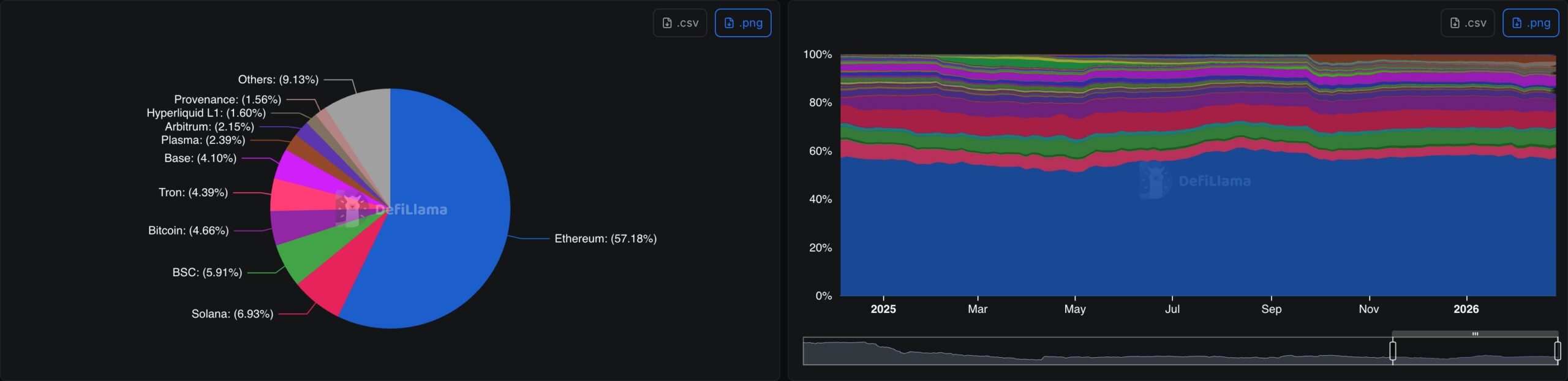
Third-party analytics summaries in 2025 reported Near reaching more than 30 million monthly active users, with some datasets putting the figure Near 46 million by May 2025. Even if you treat address-based user metrics cautiously, the scale of activity was large enough to put Near back into serious adoption conversations. Official Near materials also say the network achieved a 1 million TPS benchmark and now advertises 600ms block times with 1.2-second finality.
On the DeFi side, DeFiLlama currently shows about $100.4 million in Near chain TVL, roughly $120.6 million in stablecoin market cap on-chain, and about $103.3 million in 24-hour DEX volume. Those numbers are not huge versus the biggest L1s or L2s, but they do show that Near has retained a real financial footprint while building its chain-abstraction layer.
The “Chain Abstraction” Revolution
Near Intents & Near.com: One Account for Bitcoin, Solana, and Ethereum
Near’s best 2026 narrative is that it wants Web3 to feel invisible. The chain abstraction docs say users should be able to operate across chains with a single Near account, while the new Near.com launch says users can swap, go confidential, and trade peer-to-peer across 35+ blockchains from one account. Near’s own homepage goes even further: “No wallets. No bridges. No tokens required.”
For investors, that matters because it changes how to think about a Near protocol price prediction 2030. If Near succeeds, its value may come less from being the place where every asset lives and more from being the place where actions are coordinated. That is a much bigger TAM than a single-chain dApp ecosystem.
Here is the practical difference between Near Intents and standard bridging:
| Feature | Near Intents / Near.com | Standard bridging flow |
| User steps | Often abstracted into 1-click flows | Multiple manual steps across source/destination chains |
| Wallet switching | Mostly hidden from the user | Usually required |
| Fee experience | Fees embedded in quote or handled in background | Separate gas + bridge fees + destination gas |
| Time to completion | Designed for faster, simplified routing | Often slower and operationally messy |
| UX complexity | Low | High |
Near documents describe Intents as a multichain transaction protocol where users specify outcomes and third parties compete to fulfill them. Separate docs also note that the 1-Click API abstracts the full cross-chain flow into a single call, while earlier chain-abstraction explainers explicitly contrast this with traditional wallet-switching and bridge-heavy UX. Rainbow-style bridging could take 4–8 hours for Near-to-Ethereum transfers, while Omni Bridge reduces verification times from hours to minutes.
How Near Operates Other Blockchains Under the Hood
The real engine here is Chain Signatures. Official documentation says Near accounts and smart contracts can sign and execute transactions across many blockchain protocols, including Bitcoin, Ethereum, Solana, XRP, Sui, Aptos, and EVM chains like Base and Arbitrum. The key point is that developers can manage multichain interactions from one Near account using MPC rather than a centralized signer.
That means Near is not merely “compatible” with other chains. It is trying to act on them. If that stack gains traction, Near crypto prediction models that only compare Near to other monolithic L1s may be missing the bigger picture.
How Cross-Chain Swaps Finally Accrue Value to Near Holders
A major criticism of Near in 2024 and 2025 was simple: cool tech, weak token value capture. That is why the new fee-switch language matters. Near’s latest tokenomics update says the Near Intents fee switch is live, with automatic revenue sharing and payouts denominated in Near. The Near ecosystem catalog also states that the switch ensures Intents usage translates into protocol revenue and increases value capture for Near.
This is one of the strongest arguments for a more constructive Near coin price prediction 2030. High usage without token capture often leads to weak token performance. High usage plus fee capture is a different equation.
Building the World’s First User-Owned AI Stack
IronClaw AI & TEE GPU Marketplace: Solving the Compute Scarcity
Near is now positioning itself as “the blockchain for AI.” The official AI page says Near supports encrypted model execution, verifiable compute, and multichain action. The Near.ai OpenClaw page adds that OpenClaw and IronClaw run inside Trusted Execution Environments, where data remains protected even from the provider. The IronClaw repo further notes that IronClaw defaults to Near AI.
That matters because AI infrastructure is becoming a valuation multiplier across crypto. In February 2026, Near also publicized an integrated stack with confidential transactions, hardware-secured AI agents, built-in revenue sharing, and a multichain super-app. If the market decides Near belongs in both the chain-abstraction and AI-infrastructure buckets, the upside for a long-term Near protocol price prediction expands materially.
Why Near is the Preferred Backend for AI Assistants?
Near’s AI docs say agents can transact on all chains using Chain Signatures, while the Shade Agent Framework lets developers build verifiable, trustless, multichain AI agents operating in TEEs. Near AI docs also describe private inference in GPU TEEs with real-time attestation. In plain English: the project wants AI agents that can hold wallets, use tools, preserve privacy, and prove how they executed.
This is where the “user-owned AI” thesis becomes more than branding. Near’s 2024 and 2026 messaging repeatedly frames AI as something users should control rather than outsource to centralized platforms. That narrative is unique enough to support premium multiples if adoption actually arrives.
Privacy Shards & Confidential Accounts
The privacy angle is increasingly important. Recent Near materials emphasize confidential transactions, restricted-visibility execution for Intents, and TEE-secured workloads. That suggests Near is moving toward a stack where multichain execution and private AI can coexist, which is exactly what enterprise and agentic apps will want.
Near Protocol Price Prediction 2026
Short-Term Forecast (Q2–Q4 2026): the Post-NearCON Rally
For Near, our 2026 model is:
- Bearish case: $0.85–$1.20
- Base case: $1.60–$2.20
- Bullish case: $2.80–$3.80
Why those ranges? Because Near already has live chain-abstraction tooling, the fee switch is live, AI products are expanding, and institutional wrappers are being explored via the Bitwise Near ETF filing. Against that, the token still needs to prove sustained demand, and DeFi scale remains modest compared with top competitors.
Technical Analysis: Testing Resistance at $2.73 and $4.10
Source: Tradingview
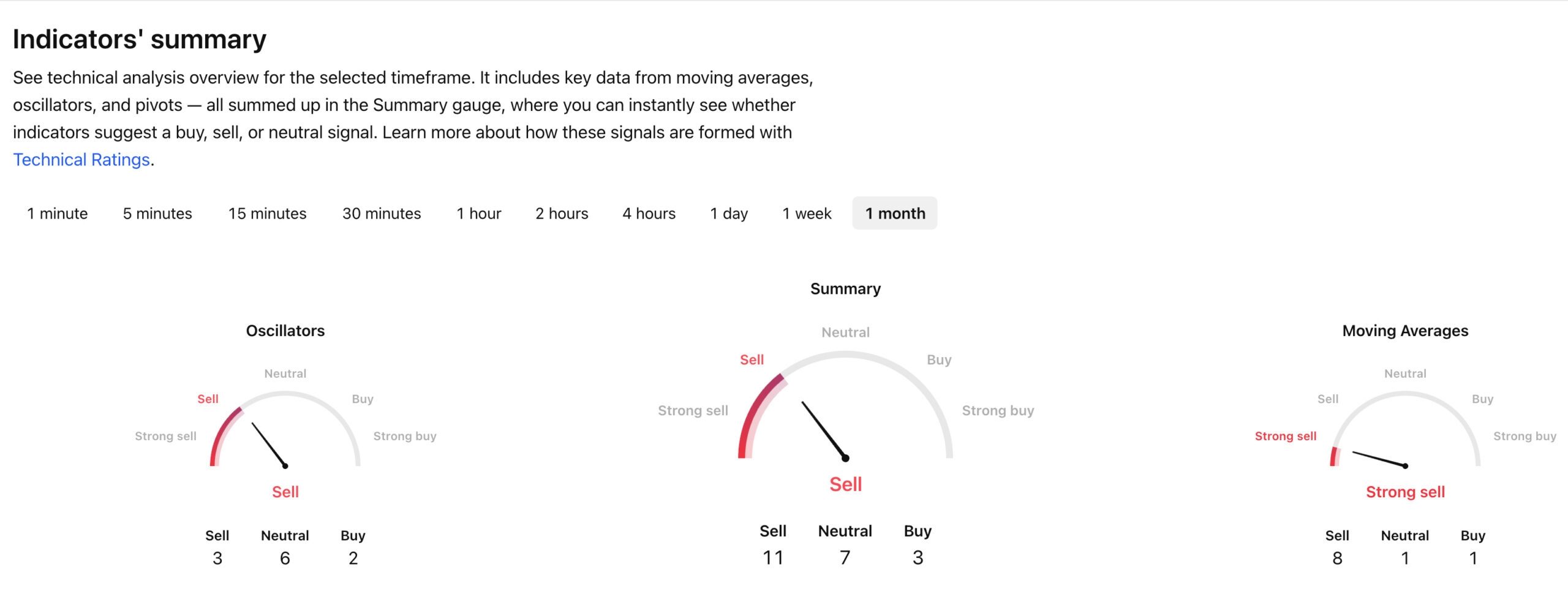
Technically, three zones matter. First, the market must defend the broad $0.85–$1.00 area to avoid slipping back into deep-capitulation territory. Second, bulls need to reclaim $1.50 and then $2.00 to prove the February rebound is more than a relief bounce. Third, if Near catches a stronger alt rotation, $2.73 and $4.10 look like reasonably modeled resistance zones based on prior trading structure and the psychology of round-number breakouts. Those two upper numbers are analytical targets, not official levels. The live data point anchoring this setup is the current spot Near $1.13.
The “Brave Integration” Impact: Onboarding the Next 100 Million Users
We would not model “100 million users” as a Near-term certainty. But the Brave as a distribution catalyst is worth watching. Near’s latest tokenomics post says Near AI is already serving enterprises and end users through integrations that include Brave’s privacy browser. That kind of distribution partnership matters more than another small DeFi fork.
Near Protocol Price Prediction 2027–2029
2027 Near Outlook: When AI Intents Become the Standard
If Near turns Intents into a default multichain UX layer, 2027 could be the year the token begins to re-rate. Our 2027 range is $2.20 to $4.80, with a base case Near $3.20. This is where Near price prediction 2030 searches often start: investors want to know whether Near can become a cross-chain utility asset rather than another L1 that lives and dies by native TVL.
2028 Near Price Prediction: Bitcoin’s Next Cycle and BTCFi Integration
Because Chain Signatures explicitly support Bitcoin workflows, Near has a credible path into BTCFi rather than just talking about it. If the next halving cycle renews demand for BTC-native yield, swaps, and settlement, Near could benefit disproportionately. Our 2028 range is $3.00 to $6.50, base case $4.40.
2029 Vision: Near Protocol as the Global Settlement Layer for AI-to-AI Trades
By 2029, the best bull thesis is not “Near has fast blocks.” It is “Near coordinates machine-to-machine transactions across chains with privacy and verification.” If that thesis lands, our 2029 range is $4.00 to $8.50, with upside skew if agentic commerce becomes real.
Near Protocol Price Prediction 2030–2035
Can Near Hit $100? Analyzing Market Cap Scenarios vs. Ethereum
At today’s circulating supply of about 1.289B Near, the market caps would look like this:
| Near price | Approx. market cap |
| $10 | $12.89B |
| $25 | $32.22B |
| $50 | $64.44B |
| $100 | $128.88B |
Those numbers do not make $100 impossible. They do make it extremely ambitious. A Near coin price prediction 2030 of $100 assumes Near becomes one of crypto’s largest infrastructure assets and captures major share in AI, multichain execution, and institutional settlement. Our 2030 base case is $6.50, with a bullish stretch target Near $10–$12. At that point, the long-tail Near coin price prediction 2030 bull case becomes credible, but not before.
Inflation vs. Burn: The Path to Net-Deflationary Tokenomics
This is where the math gets interesting. Older Near economics described 5% annual issuance, with 70% of transaction fees burned. In late 2025, a supported governance proposal aimed to cut maximum annual inflation from 5% to 2.5%. At today’s supply, that means roughly 64.4M Near/year under the old schedule versus 32.2M/year under the proposed reduced schedule.
Using current supply and CoinMarketCap’s “around $0.001 average transaction fee” reference, the burn potential at 1M TPS becomes huge even under conservative assumptions. This is a scenario model, not a promise:
| Avg fee per tx | Annual Near burned at 1M TPS | Burn vs 2.5% issuance |
| $0.00001 | ~195M Near | ~6.1x issuance |
| $0.00005 | ~977M Near | ~30.3x issuance |
| $0.00010 | ~1.95B Near | ~60.6x issuance |
The takeaway is not that Near will definitely become hyper-deflationary. The takeaway is that if throughput scales while fees remain non-zero, Near’s burn mechanics become a real long-term valuation driver. That strengthens any serious Near protocol price prediction 2030 or Near coin price prediction 2030 model.
2035 Long-Term Forecast: Near as the Foundation of the Open Web
For 2035, I would use a broad range: $8 to $22, with a base case around $13.50. That is the zone where the long-range Near protocol price prediction 2030 starts blending into a full Near crypto price prediction for the next decade.
Final Near Price Prediction Summary
Here is the clean version of our forecast for anyone scanning for a fast Near Protocol price prediction:
| Year | Min | Avg | Max |
| 2026 | $0.85 | $1.95 | $3.80 |
| 2027 | $2.20 | $3.20 | $4.80 |
| 2028 | $3.00 | $4.40 | $6.50 |
| 2030 | $4.50 | $6.50 | $12.00 |
| 2035 | $8.00 | $13.50 | $22.00 |
Competitive Landscape: Near vs. The Industry Giants
Near vs. Solana: Chain Abstraction vs. Monolithic Speed
Solana remains much larger in raw DeFi footprint. DeFiLlama shows Solana with about $15.35B in stablecoins, $2.48Bin 24-hour DEX volume, and 2.62M active addresses in 24 hours, versus Near’s roughly $120.6M stablecoins and $103.3M DEX volume.
So why does Near still matter? Because Solana is winning speed and consumer liquidity, while Near is aiming at multichain orchestration. Different game, different moat.
Near vs. Ethereum L2s: Why “One Chain to Rule Them All” is Winning
Base and Arbitrum still dominate Near in DeFi capital. DeFiLlama currently shows Base Near $3.94B TVL and Arbitrum with strong stablecoin and perps activity. That is why Near cannot rely on TVL alone to win investor attention. It has to win on abstraction, cross-chain UX, and AI integration.
Does SUI or Aptos Compete with Near AI?
Sui and Aptos are relevant because they also target performance and developer mindshare. DeFiLlama shows Sui around $1.05B bridged TVL and Aptos with roughly $1.79B in stablecoin market cap, which means Near is not competing in an empty field. Still, neither Sui nor Aptos currently owns Near’s chain-signature plus intents plus AI-agent narrative.
Tokenomics & Ecosystem Health
Understanding the 3.5% Inflation Rate: Rewards vs. Staking Yields
This needs honesty. Many older articles cite Near’s 5% issuance model. Some newer commentary uses a rough “3.5%” shorthand. But the most important current fact is that Near Foundation-backed governance efforts in late 2025 explicitly supported cutting maximum inflation to 2.5%. So if you are building a fresh Near protocol prediction, you should not blindly repeat outdated inflation numbers.
Treasury Transparency: How $800M+ in Grants is Fueling Developer Growth
Near’s ecosystem famously announced $800 million in funding initiatives in 2021. That does not mean $800 million is still sitting around unused, but it does show the project has long been willing to subsidize ecosystem growth aggressively.
Institutional Adoption: Grayscale, Bitwise
The cleanest institutional signal is Bitwise’s SEC filing for a Bitwise Near ETF in May 2025. Separately, Bitwise’s January 2026 advisor survey said crypto allocations by financial advisors hit an all-time high in 2025. That is not proof of massive Near inflows today, but it does mean the institutional setup around altcoin exposure is improving.
Is Near a “Buy” in the 2026 Market?
The Bull Case: The Execution Layer for the Trillion-Dollar AI Economy
The bull case for Near Protocol price prediction models is straightforward:
Near now has credible claims in five valuable narratives at once — sharded scalability, multichain execution, BTCFi access through Chain Signatures, private AI infrastructure, and improving token value capture through the fee switch. If even two of those scale meaningfully, Near could re-rate much higher than its current $1.46B market cap.
The Bear Case: Tech Complexity and Fragmented Liquidity Risks
The bear case is equally real. Near’s DeFi footprint is still much smaller than Base, Arbitrum, and Solana; user metrics can be noisy; and ambitious architecture does not always convert into token demand. If abstraction becomes a commodity feature or AI demand shifts elsewhere, Near could remain structurally undervalued for years.
Where to Buy and Safely Exchange Near?
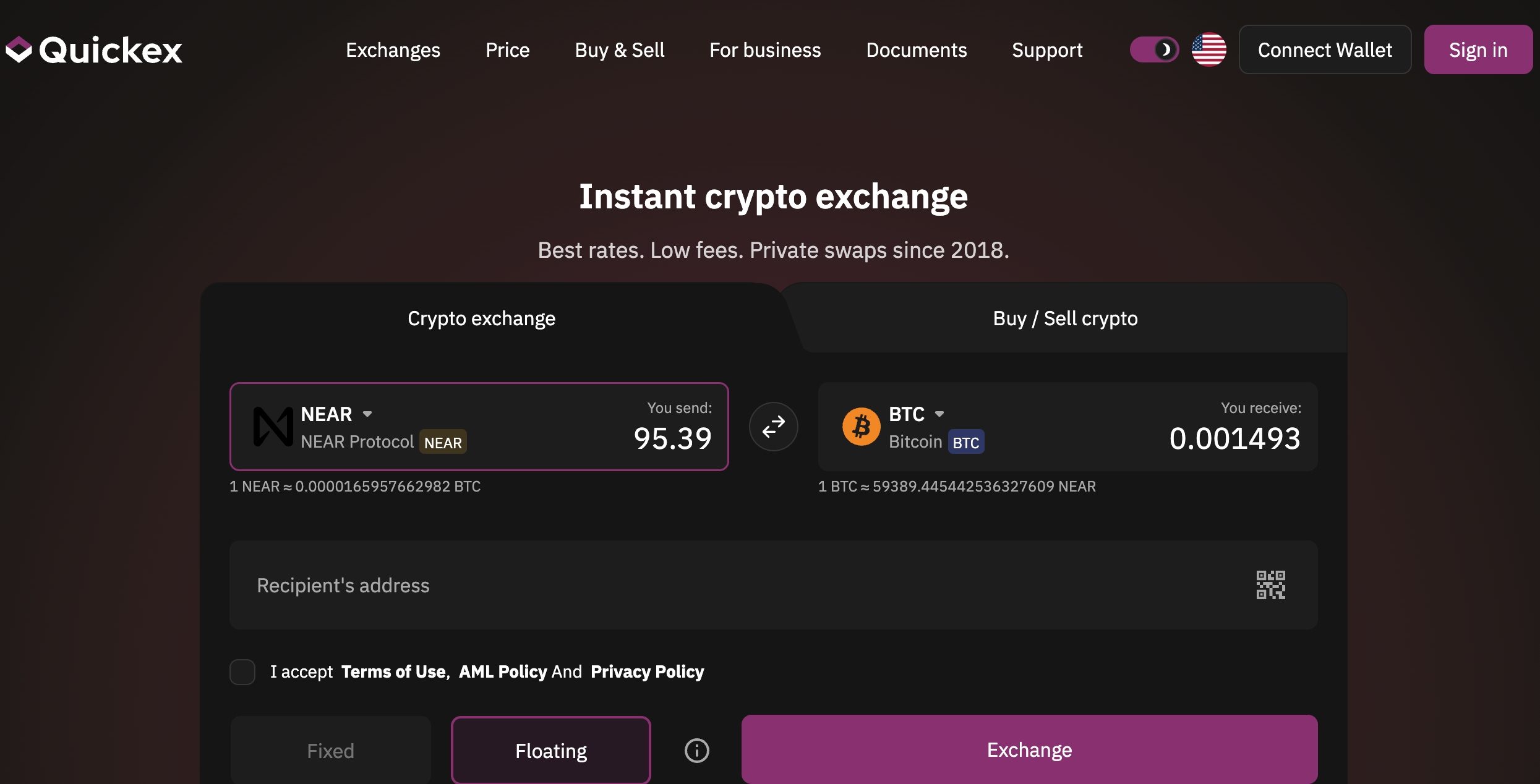
If you want to buy or swap Near, use a reputable exchange with good liquidity, like Quickex; then move long-term holdings to a wallet you control. For active users, the best setup is usually a split approach: a small hot-wallet balance for onchain experimentation and a hardware wallet or secured primary wallet for long-term storage. If you are interacting with the broader Near ecosystem, always verify app URLs and contract addresses carefully.
Critical Questions for Near Investors in 2026
How does Near Intents work with Bitcoin?
Through Chain Signatures, Near accounts can sign for Bitcoin and other chains, while Omni Bridge and Intents help route assets and actions across networks. The goal is that users express an outcome, and the protocol handles the multichain complexity under the hood.
What is the “User-Owned AI” movement?
It is Near’s thesis that AI should be private, verifiable, and controlled by users rather than centralized platforms. Official Near messaging repeatedly frames its AI stack around TEEs, verifiable agents, and user-owned infrastructure.
Is the Near Protocol still carbon neutral?
Near still presents itself as carbon-neutral or climate-neutral in official materials, with South Pole certification highlighted on Near-owned pages and docs.
Can I use Near to pay for AI compute power?
In practice, Near is already being positioned as the coordination and verification layer for AI agents and confidential inference, but the exact payment rail depends on the product. For developers and advanced users, Near-native tooling already supports multichain actions, agent deployment, and private inference flows.
Disclaimer: The material in this article is not financial or investment advice. Everything stated here reflects the author's personal view and should not be treated as a recommendation to trade or invest. We make no warranties regarding the accuracy, reliability or completeness of the information presented. Cryptocurrency markets are highly volatile and can move unpredictably. Before committing any funds, every investor, trader or crypto user should study several independent sources and check the regulations that apply in their own jurisdiction.