
Onyxcoin (XCN) is one of those tokens that can confuse investors at first glance. You’ll see it described as an Ethereum ERC-20, a governance asset, and a gas token; yet the broader Onyx stack talks about a “financial ledger” and even a Layer-3 network built on Arbitrum/Base. That mismatch between quick summaries and the actual architecture is a big reason XCN gets mispriced: some traders treat it like a legacy “rebrand token,” while others treat it like a future-facing enterprise finance play.
This article delivers a scenario-based Onyxcoin price prediction for 2026–2030, anchored to February 2026 live market data (price, market cap, volume, supply). We’ll also pull in on-chain indicators (holders, activity), the rebrand timeline, and catalysts the market has already reacted to in 2026, then convert all of that into realistic ranges for each year, plus a comparison table you can actually use.
Not financial advice. Crypto is volatile, and enterprise narratives can take years to materialize.
What Is Onyxcoin (XCN)?
Onyxcoin (XCN) is the utility and governance token for the Onyx ecosystem. According to the official Onyx site, XCN is an Ethereum ERC-20 asset that operates as the utility, gas, and governance token of Onyx.
From Chain Rebranding to Onyx Protocol: Enterprise Blockchain Focus
XCN’s identity is closely tied to a major naming transition: Chain (XCN) → Onyxcoin (XCN).
- Bittrex Global posted an exchange notice stating it “completed the rebranding of Chain (XCN) to Onyxcoin (XCN)” and that no action was needed from holders.
- Onyx’s own materials frame the product direction as “financial-grade” infrastructure. On the homepage, Onyx describes itself as a “modular blockchain designed for financial-grade applications,” emphasizing low fees and near-instant confirmations.
- The Onyx whitepaper goes further: it explicitly calls Onyx a Layer 3 Ledger built on Arbitrum Orbit, using Base (Layer 2) for settlement and AnyTrust for data availability, positioning it for institutional finance, DeFi, and real-world asset tokenization.
So, when people talk about “enterprise blockchain focus,” that’s not just marketing fluff. The official docs repeatedly point to financial use cases: payments, securities, cross-border rails, and compliance-aware workflows.
Key Technology: Layer-1 for DeFi, Payments, and Institutional Finance
The heading says “Layer-1,” but the most accurate, source-backed description is: XCN is an ERC-20 token on Ethereum, while the Onyx execution environment is a Layer-3 ledger that inherits security from Ethereum/Base through its stack design.
Here’s what the official sources say:
- Onyx is “built as a Layer 3” and shares the economic security of Ethereum and Base.
- The whitepaper explains that Onyx is a modular L3 architecture enabling specialized app-specific rollups, full EVM compatibility, and low-cost execution, targeting institutional finance, DeFi, and tokenized real-world assets.
- Onyxcoin (XCN) powers transaction fees and governance; it’s described as the native gas token and governance asset for the Onyx Ledger, supporting transactions, smart contracts, payments, staking, and DAO governance.
In practical terms: if the Onyx Ledger gains traction, XCN becomes more than a ticker, because it’s explicitly positioned as the fuel (fees) and coordination mechanism (governance + staking).
Real-World Use Cases: Cross-Chain Assets, Compliance Tools, Ecosystem
Onyx’s positioning is very “finance-forward.” In the Onyx site UI, it calls out cross-border banking, securities, and payment applications.
From the whitepaper and ecosystem section, you can extract three real-world buckets:
- Cross-chain assets and bridging
The Onyx ecosystem includes a bridge and “Bridged USDC,” describing stablecoin transfers onto Onyx through cross-chain bridging.
The whitepaper also describes bridged supply management for XCN and mentions bridging to Base via Superbridge and to BSC via Wormhole (with locked equivalence mechanics). - Compliance-aware governance and finance UX
The whitepaper explicitly notes that a governance model for a public ledger must account for diverse stakeholders, including “regulatory authorities,” and frames governance as a key part of sustainable financial-grade infrastructure. - Ecosystem apps and tooling
The Onyx site lists ecosystem components like an AI agent, bridge tooling, and third-party developer tooling (e.g., Thirdweb integrations).
This matters for any Onyxcoin prediction because enterprise-aligned narratives tend to move in “adoption steps,” not in overnight magic. The market usually needs proof: usage, partners, and repeatable fee demand.
Onyxcoin Price History and Key Milestones
XCN’s chart history reflects a classic arc: early traction → a major 2022 peak → a long cooldown → periodic narrative spikes. Understanding those prior regimes helps you build a more realistic XCN price prediction model for 2026–2030.
Early Chain Days, 2022 Peak, and Post-Rebrand Performance
Multiple sources track the 2022 peak around late May:
- CryptoRank lists Onyxcoin’s highest price in USD as $0.184 on 2022-05-27.
- Rain (a brokerage/exchange) also cites an ATH around $0.1841 on 27 May 2022.
After that peak, XCN experienced the kind of prolonged decline common in post-mania cycles, especially for tokens tied to enterprise narratives that take longer to realize. The market often “forgets” these tokens until a new catalyst appears.
Then the rebrand and ecosystem reframing created a new identity lane. Bittrex’s rebranding notice confirms the Chain→Onyxcoin naming transition as something exchanges implemented at the infrastructure level.
Major Events: Partnerships, Upgrades, and 2026 Surges
Even in risk-off conditions, narrative catalysts can create sharp XCN moves.
One concrete example: CoinMarketCap’s update notes a January 12, 2026 rally where XCN jumped over 15% in 24 hours after an announcement about expansion into South Korea (Korean-language site + ambassador search).
Yahoo Finance also covered early-2026 XCN volatility, describing a strong surge in the first week of 2026 (as a market news recap).
Those events matter for prediction-building because they show what actually moves XCN in the short run: regional expansion narratives, exchange/community catalysts, and broader market beta.
Onyxcoin Current Price and Market Overview
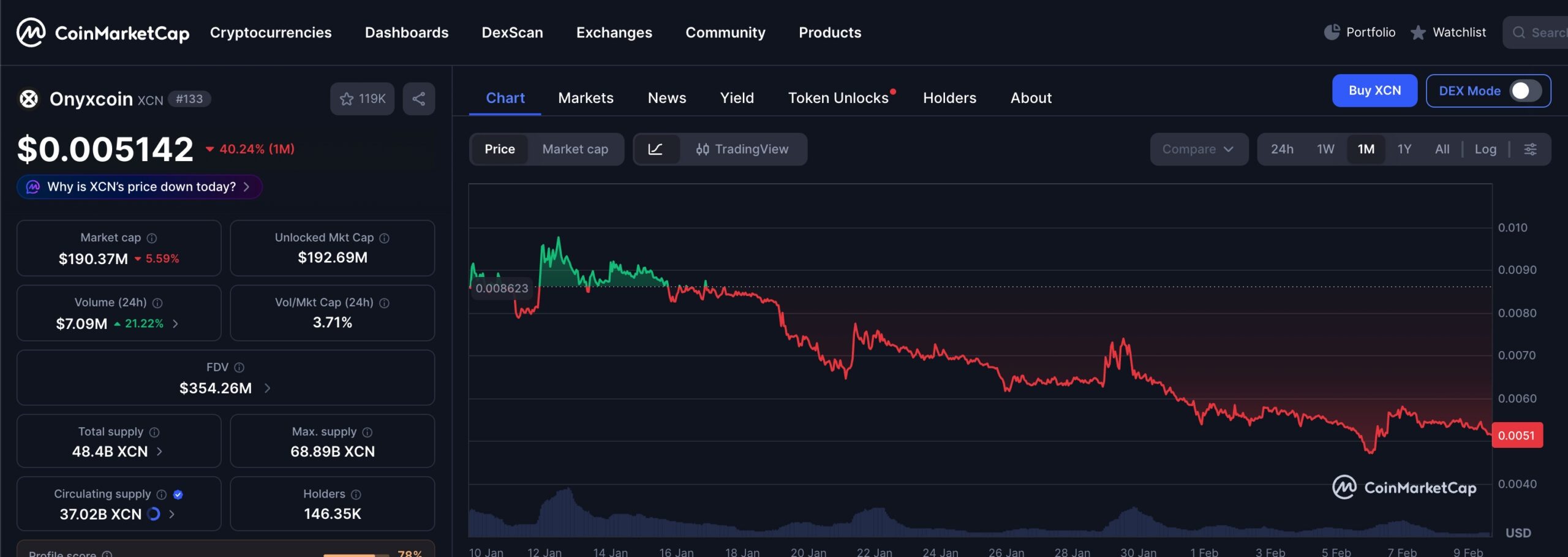
Source: Coinmarketcap
Let’s set a baseline using the most visible market data sources.
Live XCN Price, Market Cap, and Trading Volume
CoinMarketCap’s live XCN page shows approximately:
- Price: ~$0.00515
- Market cap: ~$190M
- 24h volume: ~$19.5M
- Circulating supply: ~37.01B XCN
- Total supply: ~48.4B XCN
- Max supply: ~68.89B XCN
- Holders: ~146.35K
CoinGecko shows a very similar snapshot: price around the same zone, 24h volume in the high teens (millions), and market cap around ~$190M.
These numbers matter because they define the “math” behind targets. For example, moving from $0.005 to $0.05 (a 10x) is a different liquidity challenge than moving from $0.50 to $5 (also a 10x).
On-Chain Metrics: Supply Circulation, Transactions, and Holder Activity
For on-chain and network context, we can combine market trackers with Onyx’s own published metrics:
- Onyx’s official site states XCN is an Ethereum ERC-20 asset and shows “170K+ onchain XCN holders” (a higher figure than CMC’s holder number, likely due to measurement differences across chains/bridges).
- The same Onyx page highlights an average block time of ~1.2s and an average transaction fee of ~$0.00001 on the Onyx Ledger.
- The Onyx whitepaper describes XCN supply mechanics: fixed issuance at genesis, a burn mechanism, and governance-controlled emissions plus cross-chain bridging rules to keep supply conformance.
If you’re building a longer-term XCN crypto price prediction, these metrics help you separate “token pumps” from “network traction.”
Recent Sentiment and Fear & Greed Index
Crypto sentiment in early February 2026 is still shaky. One Fear & Greed snapshot shows Extreme Fear conditions (low score).
In Extreme Fear regimes, XCN tends to behave as “high beta”: it can drop harder during market-wide selloffs and rebound fast on catalysts, especially if liquidity is thin.
Onyxcoin (XCN) Short-Term Price Prediction 2026
Short-term forecasts should be ranges, not single numbers. For XCN, two forces dominate 2026:
- market regime (risk-on vs risk-off), and
- catalyst density (news, partnerships, upgrades, regional pushes).
XCN Price Forecast for Q1–Q2 2026
With XCN around ~$0.005 in early February 2026, here are realistic scenario ranges for the first half of 2026:
Bear case: $0.0035–$0.0055
- Broader market remains risk-off
- alt liquidity stays thin
- XCN fails to hold momentum after catalyst spikes
Base case: $0.0050–$0.0090
- Market stabilizes
- XCN oscillates between support/resistance while slowly rebuilding
Bull case: $0.0090–$0.015
- Requires broader market recovery + at least one strong catalyst similar to the January 2026 narrative burst (regional growth / partnership headlines).
A useful reality anchor: CoinMarketCap’s historical data shows XCN trading in the ~$0.005–$0.006 area across early February 2026 daily candles, which supports these near-term bands.
Q3–Q4 2026 Outlook and Near-Term Catalysts
For the second half of 2026, XCN’s ability to trend higher depends on whether the Onyx stack can turn “enterprise ledger” messaging into measurable adoption, plus whether crypto as a whole shifts into a healthier liquidity cycle.
Near-term catalysts to watch:
- Ecosystem expansion announcements (like the South Korea push that moved price).
- Protocol upgrades and performance storytelling (Onyx emphasizes low fees and fast confirmations: markets tend to re-rate chains that prove this at scale).
- Cross-chain stablecoin rails (bridged USDC and easy bridging can support DeFi/payment usage).
- Token utility visibility (fees paid in XCN + burn component; if activity rises, the “value capture” story becomes easier to sell).
Q3–Q4 2026 ranges:
- Bear: $0.0030–$0.0060
- Base: $0.0060–$0.0120
- Bull: $0.0120–$0.0250
These ranges set up the medium-term forecasts for 2027–2030.
Onyxcoin Price Prediction 2027
By 2027, enterprise-aligned tokens usually need to show tangible traction: transactions, partners, and an ecosystem that isn’t purely speculative.
2027 scenario ranges:
- Bear: $0.0035–$0.0075
- Base: $0.0080–$0.0180
- Bull: $0.0180–$0.0400
The bull case becomes plausible if Onyx’s “financial-grade ledger” narrative translates into real usage and repeatable on-chain activity, especially since the project frames XCN as gas + governance for the ledger.
Onyxcoin Price Prediction 2028
2028 is often where infrastructure narratives either compound or stall. The base case assumes gradual adoption and a healthier macro cycle for crypto.
2028 scenario ranges:
- Bear: $0.0050–$0.0100
- Base: $0.0120–$0.0300
- Bull: $0.0300–$0.0700
In this bull case, you start hearing more searches like Onyxcoin prediction and onyx crypto price prediction because traders want “the next enterprise chain that finally caught on.”
Onyxcoin Price Prediction 2029
If Onyx builds sticky rails for cross-chain assets and financial apps, 2029 can be a “multiple expansion” year, especially in a risk-on environment.
2029 scenario ranges:
- Bear: $0.0070–$0.0150
- Base: $0.0200–$0.0500
- Bull: $0.0500–$0.1200
Note: these ranges still sit below the 2022 peak (~$0.184). That’s intentional. Many tokens never revisit prior cycle highs unless they achieve meaningfully stronger fundamentals.
Onyxcoin Price Prediction 2030
Here’s the headline year: XCN price prediction 2030 and Onyxcoin price prediction 2030.
2030 scenario ranges:
- Bear: $0.0100–$0.0200
- Base: $0.0300–$0.0800
- Bull: $0.0800–$0.1800
The bull range allows for the possibility of revisiting the historical ATH zone (~$0.18) cited by multiple trackers, but only under strong adoption + a favorable market cycle.
If you want an alternate phrasing: this is a realistic XCN coin price prediction 2030 band that doesn’t pretend we know the exact number.
Long-Term Onyxcoin Forecast 2035–2040
Long-range forecasts are conditional. Still, we can outline the “if-then” logic behind Onyxcoin price prediction 2040 and XCN price prediction 2040.
If Onyx becomes meaningful finance infrastructure:
- XCN demand can increase because fees are paid in XCN and part is burned, according to the Onyx site.
- Governance-driven tokenomics (burns, incentives) could support scarcity narratives if activity grows.
If Onyx adoption stalls:
- XCN may remain a cyclical “beta token” that pumps on headlines but struggles to sustain higher valuation.
A sensible long-term range (high uncertainty):
- Bear 2040: $0.01–$0.05
- Base 2040: $0.05–$0.20
- Bull 2040: $0.20–$0.60+
That’s the cleanest way to express XCN price prediction 2040 without pretending certainty.
Onyxcoin Price Prediction Table
Below is a practical year-by-year comparison table (bear/base/bull) you can use as a planning reference.
| Year | Bear Case | Base Case | Bull Case | What Would Need to Be True |
| 2026 | $0.0030–$0.0060 | $0.0050–$0.0120 | $0.0120–$0.0250 | Market stabilizes + catalysts repeat (e.g., regional expansion news). |
| 2027 | $0.0035–$0.0075 | $0.0080–$0.0180 | $0.0180–$0.0400 | Usage growth + clearer enterprise adoption; XCN utility as gas/governance becomes visible. |
| 2028 | $0.0050–$0.0100 | $0.0120–$0.0300 | $0.0300–$0.0700 | Ecosystem expands; cross-chain rails and apps gain real traction. |
| 2029 | $0.0070–$0.0150 | $0.0200–$0.0500 | $0.0500–$0.1200 | Risk-on cycle + liquidity deepens + proof of sustained network activity. |
| 2030 | $0.0100–$0.0200 | $0.0300–$0.0800 | $0.0800–$0.1800 | Onyx becomes a recognized finance ledger; possible revisit of prior ATH zone. |
Technical Analysis: Key Indicators for XCN
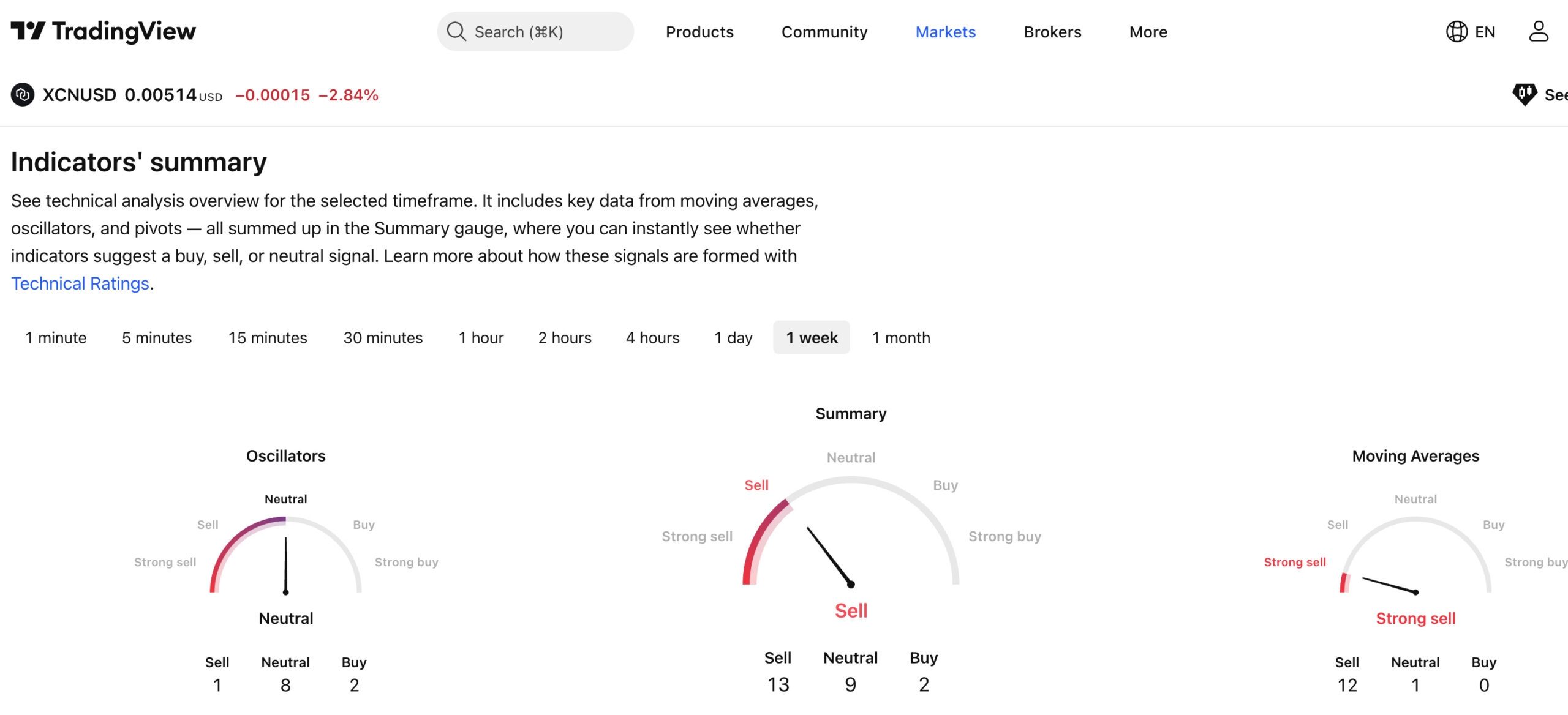
Source: Tradingview
Technical analysis helps you manage risk and timing, especially with a token that can spike on news and retrace quickly.
Moving Averages, RSI, and Momentum Oscillators
For XCN, focus on the basics that tend to work across cycles:
- 200-day moving average (200D MA): defines long-term regime (trend vs downtrend).
- 50-day moving average (50D MA): shows mid-term shifts and trend breaks.
- RSI: useful for identifying exhaustion in sharp pumps (overbought) or capitulation (oversold).
- Volume + volatility: confirms whether a breakout has real participation.
A key context point: CoinMarketCap’s own commentary notes XCN’s recent moves have been closely tied to broader market sell-offs and high correlation to Bitcoin during risk-off conditions.
Support/Resistance Levels and Chart Patterns
Using the current February 2026 zone (~$0.005) as the anchor, here are practical levels:
Support zones
- $0.0050–$0.0055: psychological/current trading band based on recent daily closes.
- $0.0030–$0.0040: deeper support if risk-off accelerates
Resistance zones
- $0.0075–$0.0090: “first real reclaim” area in many base-building structures
- $0.012–$0.015: catalyst-driven expansion zone (similar magnitude to early-2026 bursts)
- $0.05+ and $0.10+: long-term psychological milestones tied to future cycle narratives
Common chart behaviors for tokens like XCN:
- range compression → breakout on volume
- news spike → retrace → higher low (healthiest pattern if adoption is real)
- failed breakouts during Extreme Fear regimes (most common trap)
On-Chain Signals: Volume Trends and Network Activity
On-chain doesn’t mean “perfect truth,” but it provides better context than price alone.
Signals that matter for XCN:
- Holder growth: CoinMarketCap lists ~146K holders, and Onyx’s own site cites 170K+ onchain holders (measurement differences can exist due to bridged networks).
- Fee/throughput narrative: Onyx highlights ~1.2s average block time and very low average transaction fees on the ledger. If you see these claims reflected in sustained usage, it can support long-term valuation narratives.
- Market volume: XCN’s ~$19M daily volume indicates it can move quickly when traders rotate into it, but also that liquidity is still modest relative to mega-caps.
Bullish Factors That Could Drive Onyxcoin Price Higher
Institutional Adoption and Enterprise Blockchain Demand
The bullish thesis for XCN is essentially: “Onyx becomes useful infrastructure for financial-grade apps.”
Onyx’s own materials repeatedly focus on financial applications: banking, securities, payments, and cross-border use cases.
If even a small slice of institutional-style usage lands on the ledger, that can improve the “value capture story” for XCN as gas, staking, and governance.
Protocol Upgrades, Partnerships, and Ecosystem Expansion
XCN tends to respond to clear, easy-to-understand growth catalysts.
We already saw a concrete catalyst in 2026: the South Korea expansion narrative that CoinMarketCap reported as moving the price.
Over time, the more meaningful catalysts are:
- ecosystem apps and developer tooling (e.g., Thirdweb integration visibility),
- cross-chain rails for stablecoins and asset transfer,
- and governance-led tokenomics adjustments (burn/incentive tuning).
Broader Market Cycles and Correlation with Bitcoin/Ethereum
XCN still trades like a risk asset. CoinMarketCap’s analysis explicitly points to strong beta/correlation effects in market-wide sell-offs.
That means XCN can surge in risk-on cycles and drop hard in risk-off regimes, even if Onyx’s product development stays steady.
So, a bullish onyx coin price prediction isn’t just about Onyx. It’s also about macro liquidity returning to altcoins.
Risks and Bearish Scenarios for XCN
Competition from Established Layer-1s and DeFi Platforms
Onyx is entering a crowded market. Even if the ledger is fast and cheap, it competes with:
- major Layer-1 ecosystems (liquidity inertia is real),
- Ethereum Layer-2s,
- and specialized enterprise chains.
The Onyx whitepaper argues modular L3 architecture offers specialized rollups and scalability benefits.
But competition risk remains: the market doesn’t reward “good tech” by default: it rewards adoption.
Tokenomics Issues, Dilution, and Regulatory Hurdles
Supply narratives can cap upside if markets expect dilution.
CoinMarketCap lists:
- total supply ~48.4B
- max supply ~68.89B
- circulating ~37.01B
Onyx’s whitepaper discusses emission controls, governance-managed incentives, and burn mechanisms.
That can be bullish if activity rises and burns/incentives are managed well, but bearish if emissions outpace demand.
Regulatory hurdles are also more relevant for “financial-grade” networks. If the project leans into institutional rails, it may face stricter compliance expectations over time.
Market Volatility and Adoption Delays
The simplest bear case is also the most common:
- crypto remains volatile,
- adoption takes longer than expected,
- and XCN becomes a “news spike token” rather than a sustained trend asset.
Even in 2026, CMC notes how quickly XCN can move with broader market stress.
Is Onyxcoin (XCN) a Good Investment in 2026?
It can be, if you treat it like what it is: a speculative bet on a finance-oriented blockchain stack with real execution risk.
Bull Case: Path to $0.01–$0.05 with Enterprise Growth
In the bull case, XCN benefits from three tailwinds at once:
- Onyx ledger adoption (fees paid in XCN + burn component becomes meaningful),
- ecosystem expansion (bridges, stablecoins, developer tooling),
- risk-on market cycle (alts rerate upward).
In that environment, a move to $0.01–$0.05 is plausible: especially since $0.01 would still be far below the 2022 ATH region (~$0.18).
This is where phrases like XCN coin price prediction and XCN crypto price prediction tend to spike in search interest: traders start looking for “catch-up” assets.
Bear Case: Stagnation Below $0.005
Bear case: markets remain weak and XCN can’t build sustained demand above its supply dynamics.
That could mean:
- long periods of chop around the current zone, or
- gradual drift below $0.005 during prolonged risk-off cycles.
Our Prediction Methodology
This Onyxcoin price prediction model blends:
- Live market baseline (Feb 2026): price, market cap, volume, supply, holders
- Protocol fundamentals: Onyx’s ledger design, fee claims, burn mechanism, governance role of XCN
- Catalyst evidence: real 2026 market reactions (e.g., South Korea expansion news)
- Technical levels: support/resistance around current ranges, and trend regime via moving averages
- Scenario ranges: bear/base/bull because crypto outcomes are fat-tailed
This approach keeps the XCN price prediction grounded in actual data while still acknowledging uncertainty.
Where to Buy and Exchange XCN Securely?
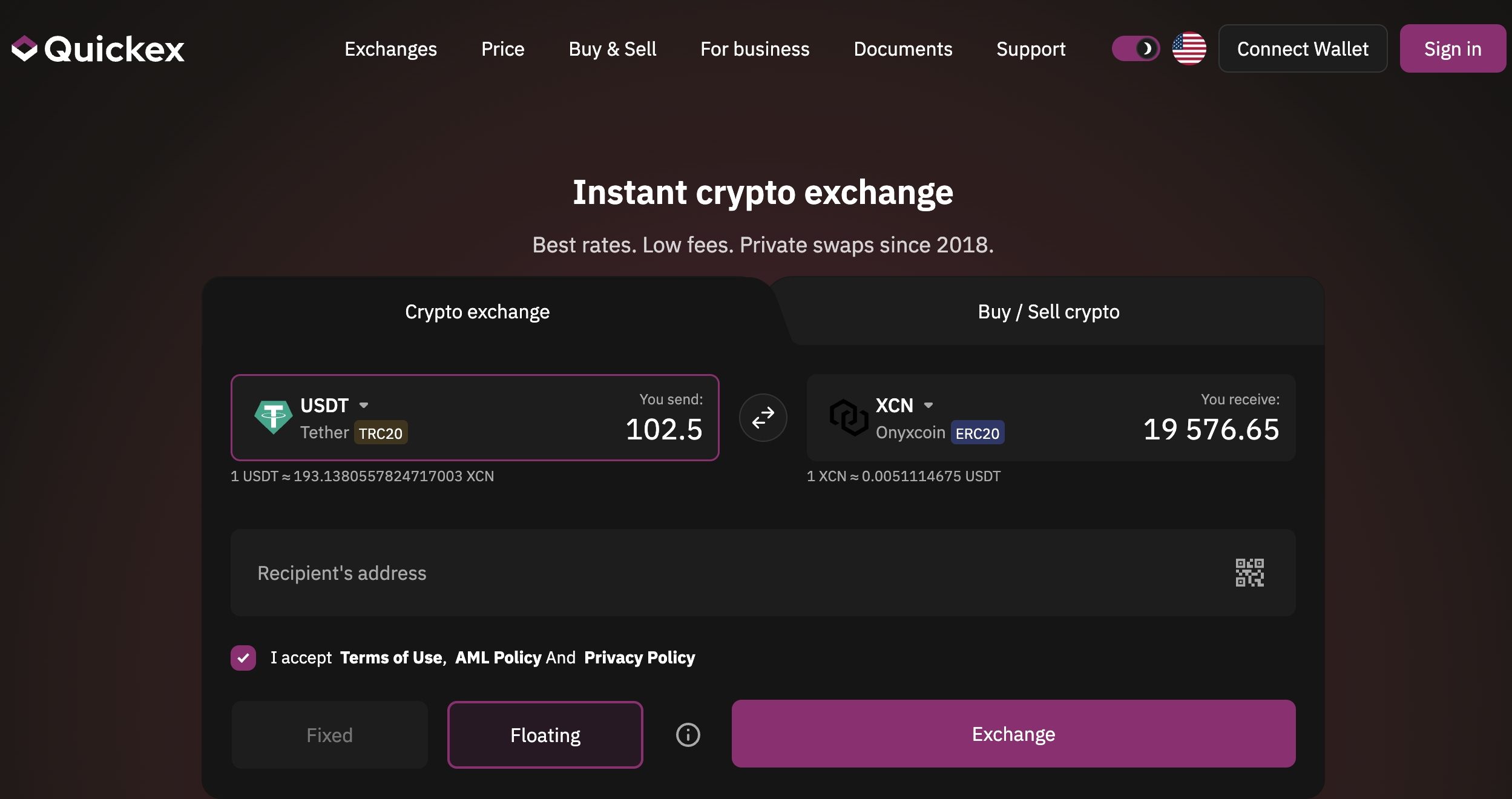
You can buy XCN through major exchanges and broker platforms. Quickex, for example, provides a price page and circulating supply stats for Onyxcoin.
If you’re using an instant swap service like Quickex, here’s how it works and how to think about it safely. Quickex is an instant crypto exchange that lets users swap coins “in minutes,” providing exchange options like XMR to USDT via partners.
- Fixed rate: fee 1% + network fee; rate frozen for 12 minutes; if market rate changes beyond a threshold before detection, you may be offered a refund or proceed at market rate.
- Floating rate: fee 0.5% + network fee; rate isn’t fixed until funds are recognized and the swap completes; final amount can vary with market conditions.
If you choose to use any instant swap platform:
- start with a small test amount,
- double-check wallet addresses and networks,
- and avoid leaving funds on third-party services longer than necessary.
Frequently Asked Questions (FAQ)
What Is the Onyxcoin Price Prediction for 2026?
Our scenario-based Onyxcoin price prediction for 2026 is:
- Bear: $0.0030–$0.0060
- Base: $0.0050–$0.0120
- Bull: $0.0120–$0.0250
This is anchored to XCN trading around ~$0.005 in early February 2026 with ~$190M market cap and ~$19M daily volume.
Will XCN Reach $0.01 or Higher?
Yes, it’s plausible in a risk-on cycle, especially if Onyx’s ledger adoption grows and catalysts keep landing. A move to $0.01 would still be far below the 2022 ATH zone (~$0.18), which multiple sources cite.
For the long view, see the XCN price prediction 2030 ranges above (bear/base/bull).
How Does Onyxcoin Differ from Other Enterprise Blockchains?
Onyx leans into a modular “financial ledger” narrative and explicitly positions itself as a Layer 3 built on Arbitrum Orbit, settling to Base, with EVM compatibility and specialized rollups for application-specific needs.
XCN’s role is emphasized as gas + governance + staking asset across that ledger stack.
What Impact Did the Chain-to-Onyx Rebrand Have?
The rebrand clarified positioning: from “Chain” branding to “Onyxcoin/Onyx Protocol” branding centered on finance-grade infrastructure.
Exchanges implemented the naming change directly (e.g., Bittrex confirming the Chain→Onyxcoin rebrand).
From a market standpoint, rebrands can help narratives, but long-term price ultimately follows adoption and liquidity.