
If you’ve been watching decentralized compute tokens, you’ve probably noticed something confusing: demand for GPU power keeps making headlines, yet some tokens still trade like the market is unconvinced. Render is a perfect example. On paper, it’s positioned at the intersection of AI, 3D content, and DePIN (Decentralized Physical Infrastructure Networks). In practice, price action can feel like a coin flip driven by macro, rotation, and narrative cycles.
This guide is built to be practical: we’ll cover what’s happening right now, what actually makes the Render ecosystem different, and what a realistic Render price prediction range could look like from 2026 through 2030, plus a longer-horizon view into 2035.
Disclaimer: This article is for educational purposes only and is not financial advice.
Render Market Pulse: February 2026 Status Report
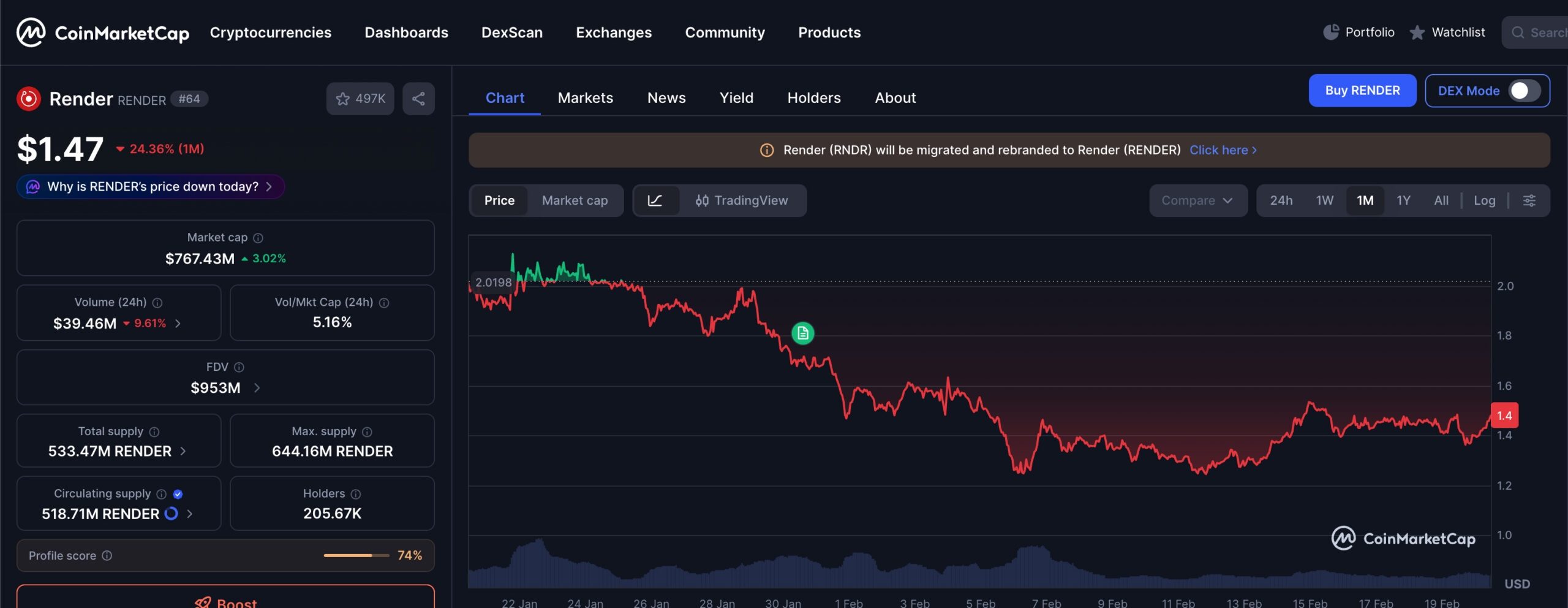
Source: Coinmarketcap
Render Price Performance: Analyzing the 2025 AI Supercycle
Let’s anchor this with today’s baseline. As of February 20, 2026, Render (ticker: Render) is trading around the mid–$1 range, with a market cap in the ~$700M–$800M band depending on the venue and intraday move. CoinMarketCap lists key supply stats (circulating supply ~518.7M, total supply ~533.5M, max supply ~644.2M) and a market cap around the mid-$700M range.
So what happened to the “AI supercycle” narrative everyone was yelling about in 2024–2025?
A simple way to think about it: AI and GPU demand can be structurally bullish, while token prices remain cyclically bearish. In hot markets, the crowd bids the “story” first (AI, DePIN, GPUs), then later starts caring about unit economics: Who pays? How does usage translate into token demand? How much gets burned? How much gets minted?
Render’s all-time high is often quoted in the low-to-mid teens; MetaMask’s pricing page lists an ATH around $13.53. That matters because many long-term holders still frame the chart as “down massively from peak,” even if the network itself is progressing.
From an investor psychology standpoint, 2025 was a classic “expectations vs. execution” year:
- Expectations: AI demand instantly pumps all GPU networks.
- Execution: Real usage ramps, but token value capture is gradual, and the market rotates to the next shiny thing every few months.
That’s why any serious Render crypto price prediction for 2026–2030 should be scenario-based, not one magic number.
The Solana Migration Success: Ecosystem Growth Post-Upgrade
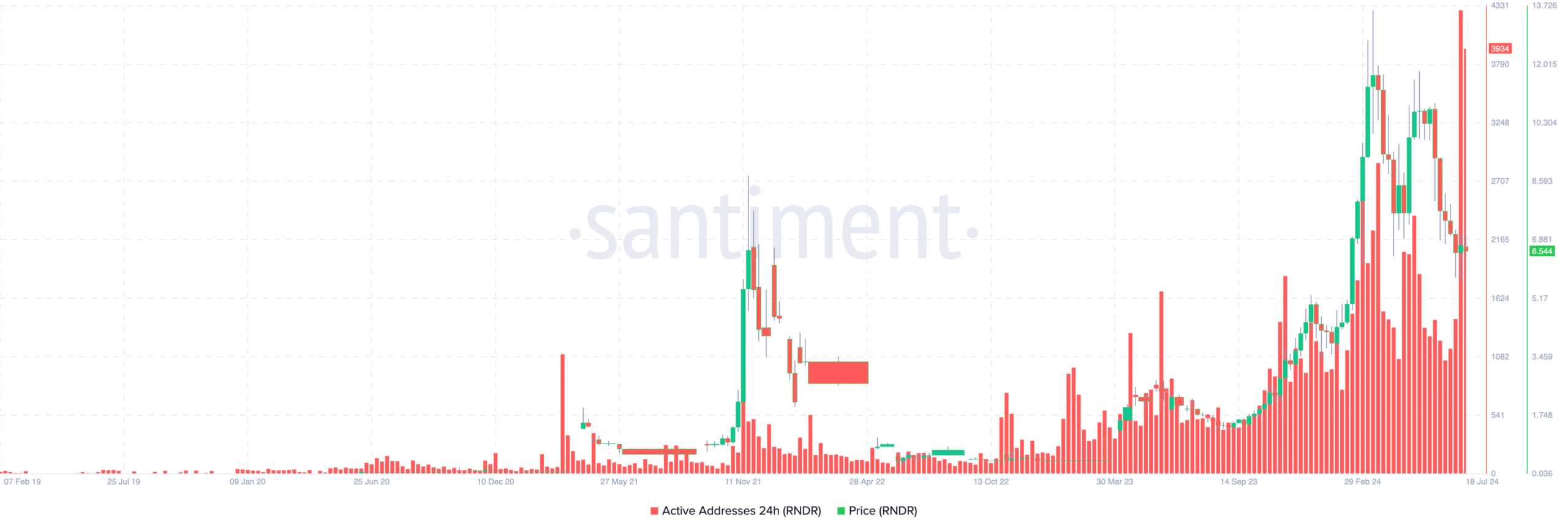
Source: Beincrypto
Before we forecast forward, we need to clean up a common confusion: RNDR vs. Render.
Render’s legacy token lived on Ethereum (and at times Polygon). The upgraded token is Render on Solana, following community governance and a structured migration process. The Render Foundation has an official upgrade portal for converting RNDR to Render.
Look Back: RNDR → Render Migration Milestones
Below is a practical “memory refresher” for anyone researching RNDR price prediction content but holding or tracking the newer Solana-based asset:
| Date | Milestone | Why it mattered |
| Mar 2023 | Discussion/proposal for Solana expansion (RNP-002 era) | Set the direction toward a high-throughput chain for payments + emissions. |
| Nov 2, 2023 | Render Foundation announced successful core upgrade to Solana | Major infrastructure step; holders could migrate via the upgrade assistant. |
| Dec 20, 2023 | BME emissions live on Solana | Operationalized the burn/mint framework on Solana. |
| Aug–Sep 2024 | Exchanges completed RNDR→Render conversions (example: Kraken Aug 6; Newton Sep 9) | Reduced ticker fragmentation and simplified liquidity for many users. |
Why the migration matters for price: cheaper and faster transactions make it easier to run “usage-driven tokenomics” at scale, especially when you want on-chain settlement for compute work.
Key Stats: Circulating Supply, Burn Rate, and Node Operator Growth
Now for the numbers that actually connect the story to token mechanics.
Supply & dilution (the “how much more can unlock?” question):
- Circulating supply is roughly 518.7M Render, with total supply around 533.5M and max supply around 644.2M listed by major market trackers.
Network usage & capacity indicators:
- The Render Foundation’s dashboard shows total frames Rendered ~68.37M and total nodes since inception ~5,600.
Burn progress (a simple “is this tokenomics actually doing anything?” checkpoint):
- In its December 2025 monthly report, the Render Network Foundation highlighted a milestone of 1,000,000 Render burned under the Burn-Mint Equilibrium model.
Those three pieces: supply, burns, and network growth to create the backbone of any credible Render token price prediction:
- If usage grows faster than emissions, scarcity improves.
- If emissions outpace burns, price needs stronger narrative demand to compensate.
- If nodes and job volume expand, the “utility” story becomes easier to defend through bear markets.
Why Render is the Leader in DePIN
GPU Scarcity in 2026: How Render Solves the Global Compute Shortage
In 2026, the GPU market still behaves like a bottlenecked commodity. The AI world doesn’t only want more GPUs, it wants available GPUs, in the right geography, with predictable pricing and scheduling. Centralized providers can offer reliability, but they also capture the margin and control access.
Render’s pitch is straightforward: aggregate idle or underused GPU capacity and route real workloads to it, with cryptographic settlement and reputation incentives. That’s not just “crypto for crypto’s sake”, it’s a marketplace design problem.
The investment implication: if decentralized compute becomes a serious category (not a niche), Render is positioned as a specialized leader rather than a generic cloud.
Render vs. Traditional Cloud (AWS/Google)
Centralized cloud is the default, but it’s expensive, especially for GPU workloads. Decentralized marketplaces are explicitly marketing lower pricing by tapping non-hyperscaler supply.
For example, Akash publicly compares GPU hourly rates (e.g., showing an H200 rate versus AWS on its site), illustrating the broader “decentralized compute can be cheaper” argument.
Render’s edge isn’t “cheaper cloud for everything.” It’s more like:
- Better fit for Rendering / creative pipelines
- Tokenomics designed to link demand → burns
- An ecosystem that already has creator tooling and partnerships
If decentralized compute becomes a multi-trillion-dollar market, there will be multiple winners. Render’s bet is specialization + network effects.
The Apple & OctaneRender Synergy: Integration with Vision Pro 2
Source: OTOY
This is where Render becomes more than a token chart.
Render has deep roots with OTOY and OctaneRender tooling in the creative world. OTOY has publicly discussed Octane X and Apple platform support over multiple years, including collaboration around Metal and Apple hardware. AppleInsider described Octane X as rewritten in Metal “as part of a collaboration with Apple.”
Render’s own knowledge base also describes workflows where Apple creators can scale Renders from Apple Silicon devices using the Render Network.
Render Price Prediction 2026: Capitalizing on the AI Boom
This section is about near-term reality: what can plausibly happen in 2026 without assuming a perfect bull market.
Q1–Q2 2026 Forecast: Spring Rally or Cooling Period?
Given the February 2026 baseline (around ~$1.4–$1.5), a reasonable 2026 outlook needs two scenarios:
Base case (range-bound with bursts):
- Price chops while the market debates whether AI tokens are “early cycle” or “late cycle.”
- Potential range: $1.00–$2.50 in the first half, depending on macro risk-on/off.
Bull case (narrative reignition):
- A strong altcoin rotation, new partnerships, or obvious usage growth reignites buyers.
- Potential range: $2.50–$4.50 if the market decides DePIN is “the trade” again.
Bear case (macro risk + weak alt liquidity):
- If risk assets sell off and altcoin liquidity thins, tokens can overshoot downward.
- Potential range: $0.80–$1.20 during a broad drawdown.
This is why “one-number” Render coin price prediction posts can be misleading: the path matters as much as the destination.
Technical Analysis: Major Resistance at the $15.00 Psych Level
At today’s price, $15 looks absurdly far, so why talk about it?
Because the market is forward-looking, and big round-number levels shape behavior years in advance. There are typically three layers of resistance for a token like Render:
- Local resistance (near-term): zones where sellers recently dominated.
- Cycle resistance (medium-term): levels from major rallies that trapped buyers.
- Psychological + ATH resistance (long-term): “the headline number” everyone remembers.
MetaMask’s data lists an ATH in the low teens.
So a realistic “roadmap” of resistance could look like:
- $2–$3: reclaim zone where many holders look to exit “at breakeven-ish.”
- $5: narrative confirmation level (“AI/DePIN is back”).
- $10–$15: long-term bull market territory, where profit-taking can be brutal.
So yes, $15 is a “psych level.” It’s also a test of whether Render becomes a true sector leader in revenue and usage, not just in marketing.
Bear Case vs. Bull Case: What Happens if AI Growth Slows?
Render’s biggest tailwind is also its biggest narrative risk.
If AI hype cools, three things can happen:
- Token multiples compress (people stop paying “future potential” premiums).
- Usage still grows slowly (builders keep building), but price lags.
- Competitors gain share if they subsidize users or offer better economics.
The bull case is the opposite:
- AI demand continues expanding.
- On-chain compute becomes normal.
- Render’s BME model makes value capture easier to explain to mainstream investors.
In other words, the 2026 Render token prediction is not just “up or down”, it’s “does the market reward the revenue/usage loop?”
Render Price Prediction 2027–2029: Decentralized Metaverse
2027 Render Price Prediction: The Impact of Decentralization
By 2027, the main question becomes: How much of the Rendering and AI compute workflow is actually flowing through the network?
If the market sees consistent growth in:
- burns (demand),
- reliable node supply (capacity),
- and creator adoption (stickiness),
…then 2027 can be a “multiple expansion” year.
2027 scenario range (reasonable):
- Bear: $1.00–$2.00
- Base: $2.50–$6.00
- Bull: $6.00–$8.00+
This is where RNDR token price prediction searches often spike again; because traders rediscover the sector right before (or during) a cycle run.
2028 Render Price Prediction: Bitcoin Halving Cycle and Altcoin Lag
Historically, altcoins often lag Bitcoin’s major cycle catalysts, then catch up aggressively once liquidity spills over.
A sensible 2028 forecast uses “cycle logic” carefully:
- If the broader market is bullish, Render can ride the wave.
- If the market is flat, even strong fundamentals may not produce strong prices.
2028 scenario range:
- Bear: $2.00–$3.50
- Base: $4.00–$10.00
- Bull: $10.00–$15.00
Note how the bull scenario approaches the psychological zones we discussed. This is also where people start searching RNDR price prediction 2030 and Render price prediction 2030 because they want the “next cycle ceiling.”
2029 Render Price Prediction: Role in 8K Streaming and Spatial Computing
2029 is less about one event and more about infrastructure maturity.
If real-time Rendering, volumetric video, and spatial computing become mainstream, GPU demand isn’t just “training AI models.” It becomes “always-on compute for creativity.” Render’s success here depends on:
- stable pipelines,
- predictable pricing,
- and integration with creator tools.
2029 scenario range:
- Bear: $2.50–$5.00
- Base: $6.00–$14.00
- Bull: $15.00–$25.00
A true breakout requires the market to view Render as a utility network rather than a speculative token.
Render Price Prediction 2030–2035: Autonomous Agents
Can Render Reach $150? Long-Term Valuation Models
Can it? Technically yes. Is it likely? Only under extreme adoption.
Let’s do rough math. With ~519M circulating tokens, a $150 price implies a market cap around $78B. That’s “top-tier crypto” territory. To justify that, Render would need:
- very large and sticky demand,
- strong token value capture,
- and a leadership position in decentralized compute.
So the honest answer is:
- $150 is an upside tail, not a baseline expectation.
- But it’s not fantasy if the network becomes a global compute utility.
That’s why any long-range Render crypto prediction should be framed as probabilities, not promises.
The Burn Mechanism: How “Burn-and-Mint Equilibrium” (BME) Drives Scarcity
Render’s BME model is a big deal because it gives you a clean narrative: network usage can translate into token burns, while node operators earn minted rewards, creating a loop tied to demand. Render’s knowledge base describes BME as a supply-and-demand balancing framework for pricing and infrastructure incentives.
The foundation dashboard is built to visualize mint vs. burn dynamics and node rewards, which is exactly what long-term investors should monitor, not just price candles.
2035 Render Price Forecast: Global Utility for Autonomous AI Training
By 2035, the best-case world looks like:
- autonomous agents and studios routinely outsource compute,
- decentralized compute networks are accepted procurement channels,
- and Render has become a default settlement layer for specialized GPU workloads.
The bear-case world:
- centralized cloud solves pricing and supply constraints,
- or competitors win distribution and Render becomes “one of many.”
Price Prediction Table
Below is our scenario-based table you can use as a planning tool, not a guarantee. This table intentionally includes 2035 because long-term narratives matter in DePIN:
| Year | Min (Bear) | Avg (Base) | Max (Bull) |
| 2026 | $0.80 | $1.80 | $4.50 |
| 2027 | $1.00 | $3.50 | $8.00 |
| 2028 | $2.00 | $6.50 | $15.00 |
| 2030 | $3.00 | $12.00 | $35.00 |
| 2035 | $5.00 | $25.00 | $150.00 |
This aligns with how serious analysts think: ranges, catalysts, and probability, rather than “Render will be exactly $X.”
And yes, this table also answers the most common long-horizon queries like Render token price prediction 2030, Render price prediction 2030, and RNDR price prediction 2030 in a format that’s actually usable.
Ecosystem Analysis: The Partners Driving Render Value
The Solana Advantage: Transaction Speeds and DePIN Infrastructure
Solana’s main value here is operational: high throughput, low fees, and a culture of consumer-facing apps. Render’s upgrade to Solana was positioned as a core infrastructure step, with the foundation explicitly announcing the move and enabling migration tools.
For a compute network, settlement friction matters. If payments, burns, and rewards are expensive or slow, the entire model becomes harder to scale.
Cinema and Media: Major Studios Adopting Decentralized Rendering
Render’s “secret sauce” is that it isn’t starting from zero. It has creative tooling and industry relationships that many generic compute projects don’t.
The strongest signal here isn’t a single headline; it’s continued integration into real workflows and consistent network output. Monitoring “frames Rendered” and node growth on the dashboard is more meaningful than chasing rumors.
AI Partnerships: Scaling LLM Training on the Render Network
Render’s future upside increasingly depends on AI workloads, not only 3D Rendering. The ecosystem is moving toward “compute as a marketplace,” and as that expands, Render can benefit if it maintains quality, reliability, and developer mindshare.
Competitive Landscape
Render vs. Akash Network (AKT)
Akash is positioned as a decentralized cloud marketplace, more general-purpose, often marketed for AI workloads and GPU rentals. Its own site emphasizes buying/selling compute resources and highlights GPU pricing comparisons.
Render, by contrast, is more specialized: creator pipelines, Render jobs, and a token model tuned for that marketplace.
Render vs. Nosana and IO.net
IO.net is clearly framing itself as an AI infrastructure platform aggregating global GPUs. Its site describes connecting customers to GPU sources worldwide, and third-party research has covered it as a decentralized GPU network.
Competitor Matrix (Render vs Akash vs IO.net)
| Project | Core Focus | Chain / Origin | Strengths | Main Risk |
| Render (Render) | Rendering + creator workflows + AI compute expansion | Migrated to Solana; upgraded token (Render) | Creator tooling + BME narrative + real pipeline fit | Value capture depends on sustained usage growth |
| Akash (AKT) | General decentralized cloud + GPU marketplace | Cosmos-origin; decentralized compute marketplace | Price competitiveness + broad “cloud” positioning | Less specialized differentiation vs hyperscalers |
| IO.net (IO) | Solana-native decentralized GPU for AI | Solana-native AI infra; global GPU aggregation | AI-first narrative + scaling compute supply | Intense competition; reliability and enterprise trust |
Why Render’s First-Mover Advantage Remains Unshakable in 2026
The simplest bullish argument is this: Render has been building in the creative GPU world for a long time, and now the world is finally paying attention to GPU markets again.
First-mover advantage isn’t “we were early.” It’s:
- integrations
- workflow habits
- distribution channels
- reputation systems
- and a token model you can explain to non-crypto people
If Render keeps shipping and the dashboard metrics keep climbing, the market eventually notices.
Is Render (Render) a Good Investment Today?
Understanding the BME Model: How Usage Directly Impacts Token Price
This is the heart of the thesis. Under BME, token flows are meant to link network activity to supply dynamics: burns on usage, rewards to node operators, and a balancing act that can be tracked.
That’s why long-term holders should spend more time watching:
- burns (demand signal),
- rewards (emissions),
- network throughput (jobs/frames),
than staring at five-minute charts.
Risks to Consider: GPU Manufacturing and Regulatory Shifts
Even if decentralized compute wins, there are real risks:
- Supply concentration: GPU manufacturing is dominated by a few giants.
- Market cyclicality: AI demand can be real and still trade like a bubble.
- Regulatory pressure: anything “tokenized” can face new restrictions, especially around incentives and emissions.
Portfolio Allocation: How Much Render is “Too Much”?
A practical approach:
- Treat Render as a high-volatility satellite position.
- Size it so you can hold through drawdowns without panic-selling.
- Consider scaling in across months rather than buying one big entry.
This is how you survive long enough for the bullish scenario to even be possible.
Where to Buy and Exchange RNDR?
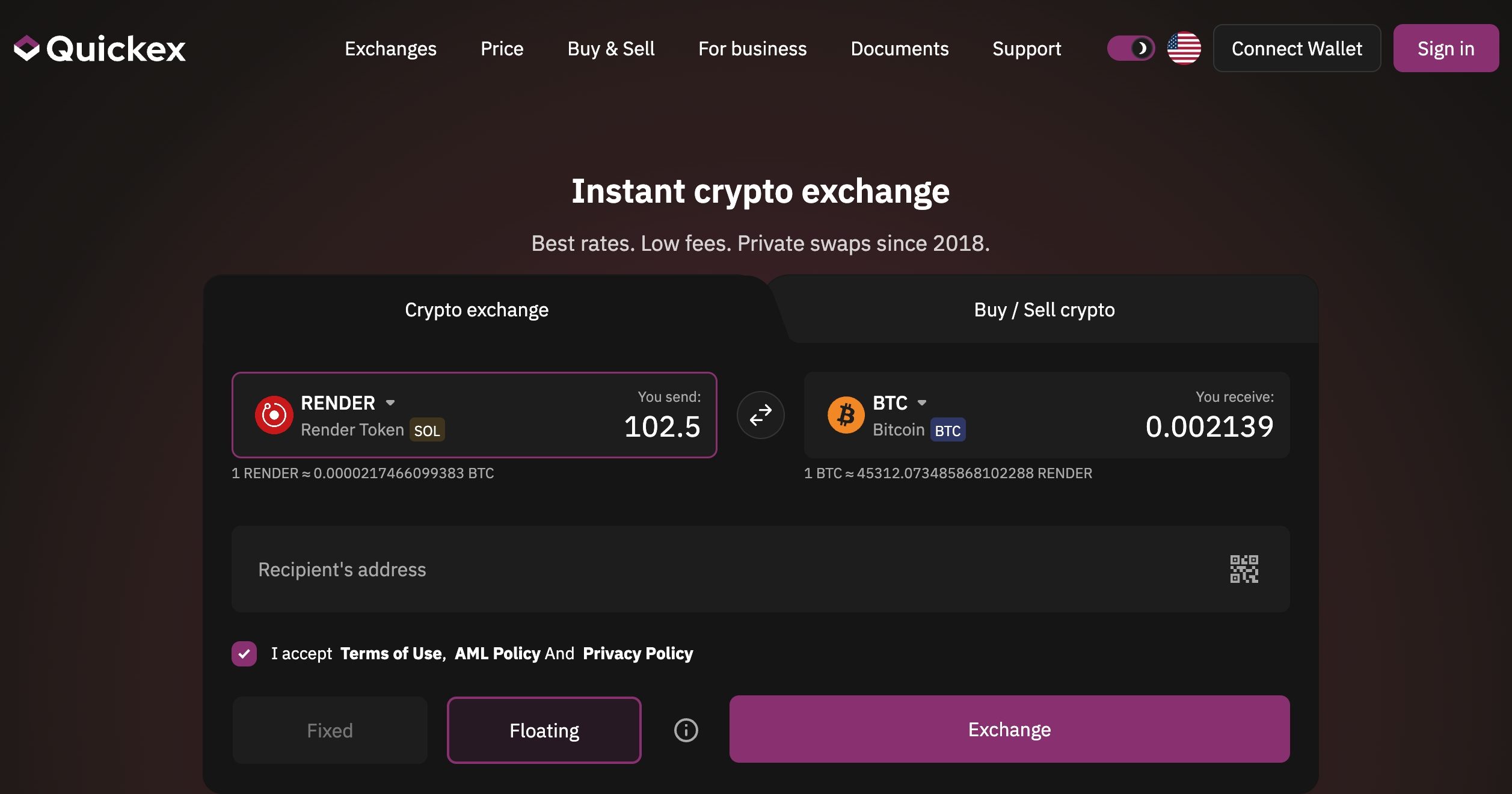
First, terminology: most users today should aim to hold Render (the upgraded token). Some platforms and content still say RNDR out of habit. If you’re swapping Render, confirm what asset you’re receiving and on which chain.
Example workflow:
- Choose the “Send” asset and the “Receive” asset (like BTC to USDT)
- Enter your destination wallet address.
- Send the required amount to the deposit address provided.
- Quickex processes the swap and sends funds to your wallet.
Security tip: always test with a small amount first, and verify the chain (Solana or Ethereum) before sending.
What Every Render Investor is Asking in 2026
Is RNDR still relevant, or should I only hold Render?
In most cases, Render is the modern target asset because it’s the upgraded token on Solana. Render Foundation’s upgrade portal exists specifically to migrate legacy RNDR to Render.
How can I earn Render by providing GPU power?
Typically, you participate as a node operator by connecting eligible GPU hardware to the network and receiving rewards for completed work (and/or availability, depending on the epoch rules). The foundation dashboard and documentation are good starting points for understanding rewards.
Does Render compete directly with Nvidia?
Not really. Nvidia builds GPUs; Render coordinates market access to GPU capacity and routes workloads. Render is closer to a marketplace layer than a chipmaker. The risk is still “dependency” (if GPUs are scarce, prices rise), but it’s not a head-to-head product competition.
What is the “Max Supply” of Render in 2026?
Major market trackers list a max supply around 644M Render (with ~518M circulating as of Feb 2026).
Disclaimer: The material in this article is not financial or investment advice. Everything stated here reflects the author's personal view and should not be treated as a recommendation to trade or invest. We make no warranties regarding the accuracy, reliability or completeness of the information presented. Cryptocurrency markets are highly volatile and can move unpredictably. Before committing any funds, every investor, trader or crypto user should study several independent sources and check the regulations that apply in their own jurisdiction.