
Starknet (STRK) sits in a very specific corner of crypto: it’s not trying to be the next meme coin or a “faster Ethereum.” It’s trying to scale Ethereum using cryptography—validity proofs—so transactions get cheaper and faster without losing the security guarantees that made Ethereum matter in the first place.
That sounds noble… but markets don’t price “noble.” Markets price adoption, liquidity, catalysts, and timing. And for Starknet, timing has been everything. STRK launched into a period where Layer-2 competition was brutal, user attention was scattered, and token unlock headlines became as important as tech upgrades. At the same time, Starknet’s roadmap has kept shipping: parallel execution, block packing, and ongoing moves toward a higher-performance rollup stack.
So what does a realistic Starknet price prediction look like from 2026 to 2030?
In this article, we’ll anchor the forecast to February 2026 live data (price, market cap, volume), then layer in on-chain signals (TVL, activity, users), major milestones (airdrop, upgrades, unlock schedule), and finally a scenario-based price range for each year through 2030—plus a clean comparison table.
Not financial advice. Crypto is volatile. Price predictions are scenario ranges, not promises.
What Is Starknet (STRK)?
Starknet is an Ethereum Layer-2 designed to scale Ethereum price using validity proofs (often called ZK proofs). Starknet describes itself as a “Validity Rollup” that retains Ethereum’s security while improving scale.
Starknet as a Validity-Rollup (ZK-Rollup) on Ethereum
A quick mental model:
- Ethereum L1 is the court of record (expensive, slow, secure).
- Starknet is a high-speed clerk that processes many transactions off-chain.
- Then Starknet posts a validity proof back to Ethereum showing “these results are correct.”
That last part—“prove it”—is the big differentiator versus fraud-proof systems. In a fraud-proof design, correctness is assumed unless challenged. In a validity-proof design, correctness is proven up-front using cryptography. StarkWare’s writeup explains why validity proofs can be more scalable and capital-efficient than fraud proofs (with the caveat that proving tech has to be advanced enough).
Key Technology: STARK Proofs, Cairo Language, and Parallelism
Starknet’s core stack can be summarized in three pieces:
1) STARK proofs
STARKs are a proof system—cryptography that can prove computation happened correctly, with efficient verification. StarkWare’s STARK overview frames it as a proof system designed for efficient verification and proof size (and highlights post-quantum-secure assumptions).
2) Cairo language
Cairo is the smart contract language (and more broadly, the computation language) used across Starknet’s ecosystem. The Cairo site describes Starknet as an L2 validity rollup on Ethereum and positions Cairo as “purpose-built for provable computing.”
3) Parallelism and performance upgrades
One of Starknet’s notable scaling pushes has been around parallel execution and block packing—features described in Starknet’s v0.13.2 upgrade materials as improving throughput and efficiency.
Parallelism matters because it’s one of the “next step” upgrades that can unlock real UX improvements for users: quicker confirmations, smoother on-chain games, and less congestion sensitivity when activity spikes.
Use Cases: DeFi, Gaming, NFTs, and Scalability for Ethereum
Starknet’s promise is simple: if Ethereum is the “settlement layer,” Starknet aims to become one of the places where day-to-day activity can happen cheaper and faster—while still settling securely back to Ethereum. Starknet’s own positioning explicitly frames it as scaling Ethereum while retaining security and decentralization.
Where that shows up in practice:
- DeFi: swaps, lending, perps, yield strategies—especially if user costs stay low enough for smaller wallets.
- Gaming: games need frequent actions; high-fee environments kill gameplay.
- NFTs: minting and trading that doesn’t feel like a luxury purchase.
- Scaling infrastructure: dev teams building Ethereum apps who want cheaper execution without jumping to a new L1.
If Starknet wins, it’s because it becomes a “default home” for certain categories of Ethereum activity—not because it’s the only L2 in town.
Starknet Price History and Major Milestones
STRK’s price story starts with its distribution mechanics: community provisions (airdrop), early liquidity, and unlock schedules. In other words, STRK didn’t just launch—it entered the market with a supply narrative.
Token Launch, Airdrop, and Initial Price Action
The Starknet Foundation announced the Starknet Provisions Program, distributing 700M+ STRK to nearly 1.3M addresses, with claiming available starting February 20, 2024 (12pm UTC).
That date is important because many tokens experience a predictable lifecycle around airdrops:
- hype builds into eligibility checks
- claim window opens → selling pressure from recipients
- a stabilization period follows
- longer-term price becomes more tied to adoption + macro cycles
In other words: even strong projects can get “airdrop-sold” early. That doesn’t automatically mean the tech is bad—it means the market is doing what markets do.
Key Upgrades and Ecosystem Developments
On the tech side, Starknet has been shipping performance-focused upgrades. Starknet’s v0.13.2 messaging emphasizes parallel execution and block packing, with the “Bolt” upgrade framing the target as faster user experience (including the idea of “2-second txs” as an aspiration/UX theme).
Why does this matter for price?
Because L2s don’t win by being slightly cheaper. They win by being so smooth that users forget they’re “using crypto.” Performance upgrades make that possible—especially for high-frequency apps like perps and games.
Also, Starknet’s token mechanics are part of the “milestone” story. Starknet’s documentation describes STRK supply creation and distribution, noting 10 billion tokens were created and minted on-chain (with distribution plans and unlock dynamics).
Starknet Current Price and Market Overview
Source: Coinmarketcap
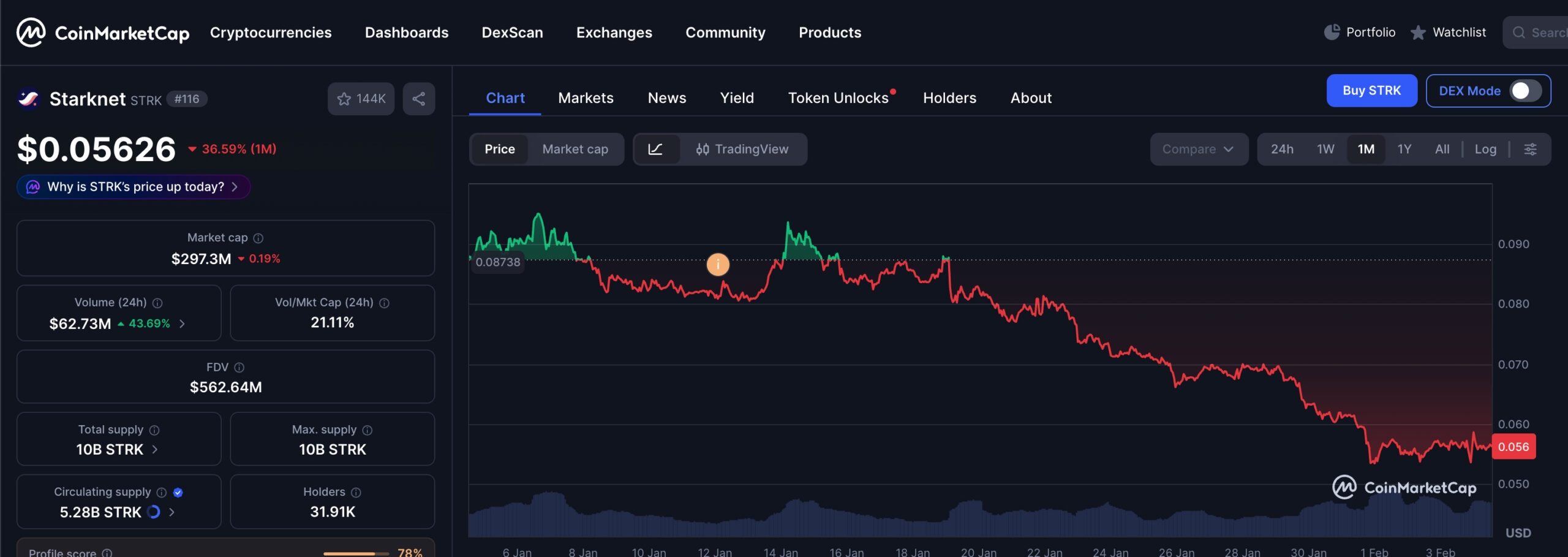
This section matters because predictions without a baseline are just vibes. The numbers below reflect early February 2026.
Live STRK Price, Market Cap, and Trading Volume
According to CoinMarketCap:
- STRK price: $0.05622
- 24h volume: $63.4M
- Market cap: $297.1M
- Circulating supply: 5.284B STRK
- Max supply: 10B STRK
That’s the “today” snapshot. It also means STRK is trading in a price zone where small changes in demand can move the chart meaningfully—because the unit price is low and perception shifts quickly.
On-Chain Metrics: TVL, Transactions, and Active Users
For L2s, price is often downstream of usage. Here are the key metrics that help separate “speculation” from “traction.”
TVL (Total Value Locked in DeFi)
DeFiLlama shows Starknet’s Total Value Locked in DeFi at ~$302.83M (24h change roughly flat in the snapshot).
Activity / throughput proxy
L2Beat’s Starknet page shows:
- Past Day UOPS: 8.78
- Past Day Ops count: ~758.74K
- Total Value Secured (TVS): ~$672.57M
- Stage: Stage 1
UOPS isn’t a perfect “transactions per second,” but it’s a useful standardized activity view across L2s.
Active users
Token Terminal’s Starknet financial statement view shows active users (daily) around 49.4K for Feb 2026 (with a visible month-over-month percentage change).
Put those together and you get a more realistic picture: Starknet isn’t “dead,” but it’s also not at the level where everyone must own STRK. It’s in that middle zone where adoption growth can genuinely matter—especially in a favorable market cycle.
Recent Sentiment and Fear & Greed Index
Source: Tradingview
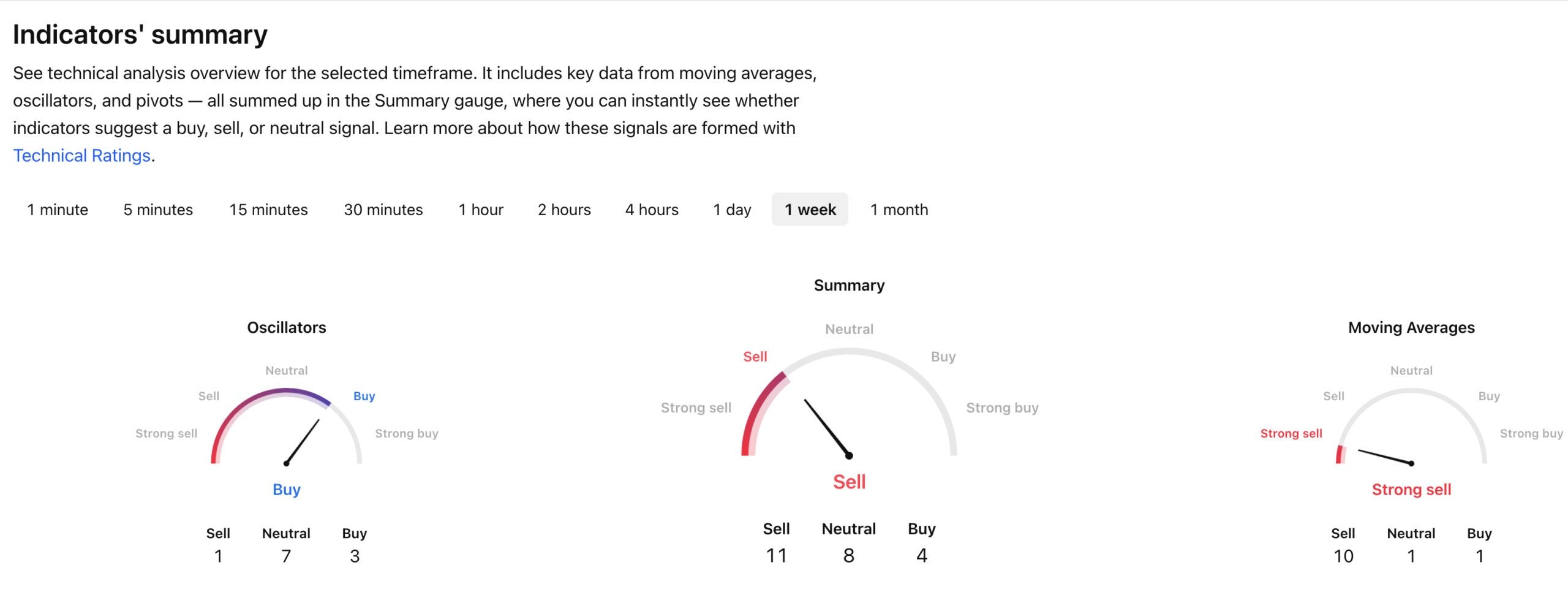
Sentiment still drives altcoins harder than most fundamentals do in the short run.
The Crypto Fear & Greed Index reading around early February 2026 is shown as Extreme Fear.
In Extreme Fear regimes, you’ll typically see:
- sharper selloffs and lower liquidity
- “bad news” priced more aggressively
- and, sometimes, great long-term entry zones—if the network keeps shipping and usage doesn’t collapse
Starknet (STRK) Short-Term Price Prediction 2026
Short-term forecasts should be range-based. STRK can swing a lot without “changing the long-term story.”
Two big short-term forces to respect:
- macro / market regime (fear vs greed)
- token supply dynamics (unlocks, emissions, staking)
STRK Price Forecast for Q1–Q2 2026
With STRK near $0.056 in early Feb 2026, here’s a realistic Q1–Q2 setup:
Bear case (risk-off + sell pressure): $0.035–$0.055
- Market stays fearful
- any rallies get sold
- unlock narratives weigh on price
Base case (stabilization + gradual recovery): $0.055–$0.090
- STRK holds the mid-$0.05 area
- bounces toward prior local zones
- activity and TVL remain stable or improve modestly
Bull case (alt rotation + positive Starknet catalysts): $0.090–$0.140
- requires broader market improvement
- and a visible Starknet catalyst (ecosystem growth or performance narrative)
For context, CoinMarketCap’s historical data shows STRK trading around $0.08 in early January 2026 (example entries), which helps define near-term resistance zones.
Q3–Q4 2026 Outlook and Near-Term Catalysts
The second half of 2026 is where narratives can shift. Here are the catalysts that matter most:
- Scaling upgrades translating into UX (faster confirmations, smoother app performance)
- TVL and stablecoin growth (more capital on-chain tends to support ecosystems)
- real app retention (not just “airdrop farming”)
- token unlock absorption (market proving it can handle supply)
Q3–Q4 2026 ranges:
- Bear: $0.030–$0.060
- Base: $0.060–$0.120
- Bull: $0.120–$0.220
Starknet Price Prediction 2026
For 2026 as a full year, a fair starknet price prediction range looks like:
- Bear: $0.03–$0.06
- Base: $0.06–$0.12
- Bull: $0.12–$0.22
Base-case logic: STRK recovers from extreme fear levels and revisits mid-range liquidity zones, but doesn’t break out into sustained “mania” unless the broader market turns risk-on.
Starknet Price Prediction 2027
2027 is the year where L2 winners usually start separating from “tech demos.” If Starknet continues improving throughput and dev UX while retaining meaningful on-chain activity, it can attract more durable usage.
- Bear: $0.04–$0.08
- Base: $0.10–$0.25
- Bull: $0.25–$0.60
Bull case requires:
- clear dApp growth and retention
- rising TVL and stablecoin depth
- and a broader Ethereum-led cycle
Starknet Price Prediction 2028
If 2028 lines up with a strong crypto cycle, L2s can run hard—especially those seen as “core infra.” Starknet’s differentiation (STARK proofs + Cairo + high-performance roadmap) gives it a narrative if adoption follows.
- Bear: $0.06–$0.12
- Base: $0.18–$0.45
- Bull: $0.45–$1.20
At this stage, people often start searching strk token price prediction and starknet token price prediction because the market tends to reward “infrastructure coins” when Ethereum is hot—but only if the chain is actually being used.
Starknet Price Prediction 2029
By 2029, the question becomes: does Starknet have a sticky economy (DeFi, gaming, apps) or does it remain “one of many L2s”?
- Bear: $0.08–$0.18
- Base: $0.30–$0.80
- Bull: $0.80–$2.00
Base case assumes Starknet remains relevant and captures a durable slice of Ethereum L2 activity, supported by steady improvements and reasonable token economics.
Starknet Price Prediction 2030
Here’s the clean headline view for 2030:
- Bear: $0.10–$0.25
- Base: $0.50–$1.50
- Bull: $1.50–$5.00
This is the range that fits the most common “what if Starknet really wins?” scenario without pretending it’s guaranteed. The bull case generally requires:
- strong L2 market growth
- Starknet ranking among top ecosystems by real usage
- and the market valuing STRK as a core asset for fees/staking/governance over time
Starknet Price Prediction Table
Here’s the year-by-year comparison table (bear/base/bull) in one glance—useful if you’re writing a plan rather than chasing candles.
| Year | Bear Case | Base Case | Bull Case | What Would Need to Be True |
| 2026 | $0.03–$0.06 | $0.06–$0.12 | $0.12–$0.22 | Stabilization from extreme fear; TVL/activity holds |
| 2027 | $0.04–$0.08 | $0.10–$0.25 | $0.25–$0.60 | dApps retain users; supply is absorbed; ETH cycle improves |
| 2028 | $0.06–$0.12 | $0.18–$0.45 | $0.45–$1.20 | Strong bull cycle + Starknet infra narrative + usage growth |
| 2029 | $0.08–$0.18 | $0.30–$0.80 | $0.80–$2.00 | Ecosystem maturity; durable liquidity; competitive position holds |
| 2030 | $0.10–$0.25 | $0.50–$1.50 | $1.50–$5.00 | Starknet becomes top-tier L2 by usage + economics |
Long-Term Starknet Forecast 2035–2040
Long-term forecasts aren’t about chart patterns—they’re about whether the network becomes a default execution layer.
Two realistic long-range outcomes:
If Starknet becomes “core infra” for Ethereum apps:
STRK can develop persistent demand tied to fees, staking, governance, and ecosystem incentives. Starknet’s documentation positions STRK as part of protocol economics and distribution mechanics, and Starknet’s yearly recap discusses staking progress and decentralization themes that matter long-term.
If Starknet stays a niche L2:
STRK can remain volatile and cyclical, with bursts during L2 hype but less enduring value capture.
The honest takeaway: 2035–2040 depends more on adoption and token utility than on any single upgrade.
Bullish Factors Driving Starknet Price Potential
This is where the upside comes from—what could make the bullish ranges plausible.
Ethereum Scaling Demand and ZK-Rollup Advantages
Ethereum scaling is not optional—it’s the only way the ecosystem serves mainstream usage without pricing out normal users. Starknet’s positioning as a validity rollup scaling Ethereum while retaining security is the core narrative.
In a world where Ethereum remains a dominant settlement layer, the L2s that provide the best UX + strongest security story can capture meaningful activity.
Ecosystem Growth: DeFi Protocols, dApps, and Partnerships
Ecosystem growth shows up in:
- rising TVL
- rising activity (UOPS / ops count)
- and rising active users
If those trends strengthen at the same time Starknet keeps shipping performance upgrades, it creates the kind of “compounding” that markets love: better UX → more apps → more users → more liquidity → better UX again.
Broader Market Cycles and Bitcoin/Ethereum Correlation
Like it or not, STRK’s biggest moves will usually happen when:
- Bitcoin risk appetite returns (fear/greed flips), and
- Ethereum narratives lead the market (L2s tend to benefit in those phases)
Starknet can be a “beta play” on an Ethereum-led cycle—meaning it can outperform in bull phases and underperform in deep risk-off markets.
Risks and Bearish Scenarios for STRK
Now the hard part: why STRK could disappoint.
Competition from Other L2s (Arbitrum, Optimism, zkSync)
Starknet isn’t competing with one chain—it’s competing with a category.
Arbitrum and Optimism have massive liquidity inertia. zkSync and other ZK stacks compete directly on the “validity proof” narrative. Even if Starknet is technically excellent, mindshare is finite and liquidity tends to cluster.
This is why Starknet must win on developer experience + user retention, not just raw cryptography.
Token Unlocks, Inflation, and Regulatory Risks
Token supply matters. Starknet’s documentation explains unlock schedules and distribution dynamics, including monthly unlocks across time windows.
DeFiLlama’s unlock tracking also highlights allocation breakdowns and unlock events.
If demand doesn’t rise fast enough to absorb supply increases, price can stagnate even while the network improves.
Regulatory risk is broader: crypto is still policy-sensitive, especially in the US and EU. Even without a direct Starknet event, regulatory tightening can crush L2 valuations temporarily.
Network Adoption Delays and Macro Volatility
Even a great L2 can suffer if:
- macro stays tight and risk assets bleed
- developers build slowly during bear phases
- users prefer cheaper L1s or other L2s for specific app categories
STRK is also sensitive to “market mood.” In Extreme Fear, even good news can get ignored.
Is Starknet (STRK) a Good Investment in 2026?
It can be—if you understand what you’re buying.
You’re not buying a meme.
You’re buying a bet that:
- Ethereum scaling demand continues, and
- Starknet earns a durable place among top L2s.
Bull Case: Path to $1–$5 with Ethereum Bull Run
The bull case stacks multiple wins:
- Ethereum enters a strong bull phase
- Starknet’s upgrades keep improving UX (parallel execution, block packing)
- TVL and usage rise meaningfully from Feb 2026 baselines
- token unlocks are absorbed by organic demand
In that scenario, a strk coin price prediction that includes $1+ targets by 2030 is not crazy—but it is the upper tail outcome, not the default.
Bear Case: Prolonged Stagnation Below $0.50
The bear case is simpler:
- L2 market becomes “winner takes most”
- Starknet remains relevant but not dominant
- supply keeps expanding faster than demand
- macro cycles stay choppy
In this world, STRK can chop below $0.50 for a long time—even with solid tech.
Our Prediction Methodology
This Starknet price prediction is built on:
- Live market baseline (Feb 2026): price, volume, market cap, supply
- On-chain fundamentals: TVL (DeFiLlama), activity and value secured (L2Beat)
- User metrics: active users view (Token Terminal)
- Catalyst mapping: protocol upgrades (v0.13.2 parallelism), staking/decentralization narrative
- Supply dynamics: docs + unlock trackers
- Market regime: Fear & Greed as a sentiment overlay
Then I convert all that into bear/base/bull ranges year-by-year to reflect uncertainty honestly.
Where to Buy and Exchange STRK?
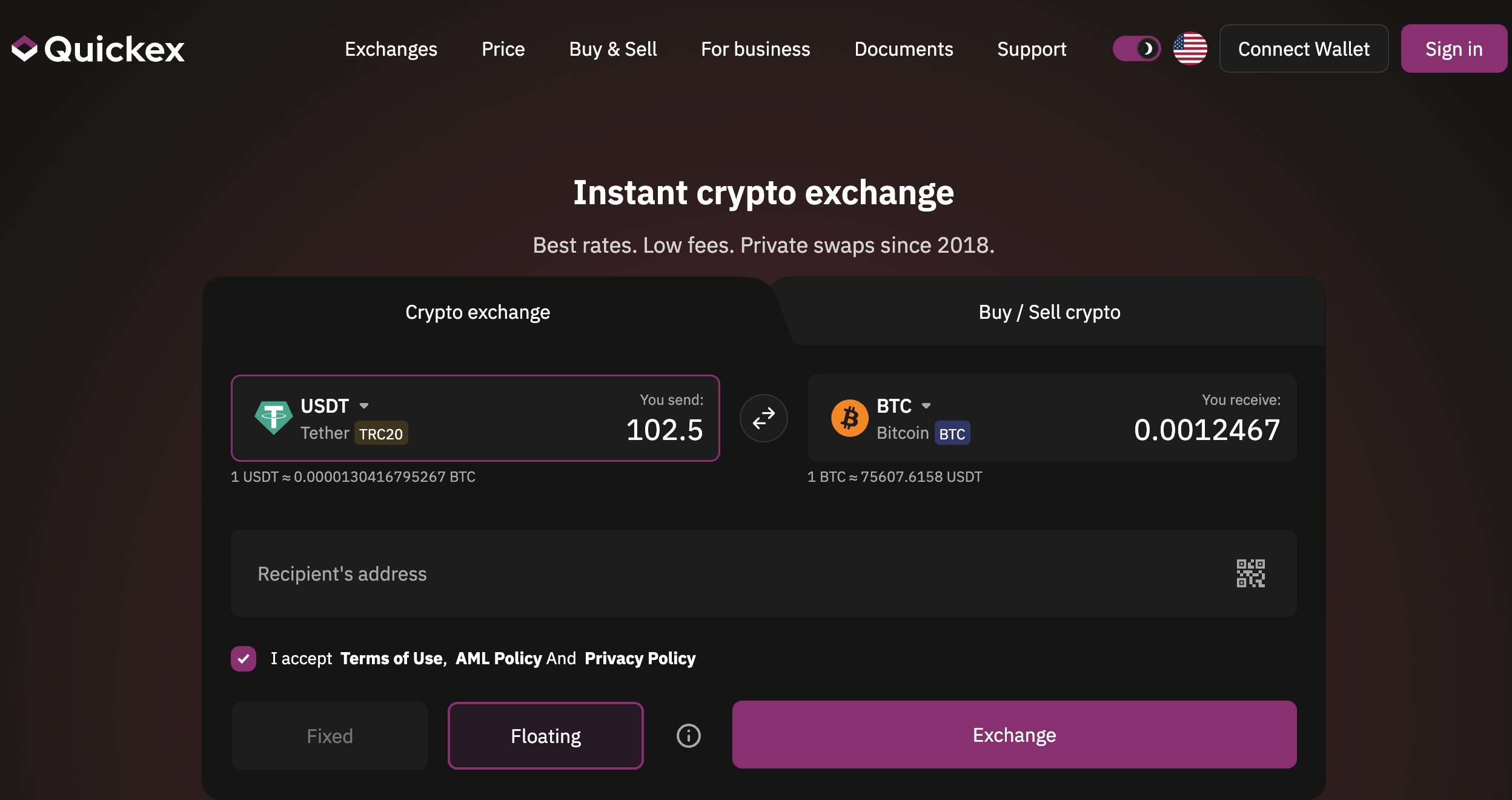
STRK is available on many major centralized exchanges and can also be swapped via instant exchanges.
If you use an instant exchange like Quickex.io, here is a safer checklist (wherever you buy):
- Prefer reputable, high-liquidity exchanges
- Don’t store long-term holdings on swap sites
- Use a trusted wallet and double-check addresses/networks
- If you’re new: start small, test withdrawals first
Frequently Asked Questions
Will STRK Reach $1 or Return to Its All-Time High?
STRK reaching $1 is plausible in a strong Ethereum-led bull market if Starknet becomes a top-tier L2 by usage and liquidity. But it likely requires multiple years of compounding adoption from February 2026 baselines (TVL, activity, users), not a single headline.
How Does Starknet Compare to Other Ethereum Layer-2s?
Starknet’s differentiation is its STARK-based validity proof stack and the Cairo ecosystem, alongside a roadmap that emphasizes high-performance execution (parallelism, block packing).
Other L2s may have stronger liquidity network effects today, so Starknet’s challenge is converting tech advantage into app dominance and retention.
What Makes Starknet’s ZK Technology Unique?
- STARK proofs: a proof system with strong cryptographic properties and efficient verification, positioned by StarkWare as scalable and based on transparent assumptions.
- Cairo for provable compute: Cairo is designed around generating proofs for computation, which is core to how Starknet scales.