
If you’re researching Terra Classic price prediction, you’re not just looking at a normal altcoin chart, you’re analyzing a “community rescue mission” with three big levers:
- supply reduction via burns
- ecosystem rebuilding via upgrades and Cosmos interoperability
- sentiment driven by exchange support and the never-ending “can it reach $1?” debate
As of March 2026, Terra Classic (LUNC) sits in an unusual place: it has a massive supply, a highly motivated community, and a technical roadmap that’s become more credible thanks to ongoing governance work and upgrades. At the same time, the math is brutal, without sustained volume and real usage, burns can feel like trying to drain an ocean with a teaspoon.
This article breaks down LUNC price prediction for 2026–2030 (and beyond) using real network data, burn mechanics, and scenario-based forecasting. This is not financial advice: think of it as a research framework you can stress-test against your own risk tolerance.
Terra Classic Market Pulse: March 2026 Status Report
Current March 2026 LUNC Performance
Source: Coinmarketcap
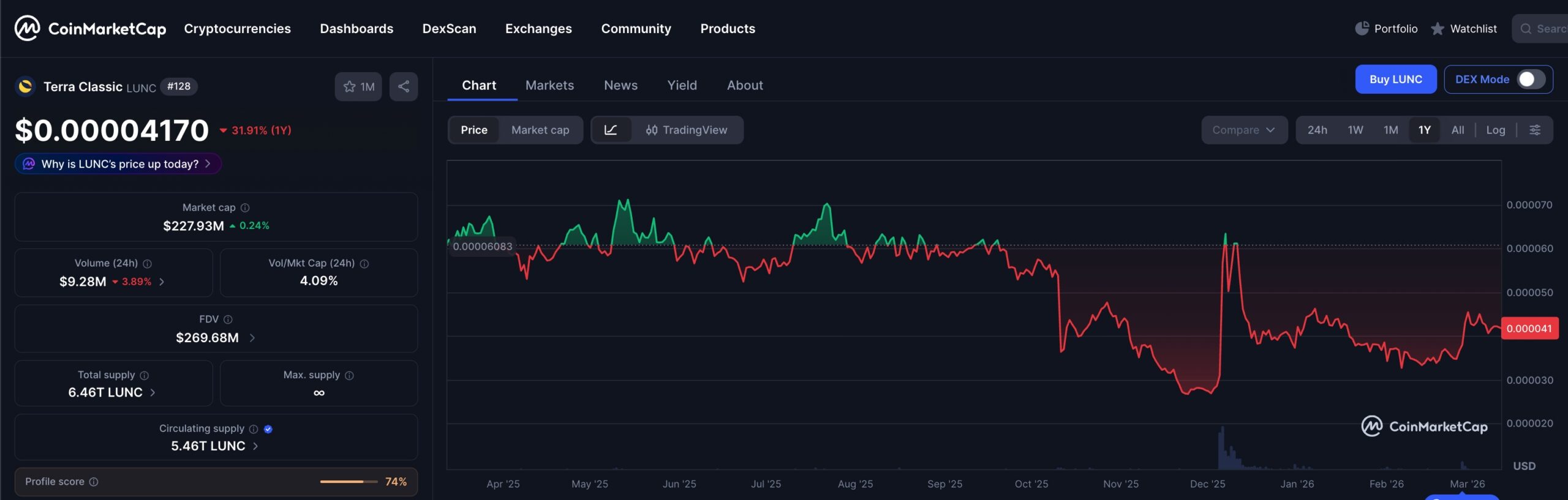
Terra Classic’s live metrics matter because LUNC prediction models are extremely sensitive to supply and liquidity.
In early March 2026, CoinMarketCap lists LUNC around the $0.00004 range with a market cap near the low hundreds of millions and circulating supply around 5.46T.
LUNCScan’s on-chain dashboard shows a similar snapshot, including a market cap around $229M and 24h volume around $9M (figures fluctuate daily).
The takeaway: LUNC is still a micro-price asset where tiny decimal moves translate into huge percentage swings, great for volatility traders, dangerous for anyone over-levered.
The 2025 Milestone: Achieving IBC Parity
When people say “IBC parity,” they usually mean: Terra Classic is becoming compatible with the wider Cosmos tooling again, bridging assets and liquidity more cleanly, and reducing the ‘island chain’ problem.
Two data points matter here:
- Upgrade cadence became more “Cosmos-native.” The v3.6.1 upgrade proposal document explicitly describes the upgrade process and timing (Dec 18, 2025) and signals continued modernization of the chain client and smart contract environment.
- Governance has been pushing toward deeper Cosmos interoperability, including an on-chain proposal aimed at moving to Cosmos SDK v0.53.x with IBC v2 (“Eureka”).
This is exactly why the Terra Classic prediction conversation shifted in late 2025: investors stopped hearing only “burns” and started hearing “infrastructure.”
Circulating Supply vs. Staked Assets and Community Pool Balance
Here’s the “health dashboard” that matters most for LUNC forecast models:
- Total supply (March 13, 2026): ~6.466T
- Circulating supply (March 13, 2026): ~5.48T
- Staking ratio: ~15.05%
- Staking pool (approx.): ~978B LUNC
- Community pool (approx.): ~7.7B LUNC
Even at ~15% staking participation, the chain’s price is still dominated by liquidity and narrative, especially Binance burn headlines and USTC re-peg speculation.
The Burn Narrative
The 0.5% Burn Tax
The burn tax is the engine behind the entire LUNC coin price prediction narrative and it has changed over time.
A core reference point is Proposal 11515, which raised the burn tax from 0.2% to 0.5%. The Terra Classic community documentation explicitly frames it as “Proposal to Increase Burn Tax (From 0.2% to 0.5%).”
Meanwhile, LUNCScan’s burn tracker summarizes the evolution: 1.2% initially (Sept 2022), reduced to 0.2%, and later increased to 0.5%, which it describes as the rate “until today.”
Burn tax is not magic. It’s a percentage of on-chain transactional flow.
A simplified model:
Daily Burn ≈ On-chain Volume (in LUNC) × Burn Tax Rate (0.5%) × Burn Allocation
So the real question for 2026 isn’t “Is the tax 0.5%?” it’s “Can Terra Classic generate enough on-chain volume to matter?” That’s why IBC compatibility, dApp activity, and exchange flows are so important. Without volume, 0.5% of “not much” is still “not much.”
Binance Support: Evaluating the Monthly Exchange Burn Contributions
Binance is still the most important single “off-chain burn” actor in the Terra Classic story.
Binance’s official announcement on its LUNC trading fee burn mechanism was updated on 2026-03-01 and includes the latest burn records. In that update, Binance lists Batch 43 as 858,230,263.95 LUNC burned (calculation period: 2026-01-31 to 2026-02-27), including the burn transaction ID.
Even more importantly, Binance reports cumulative trading fees burned (in LUNC terms) from 2022-09-21 through 2026-01-30 totaling 82,047,800,712.15 LUNC.
That number matters because it anchors the debate in hard data, not vibes: exchange burns are real, but still small versus trillions of supply, unless activity and pricing climb dramatically over many years.
Community Initiatives
Community burns come in two flavors:
- Automatic burns (burn tax on-chain)
- Manual burns (sending to burn wallet)
LUNCScan’s tracker shows 441,316,098,992 LUNC burned to date as of March 13, 2026, and also lists current total supply and circulating supply in the same snapshot.
That helps us build a “burn progress” view.
- Burned: 441.3B LUNC
- Starting supply (May 13, 2022): ~6.907T
- Burn progress: ~6.39%
Progress: 6.39%
Remaining (to burn vs. May 2022 baseline): ~93.61%
Using the burn tracker’s average burn/day ~315,225,785 LUNC, the runway looks like this:
| Burn Scenario | Approx Burn/Day | Time to Reach ~1T Total Supply* |
| Current pace | ~315M | ~47.5 years |
| 10× activity | ~3.15B | ~4.8 years |
| 100× activity | ~31.5B | ~5–6 months |
*Assumes burn rate stays constant and ignores supply dynamics from staking/unbonding and ecosystem changes. This is for intuition, not a promise.
This is why “burn narratives” alone don’t guarantee price. The network needs sustained real usage, which brings us back to IBC parity and rebuilding apps.
Terra Classic Price Prediction 2026
Q2–Q4 2026 LUNC Forecast: Price Targets Following the v3.2
Let’s address something directly: many community posts reference “v3.x governance upgrades” loosely. In practice, the upgrades that shaped the 2025–2026 narrative were the v3.5+ and v3.6.x modernization steps and the IBC-focused governance direction.
So instead of anchoring on a single label, a useful LUNC crypto price prediction for 2026 should anchor on drivers:
Base case (most likely):
- LUNC ranges with periodic spikes on burns and macro rallies.
- On-chain activity grows modestly as interoperability improves.
Bull case:
- Strong altcoin risk-on cycle + sustained exchange burns + visible progress on interoperability and USTC mechanics.
- LUNC re-rates upward, not because supply collapses overnight, but because liquidity returns.
Bear case:
- Risk-off macro + fading retail attention + on-chain volume stagnates.
- LUNC chops lower as the burn narrative loses momentum.
2026 price target range (scenario-driven):
- Min: $0.00002
- Avg: $0.00006
- Max: $0.00018
This is a practical Terra Luna Classic price prediction band for 2026 because it reflects volatility reality: LUNC can double quickly in hype waves, and it can also halve in boredom phases.
Technical Analysis: Identifying the “Floor” and Resistance
Source: Tradingview
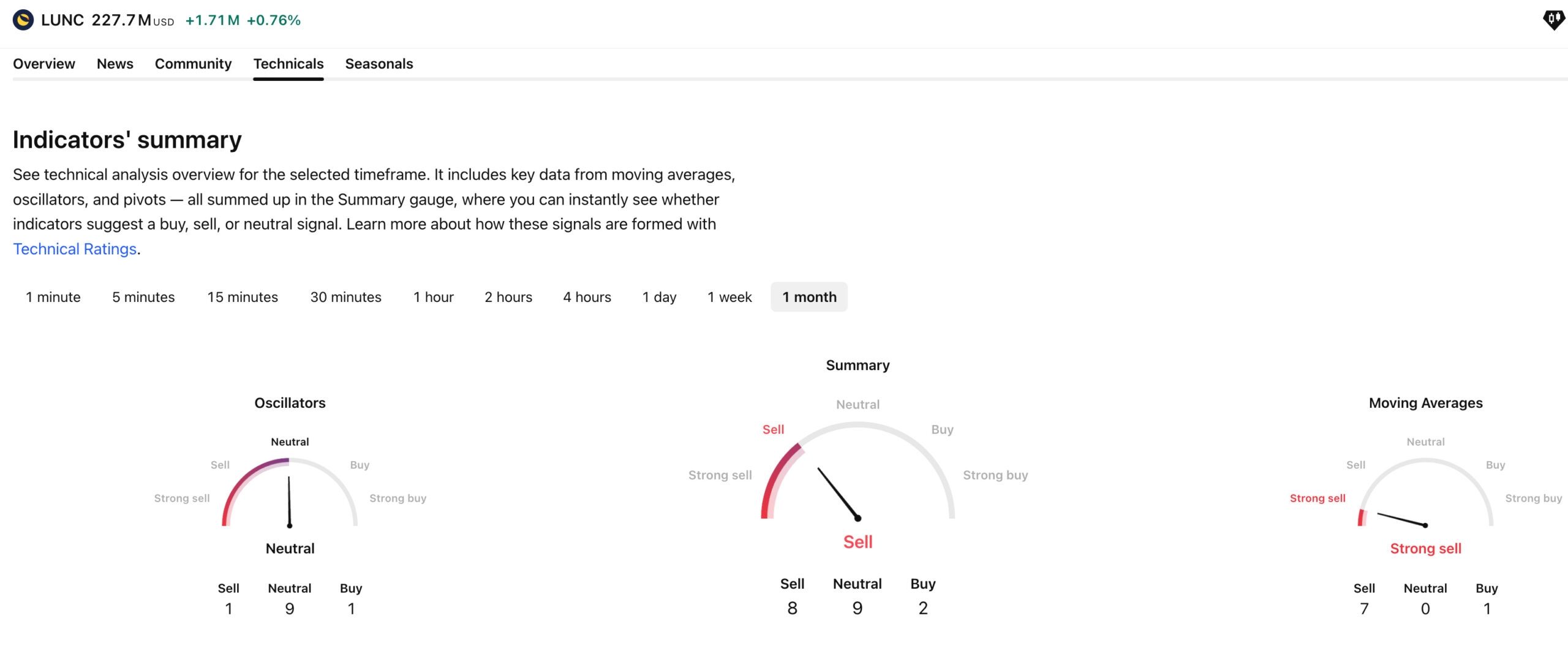
In March 2026, LUNC has been trading in a tight range around the low $0.00004s with nearby support/resistance zones noted by market trackers.
Here’s a clean way to think about levels:
- Near-term support: the “high $0.00003” zone (where buyers repeatedly defend)
- Near-term resistance: the “mid $0.00004” zone (where sellers repeatedly cap)
- Macro resistance: $0.0001 (psychological + historical interest)
- Ultra-macro resistance: $0.0005 (a level that would likely require a full altcoin bull cycle + major fundamental catalysts)
That $0.0005 number matters for forecasts because it’s the kind of level that often becomes a “magnet” in euphoric cycles, but only after the market proves the chain has lasting demand.
The USTC Re-peg Factor
USTC is the shadow hanging over every LUNC crypto prediction.
If USTC recovery efforts (partial re-peg, market module changes, or controlled mechanisms) create real on-chain demand, LUNC benefits in two ways:
- more activity → more burn tax → more scarcity pressure
- higher confidence → higher liquidity and valuation
But the risk is equally real: stablecoin narratives can produce huge hype swings that later unwind. When you’re building a Terra Classic prognose, assume USTC headlines will amplify volatility: up and down.
Terra Classic Price Prediction 2027–2029
2027 Outlook: The Return of Utility DApps and Terra Station Improvements
A realistic LUNC prediction for 2027 depends less on “one big burn” and more on whether builders stick around.
If Cosmos interoperability improves and governance continues funding development (without draining the community pool irresponsibly), 2027 can become a “utility rebuild year.”
2027 targets (scenario band):
- Min: $0.000015
- Avg: $0.00008
- Max: $0.00030
2028 Prediction: Bitcoin’s Next Halving
Crypto cycles matter. In many historical patterns, the year after a Bitcoin halving tends to favor broader altcoin rotation, especially high-beta assets with strong communities.
If that repeats, LUNC coin price prediction models for 2028 can justify a higher upside ceiling, but only if Terra Classic’s on-chain activity grows.
2028 targets:
- Min: $0.000025
- Avg: $0.00012
- Max: $0.00060
2029 Vision: Can LUNC Re-establish Itself in the Cosmos Ecosystem?
2029 is where the “IBC parity” bet either pays off… or fades.
If Terra Classic becomes meaningfully integrated with Cosmos liquidity venues and can host a handful of sticky apps, LUNC may graduate from “burn meme” to “surviving legacy chain.”
2029 targets:
- Min: $0.00003
- Avg: $0.00016
- Max: $0.00075
Terra Classic Price Prediction 2030–2035
Can LUNC Hit $0.01 or $1? The Mathematical Reality
This is the #1 question in Terra Classic price prediction 2030 searches, and it deserves a clear answer: supply is the boss.
LUNCScan shows circulating supply around 5.48T in March 2026.
So if LUNC were $1 today, market cap would be roughly $5.48 trillion; larger than most realistic crypto market scenarios. That’s why $1 is usually discussed as a post-major-supply-reduction dream, not a near-term plan.
Market cap required at different supply levels
| Supply Level | Market Cap at $0.01 | Market Cap at $1 |
| 5.48T | $54.8B | $5.48T |
| 1T | $10B | $1T |
| 100B | $1B | $100B |
| 10B | $100M | $10B |
| 1B | $10M | $1B |
This table is why most serious analysts say: $0.01 is mathematically possible only if supply drops dramatically or demand explodes into a top-tier narrative. And $1 requires an even more extreme combination.
So for Luna Classic price prediction discussions, a better approach is: pick a plausible future market cap range, estimate plausible supply range, then compute price, not the other way around.
The Role of the “Tax Split”
Here’s the tricky part: burning helps scarcity, but development funding helps survival.
The original economic policy discussions around burn tax framed it as an incentive-alignment tool.
By 2026, the community is still debating how to balance “burn more” vs “build more,” including ongoing discussions around tax splits and funding mechanisms (you can see these governance threads continuing into 2026).
If Terra Classic underfunds builders, the chain risks becoming a hollow meme. If it overfunds development without accountability, it risks trust erosion. The “right” answer is somewhere in the middle and it will shape any LUNC price prediction 2040 or LUNC price prediction 2050 style long-range view.
2035 Long-Term Terra Classic Forecast
For long-term forecasts, it’s better to speak in scenarios than certainties.
2035 targets (highly speculative):
- Min: $0.00005
- Avg: $0.0010
- Max: $0.01
That upper bound assumes: major supply reduction + durable ecosystem + at least one “killer” use case that generates sustained volume. Without those, long-range upside compresses.
If you’re looking for a Luna Classic price prediction 2035, treat it like venture capital probability: high upside, non-trivial chance of disappointment.
Terra Classic Price Prediction Table
Below is a scenario-based Terra Classic price prediction table designed for realism, not hype. It’s a structured LUNC crypto price prediction framework you can update as supply, burns, and usage change.
| Year | Min | Avg | Max |
| 2026 | $0.00002 | $0.00006 | $0.00018 |
| 2027 | $0.000015 | $0.00008 | $0.00030 |
| 2028 | $0.000025 | $0.00012 | $0.00060 |
| 2029 | $0.00003 | $0.00016 | $0.00075 |
| 2030 | $0.00002 | $0.00025 | $0.00150 |
| 2035 | $0.00005 | $0.00100 | $0.01000 |
This table aligns with the reality that LUNC price prediction 2030 outcomes depend on burn effectiveness, IBC-driven utility, and macro cycles, not just community optimism.
Who is Leading the LUNC Development?
Genuine Labs and the L1 Joint Task Force
The chain’s credibility depends on organized development, not just memes.
The “Joint L1 Task Force” thread on the Terra Research Forum shows concrete budgeting and an explicit goal of training developers on Cosmos SDK internals to strengthen long-term L1 maintenance capacity.
That kind of operational detail is what separates “community chain” from “abandoned fork.”
Are Real-World Businesses Using the Classic Chain?
Terra Classic’s enterprise narrative is weaker than top L1s, but payments tooling and integrations still matter. If LUNC becomes easy to move cross-chain (IBC) and easy to spend through payment rails, it can keep a niche alive.
This is less about Fortune 500 adoption and more about practical usability: wallet UX, exchanges, and stable transfer reliability.
How a Leaderless Community Manages a Global Network
One of the most important “trust shifts” happened when Terraform Labs began winding down. Terra’s official site notes Terraform Labs is winding down as of September 30, 2024.
That pushes responsibility and credit onto validators and community governance. It also means future controversies can’t be “blamed on TFL.” The chain either proves it can self-govern, or it doesn’t.
Competitive Landscape: LUNC vs. The “New” LUNA
Terra Classic vs. Terra (LUNA 2.0): Comparing Ecosystem Adoption
Terra’s split created two separate bets:
- LUNC: recovery + burns + legacy infrastructure
- LUNA (2.0): new chain narrative + new app ecosystem
Institutional research summaries from the post-collapse period explain the fork and the rebranding of the original chain as Terra Classic. Read more on What is Wrapped Terra.
LUNC vs. PEPE and SHIB
Memecoins compete for attention, not fundamentals. LUNC is a hybrid: it has meme energy and a functioning governance chain. That’s an advantage, but only if the chain stays alive technically and economically.
LUNC’s Established Infrastructure Gives It an Edge Over New Memecoins
New memes can pump faster. LUNC can survive longer if:
- it remains interoperable (Cosmos upgrades)
- burns remain transparent
- governance funds real work
Is Terra Classic (LUNC) a Good Investment in 2026?
The Bull Case: Deflationary Momentum
The bullish thesis for 2026 is simple:
- Burn tax is in place (0.5%)
- Exchange burns are documented with on-chain transaction IDs (Binance batch reporting)
- Interoperability roadmap is active (Cosmos SDK / IBC proposals)
If crypto goes risk-on, LUNC can ride the “revival” narrative hard.
The Bear Case: Regulatory Uncertainty and Technology Shifts
The bearish thesis:
- supply is still huge
- volume may not grow enough to make burns meaningful
- attention can rotate away quickly
- regulatory or exchange policy shifts can reduce liquidity
Where to Buy and Exchange LUNC?
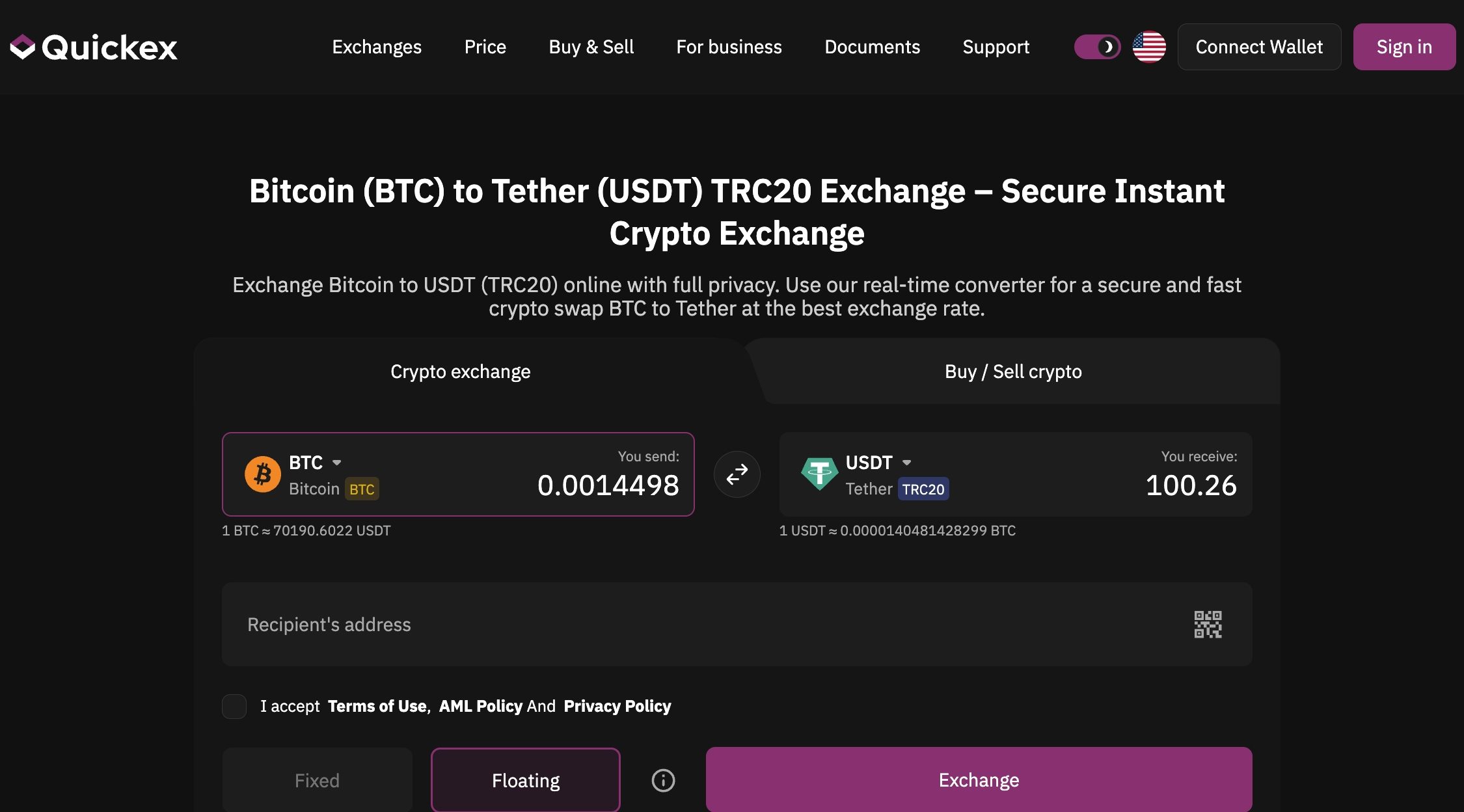
If you want a quick swap route, Quickex is a centralized exchange with no registration and “no KYC” in the basic flow, while still applying risk-based AML checks that can trigger verification in certain cases.
How it works (simple flow):
- Choose the coin you send and the coin you receive, like BTC to USDT
- Enter your receiving wallet address
- Send funds to the provided address
- Receive swapped coins after confirmations
FAQ: Critical Questions for the LUNC Community
When will LUNC reach 1 cent?
A one-cent LUNC depends on two variables: market cap and supply. With ~5.48T supply, $0.01 implies ~$54.8B market cap, possible only under a major bull cycle and/or massive supply reduction.
Is Terraform Labs still involved with Terra Classic?
Terraform Labs has been winding down (as of Sept 30, 2024), which reinforces that Terra Classic is now effectively community-driven.
How do I participate in LUNC governance voting?
You generally participate through Terra Classic governance interfaces/wallet tooling, staking to validators, and voting on proposals. Governance documentation for Terra-based systems is rooted in Cosmos SDK governance patterns.
What is the best wallet for staking LUNC in 2026?
Most users stake through Terra ecosystem wallets that support Terra Classic, or via supported interfaces linked by explorers and community tooling. Always verify you’re on Terra Classic (LUNC) and use hardware wallet support where possible.
Disclaimer: The material in this article is not financial or investment advice. Everything stated here reflects the author's personal view and should not be treated as a recommendation to trade or invest. We make no warranties regarding the accuracy, reliability or completeness of the information presented. Cryptocurrency markets are highly volatile and can move unpredictably. Before committing any funds, every investor, trader or crypto user should study several independent sources and check the regulations that apply in their own jurisdiction.