
Tron (TRX) is one of crypto’s most misunderstood “blue chips.” It rarely gets the same mainstream excitement as Ethereum or Solana: yet it quietly processes massive stablecoin flows, runs at high throughput with low fees, and ranks among the most active networks by daily transactions and addresses. In 2026, Tron’s story is less about hype and more about infrastructure: it’s the settlement rail many users already rely on, especially for USDT.
That creates a unique setup for any Tron price prediction. TRX doesn’t need a “new narrative” to be useful, its sTrongest narrative is that it’s already being used. But price doesn’t move on utility alone. TRX still trades with the broader market cycle, and it carries baggage: delegated PoS centralization criticisms, Justin Sun controversies, and regulatory uncertainty.
This guide gives you a grounded Tron price predictions framework for 2026–2030 using February 2026 live market data, on-chain metrics (stablecoin market cap, active addresses, transactions, DEX volume), and technical analysis and scenario modeling (bear/base/bull). You’ll also get a year-by-year forecast table and long-term outlook to 2050.
Not financial advice. Crypto is volatile, and forecasts are scenarios, not promises.
What Is Tron (TRX)?
Tron is a blockchain that was first made to help people share content and entertainment without an authority. Over time it changed into a system that can handle a lot of transactions quickly which’s useful for stablecoins, DeFi and dApps. The Tron blockchain has its token called TRX. People use TRX to pay for things like bandwidth and energy on the Tron blockchain to stake and to help make decisions, about how Tron should work.
Origins: Justin Sun, Decentralized Entertainment, and Delegated Proof-of-Stake
Tron was started by Justin Sun. This is a thing about Tron: it uses a special system called delegated proof-of-stake.
In Trons delegated proof-of-stake system, people who have Trons money called TRX get to vote for some people called Super Representatives. There are 27 of these Super Representatives. They are in charge of making sure everything runs smoothly. That transactions are valid.
The people who made Tron wanted to make sure it worked well and that it was cheap to use.
You can learn more about how Trons delegated proof-of-stake system works and what these 27 Super Representatives do on CoinMarketCap Academy. They have information, about Trons delegated proof-of-stake approach and the Super Representatives.
Kraken’s educational overview also highlights the rotating set of 27 super representatives and the governance model where representatives are chosen on a schedule.
This governance model is one reason Tron can be fast and cheap, but it’s also one reason critics argue Tron is more centralized than some other major networks (we’ll cover that in the risk section). Here is How to Send Tron Securely and Easily.
Key Technology: High TPS, Low Fees, and Sharding Potential
Tron’s “feel” for users is simple: transfers are fast and usually cheap. That experience is a big reason it became a stablecoin rail.
From an architecture standpoint, Tron’s DPoS block production is the main throughput lever: fewer block producers means faster coordination and higher transaction capacity. Educational resources describing Tron emphasize high performance and low-cost transactions as core design goals.
On “sharding potential”: Tron has historically discussed scaling via network optimizations, resource models (bandwidth/energy), and upgrades, but it’s best to treat sharding as a future scaling option rather than a guaranteed roadmap deliverable. The market tends to reward what’s already visible: real usage and stable fee conditions.
Real-World Use Cases
Tron’s most important real-world use case in 2026 is stablecoin settlement, especially USDT on Tron.
DeFiLlama’s Tron chain dashboard shows:
- Stablecoins market cap: about $85.7B on Tron
- USDT dominance: roughly 98.37% of stablecoins on Tron
- Active addresses (24h): ~3.6M
- Transactions (24h): ~11.7M
DeFiLlama’s dedicated stablecoins page for Tron shows a similar figure (~$85.8B stablecoins on Tron) and USDT dominance ~98.39%.
That’s a huge statement: Tron isn’t just hosting stablecoins; it’s hosting them in a way that’s overwhelmingly USDT-driven. If you’re building a Tron future price prediction, you can’t ignore that TRX price is indirectly tied to the health of those rails, because more stablecoin usage tends to correlate with more transactions, more fees, and sTronger network stickiness (even if users don’t “buy TRX because USDT is popular”).
Beyond stablecoins, Tron supports:
- DeFi protocols (lending, DEXs, yield platforms)
- dApps (games, wallets, payments)
- cross-chain flows through bridges and centralized exchange integrations
But in 2026, the “killer app” remains stablecoin settlement volume.
Tron Price History and Key Milestones
Tron’s chart story looks like many long-lived L1s: early ICO hype, multi-cycle booms and busts, and renewed utility-driven stability.
From 2017 ICO to All-Time High and Bear Market Cycles
Tron began in the 2017 era and has lived through multiple bear markets. By late 2024, TRX hit a new multi-year peak.
CoinMarketCap lists TRX’s all-time high as $0.4407 on Dec 03, 2024, and shows it trading roughly ~36% below that peak in early February 2026.
CoinGecko reports a similar ATH magnitude (around $0.4313) and notes current trading below that peak.
In other words: TRX’s “ATH ceiling” is under $0.50, unlike many large caps whose ATHs are multiples higher. That matters for TRX price prediction modeling: reaching $1 would be more than a 2x above ATH, which would require a materially sTronger market regime or an “infrastructure repricing” thesis.
Major Events: Acquisitions (BitTorrent), Partnerships, and Network Upgrades
One of Tron’s biggest historical milestones was the BitTorrent acquisition, which expanded Tron’s narrative beyond “entertainment chain” into broader internet infrastructure.
- Variety reported in 2018 that BitTorrent was sold to Justin Sun, best known for Tron and TRX.
- CoinDesk covered the acquisition announcement, reporting that Tron acquired BitTorrent for $140 million, which coincided with TRX price gains at the time.
- Decrypt later discussed the acquisition details and referenced the purchase amount being adjusted into the ~$140M range.
On upgrades: Tron continues to iterate on fees and network parameters. For example, a Tron Improvement Proposal discussion on GitHub references the motivation to reduce transaction fees as TRX price rises, acknowledging the tension between security/stability and affordability.
There has also been public coverage (including non-primary sources) of fee reduction initiatives in 2025, which aligns with the ongoing “keep fees low” priority.
Tron Current Price and Market Overview
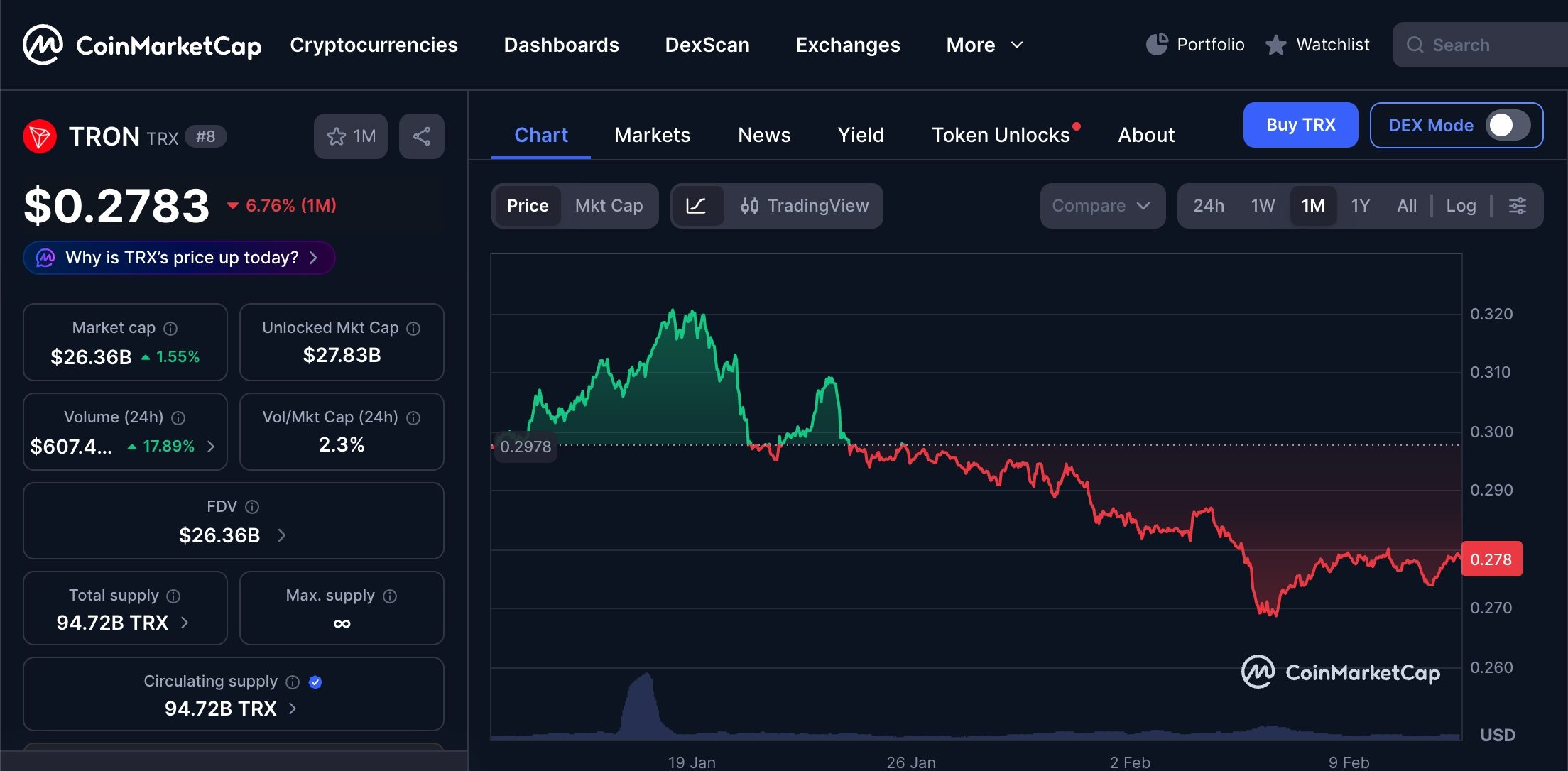
Source: Coinmarketcap
To make this forecast practical, we anchor to early February 2026 market data.
Live TRX Price, Market Cap, and Trading Volume
CoinMarketCap’s TRX page shows:
- Market cap: about $26.3B
- 24h volume: about $606M
- Circulating/total supply: about 94.72B TRX
CoinMarketCap’s historical snapshot for Feb 2, 2026 lists TRX at $0.2831 with market cap $26.82B and 24h volume ~$924M.
CoinMarketCap’s historical data shows TRX closing around $0.274 on Feb 6, 2026 with volume ~$1.15B and market cap ~$25.95B.
So for “February 2026” baseline, it’s fair to say TRX is trading roughly $0.27–$0.29, with a market cap around $26B and daily volume that can swing from ~$600M to $1B+ depending on the day.
That baseline anchors every Tron TRX price prediction scenario below.
On-Chain Metrics: TVL, Stablecoin Transfers, and Active Addresses
On-chain metrics are where Tron looks unusually sTrong relative to its social hype.
DeFiLlama’s Tron chain dashboard reports (24h/7d type metrics):
- Stablecoins market cap: ~$85.7B
- USDT dominance: ~98.37%
- DEX volume (24h): ~$70M
- Active addresses (24h): ~3.6M
- Transactions (24h): ~11.7M
For “TVL” specifically, DeFiLlama tracks TVL under its chain dashboards (and related DeFi protocol listings). Tron’s importance is not just TVL: it’s stablecoin settlement and transactions. Still, TVL matters because it reflects DeFi stickiness and capital formation.
And the stablecoin dominance data is extremely load-bearing for any Tron crypto price prediction. DeFiLlama’s Tron stablecoins page shows ~$85.8B stablecoins and USDT dominance ~98.39%.
Yahoo Finance coverage also highlighted that USDT accounts for over 98% of stablecoin volume on Tron, reinforcing that this isn’t a small edge, it’s the core of the ecosystem’s real-world usage.
Recent Sentiment and Fear & Greed Index
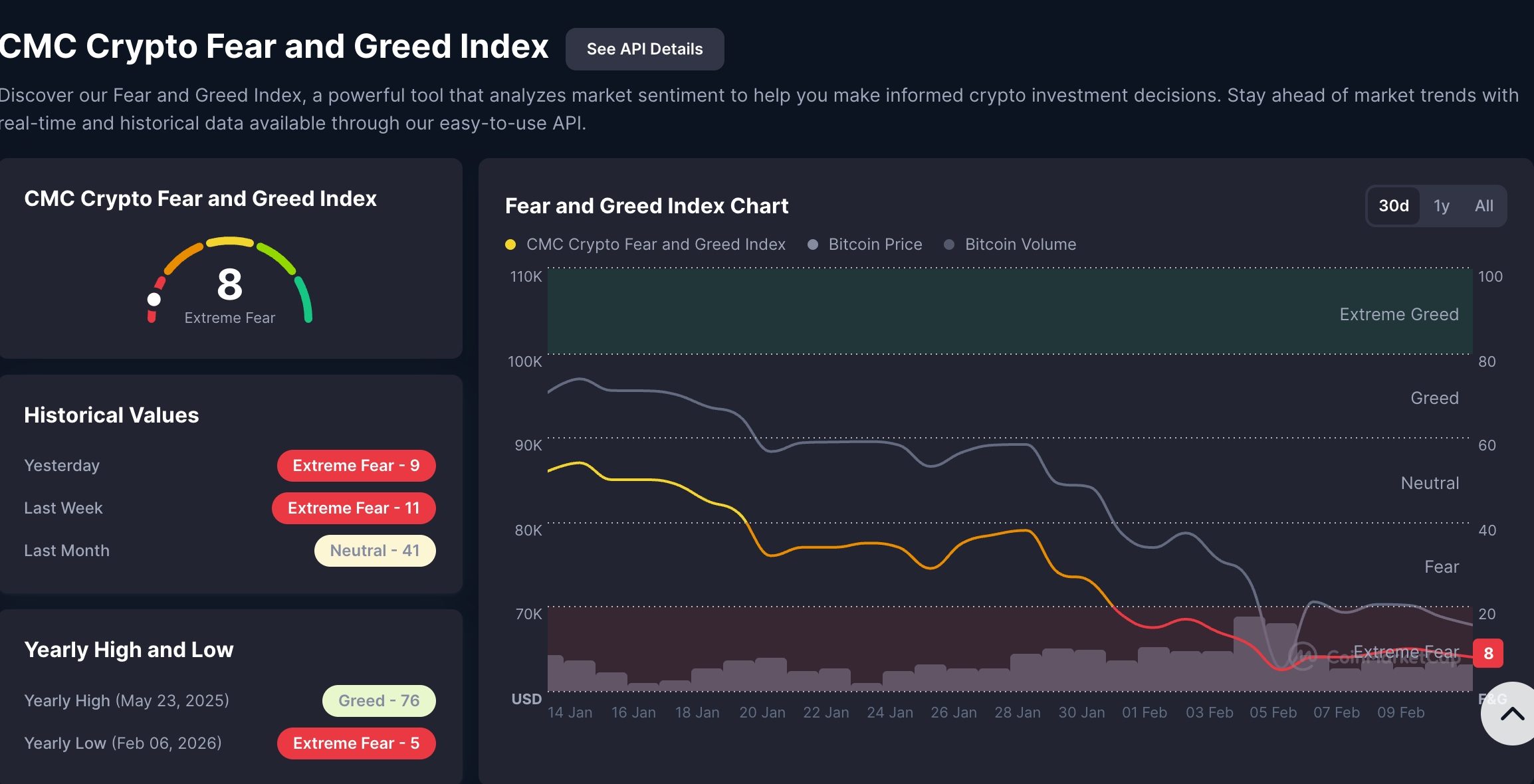
Source: Coinmarketcap
Crypto sentiment in early February 2026 is still bruised.
Glassnode’s Fear & Greed chart shows a value around 8 (Extreme Fear) as of Feb 12, 2026.
When sentiment is this low, assets with steady utility (like Tron) can still hold up better than pure hype coins, but they’re not immune. Fear regimes typically compress valuations across the board.
Tron (TRX) Short-Term Price Prediction 2026
Short-term forecasts should be ranges. TRX is liquid and large-cap, but it can still move sharply when the market shifts.
TRX Price Forecast for Q1–Q2 2026
With TRX around $0.27–$0.29 in early February 2026, here are realistic scenarios for the first half of 2026:
Bear case (risk-off persists): $0.20–$0.27
- Market stays in Extreme Fear longer than expected
- Liquidity remains defensive
- TRX drifts toward prior support zones
Base case (stabilization): $0.26–$0.35
- TRX holds its “rail token” premium
- Stablecoin flows stay sTrong (USDT dominance remains high)
- Broader market stops bleeding
Bull case (relief rally + rotation into large-cap L1s): $0.35–$0.45
- STronger crypto rebound (Bitcoin price stabilizes, alt liquidity returns)
- TRX tests the 2024 ATH zone (~$0.44)
Q3–Q4 2026 Outlook and Near-Term Drivers
The second half of 2026 comes down to three near-term drivers:
- Stablecoin rail expansion
If Tron continues to hold ~$85B+ stablecoins and USDT dominance remains near ~98%, usage is likely to remain sticky. - Fee policy and network parameter changes
Tron’s ecosystem has active governance/proposal discussions about transaction fees and network sustainability. - Macro and market cycle
TRX is still correlated with broader crypto risk appetite (especially Bitcoin’s direction).
Q3–Q4 2026 scenario ranges:
- Bear: $0.18–$0.26
- Base: $0.26–$0.38
- Bull: $0.38–$0.55
In the bull case, $0.50+ requires not only a market rebound, but also a “repricing” moment where investors reward Tron’s stablecoin dominance as a durable moat.
Tron Price Prediction 2026–2030 Table
Below is the year-by-year table for Tron forecast scenarios. These are ranges, not single-price promises.
| Year | Bear Case | Base Case | Bull Case | What Must Be True |
| 2026 | $0.18–$0.26 | $0.26–$0.38 | $0.38–$0.55 | Macro stabilizes; Tron keeps stablecoin dominance ~$85B+ on-chain |
| 2027 | $0.20–$0.32 | $0.32–$0.55 | $0.55–$0.85 | Risk-on cycle returns; TRX re-rates as “stablecoin infra” |
| 2028 | $0.22–$0.40 | $0.45–$0.80 | $0.80–$1.20 | STrong bull market; TRX breaks ATH convincingly |
| 2029 | $0.25–$0.45 | $0.55–$0.95 | $0.95–$1.60 | Continued rail dominance + real DeFi growth, not just transfers |
| 2030 | $0.30–$0.55 | $0.70–$1.20 | $1.20–$2.50 | Multi-cycle adoption; stablecoins + apps + broader crypto expansion |
Now let’s break down each year.
Tron Price Prediction 2026
For 2026, the core question is whether TRX can defend its 2024 ATH zone while the market is fearful.
- Bear: $0.18–$0.26
- Base: $0.26–$0.38
- Bull: $0.38–$0.55
The base case is supported by Tron’s massive stablecoin presence (~$85B+ stablecoins, ~98% USDT dominance) and extremely high daily activity metrics.
Tron Price Prediction 2027
In 2027, the path diverges based on whether crypto enters a true risk-on expansion.
- Bear: $0.20–$0.32
- Base: $0.32–$0.55
- Bull: $0.55–$0.85
A bull case requires:
- sustained investor preference for “cashflow/usage” chains, and
- a narrative shift where Tron’s stablecoin dominance becomes institutionally respected, not just “retail settlement.”
Tron Price Prediction 2028
This is where the “Will TRX reach $1?” conversation intensifies.
- Bear: $0.22–$0.40
- Base: $0.45–$0.80
- Bull: $0.80–$1.20
To put it plainly: $1 is not impossible, but it would represent a clean break above the 2024 ATH (~$0.44).
That kind of break typically happens in a broad bull market when investors are willing to pay for future expectations, not just current usage.
Tron Price Prediction 2029
By 2029, “rail dominance” alone might not be enough for premium valuations. Investors may demand proof that Tron also wins in:
- DeFi capital formation (TVL growth)
- app revenue
- sustained ecosystem innovation
- Bear: $0.25–$0.45
- Base: $0.55–$0.95
- Bull: $0.95–$1.60
In the bull scenario, Tron retains stablecoin dominance while also improving DeFi metrics and DEX activity; DeFiLlama’s Tron dashboard makes it easy to monitor those categories.
Tron Price Prediction 2030
Here’s the Tron price prediction 2030 and TRX price prediction 2030.
- Bear: $0.30–$0.55
- Base: $0.70–$1.20
- Bull: $1.20–$2.50
The bull case assumes a multi-cycle expansion of crypto usage and stablecoin payments globally, and Tron continues to be a preferred settlement rail, keeping USDT dominance very high or near-high.
Long-Term Tron Forecast 2030–2050
Long-term Tron price prediction 2040, Tron prediction 2040, and Tron price prediction 2050 should be framed as conditional outcomes, not single-point targets.
- If stablecoins keep growing and Tron remains a top rail:
TRX could trade in a structurally higher band because network usage stays durable (transactions, fees, and ecosystem lock-in). Tron’s on-chain activity metrics (millions of daily active addresses and ~11M+ daily transactions) are the kind of base that can support long-lived relevance. - If regulation or competition erodes Tron’s stablecoin dominance:
TRX may remain relevant but see valuation compression, especially if stablecoin flows migrate to Ethereum L2s or other fast L1s.
A balanced long-range range view:
- 2040: Bear $0.30–$0.80 | Base $0.80–$2.00 | Bull $2.00–$5.00
- 2050: Bear $0.40–$1.00 | Base $1.00–$3.00 | Bull $3.00–$8.00
These “bull” outcomes assume crypto becomes mainstream financial plumbing, and Tron remains a meaningful chunk of that plumbing. This is our Tron prognose in plain English: possible, but dependent on macro adoption and competitive outcomes.
Technical Analysis: Key Indicators for TRX
Technical analysis is most useful for TRX as a risk management layer. It won’t replace fundamentals like stablecoin dominance, but it helps with entries, exits, and recognizing regime shifts.
Moving Averages, RSI, and Oscillators
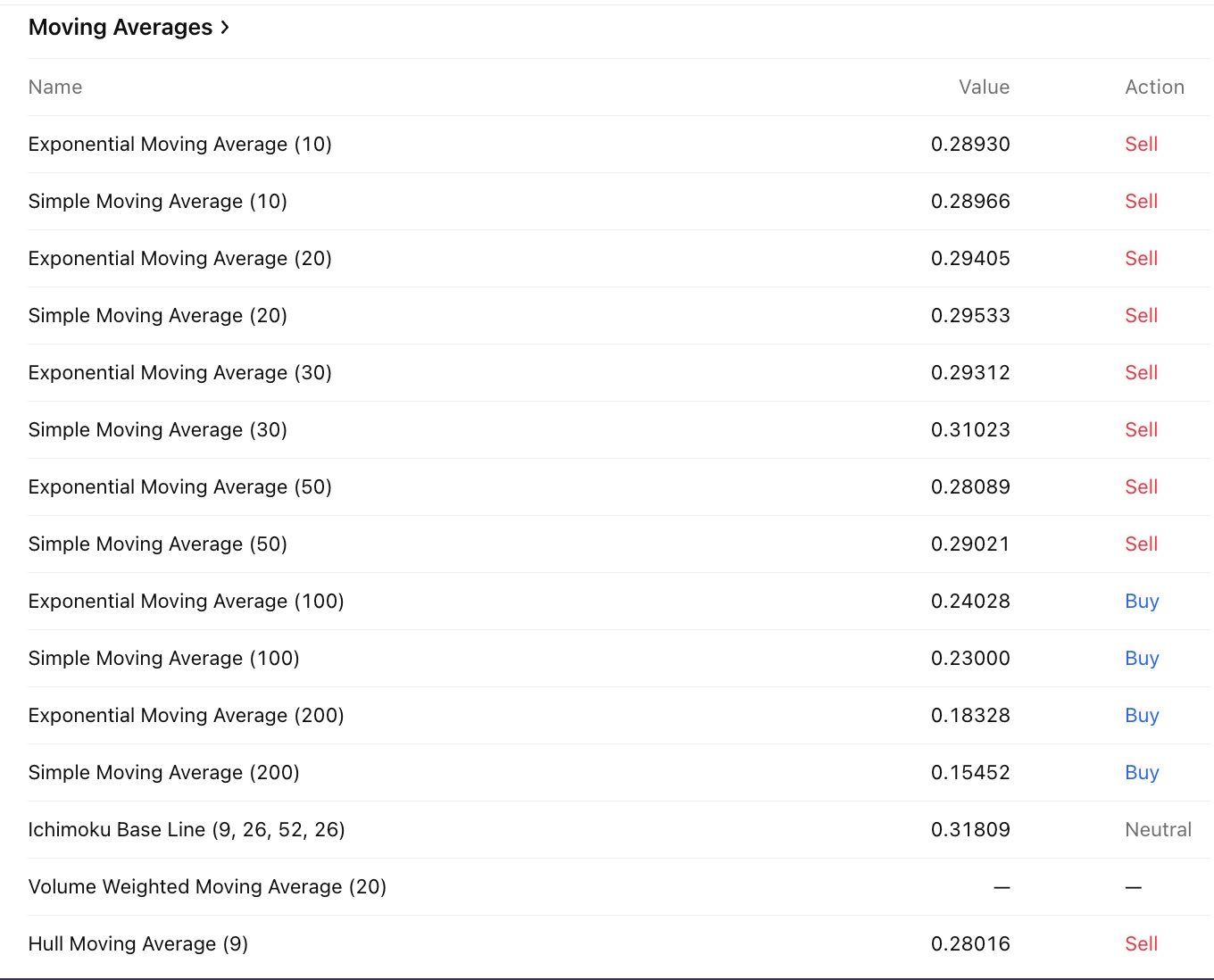
Source: TradingView
For TRX, focus on:
- 200-day moving average (200D MA): long-term trend filter
- 50-day MA: medium-term momentum and breakouts/breakdowns
- RSI: identifies oversold/overbought conditions (especially useful during fear regimes)
- MACD / momentum oscillators: helps confirm trend changes
In Extreme Fear environments (Fear & Greed ~9), oversold conditions can persist.
So combine RSI with volume confirmation and higher-low structures.
Support/Resistance Levels and Chart Patterns
Using early February 2026 prices (~$0.27–$0.29) as the pivot:
Support zones (watch levels)
- $0.26–$0.27: near-term support band (recent closes)
- $0.20–$0.22: deeper support if risk-off intensifies
- $0.15–$0.18: “capitulation zone” in a severe market drawdown
Resistance zones
- $0.32–$0.35: first recovery gate
- $0.38–$0.45: ATH region (Dec 2024 peak ~ $0.4407)
- $0.50: major psychological round number (break = narrative shift)
Patterns to watch
- Range compression → breakout (good signal if accompanied by volume)
- Breakout → retest → continuation (often safer than chasing the first move)
- Failed breakout in fear regimes (common trap)
On-Chain Signals: Transaction Volume and Network Activity
TRX is a rare case where “on-chain basics” are extremely sTrong and visible.
DeFiLlama reports:
- Transactions (24h): ~11.7M
- Active addresses (24h): ~3.6M
- DEX volume (24h): ~70M
If those numbers stay resilient while price consolidates, it often suggests the chain’s utility is intact, even if markets are scared. If those metrics trend down materially, it’s a warning sign that the “rail dominance” story is weakening.
Bullish Factors That Could Drive Tron Price Higher
Dominance in Stablecoin Transfers (USDT on Tron)
This is the most important bullish factor, period.
DeFiLlama shows Tron hosting roughly $85.8B stablecoins with USDT dominance ~98.39%.
That’s not a “nice stat.” It’s a moat. It means Tron is one of the world’s most-used digital dollar settlement networks.
If stablecoin adoption keeps growing globally, and Tron keeps a meaningful share of that growth, TRX has a sTrong fundamental “relevance floor” compared to L1s whose usage depends mainly on speculation.
DeFi and dApp Growth, Partnerships, and Justin Sun Influence
Tron’s dApp and DeFi growth can reinforce the stablecoin rail narrative by adding more reasons to stay on-chain.
There’s also the “Justin Sun factor”: whether you love him or hate him, he’s historically been a powerful attention and partnership catalyst. Attention can attract liquidity and builders, especially in crypto where narratives matter.
On the network side, active governance and proposals around fees show ongoing ecosystem tuning, which can keep Tron competitive as usage scales.
Broader Market Cycles and Bitcoin/Ethereum Correlation
TRX still moves with broader market cycles. Even a utility-heavy chain re-rates upward in bull markets because investors price in future growth and risk appetite expands.
So a higher TRX forecast often requires:
- Bitcoin stability or growth
- improved sentiment (Fear & Greed rising out of Extreme Fear)
- rotation into large-cap L1s
Risks and Bearish Scenarios for TRX
Centralization Concerns and Delegated PoS Criticisms
DPoS is efficient, but it invites centralization criticism.
Tron relies on 27 super representatives elected by TRX holders.
Critics argue that concentrated influence (large holders, SR relationships) can reduce censorship resistance compared to more decentralized validator sets.
That doesn’t automatically break the network, but it can:
- reduce institutional comfort
- increase regulatory attention risk
- create governance fragility if politics around SRs intensify
Regulatory Risks, Justin Sun Controversies, and Competition
Regulatory risk is a constant for all major chains, and Tron’s stablecoin dominance could become a double-edged sword: it makes Tron important, but also makes it visible.
Competition is also real:
- Ethereum L2s keep improving
- Solana price keeps pushing performance and consumer apps
- other L1s compete for stablecoin settlement flows
If a competitor offers similar cost + better trust perception, stablecoin issuers and exchanges may shift over time. That’s a slow risk, but it matters for Tron crypto prediction and Tron coin prediction long-term.
Market Volatility and Macroeconomic Factors
TRX is still a crypto asset. In macro risk-off periods, correlations rise and even sTrong networks can drop.
Also, if global liquidity tightens (rates, risk aversion), speculative capital tends to exit alts first. That’s why bear-case outcomes remain plausible even for networks with real usage.
Is Tron (TRX) a Good Investment in 2026?
It depends on your goals. If you’re looking for a memecoin-style moonshot, TRX probably isn’t that. If you’re looking for a large-cap network token with proven usage and deep stablecoin relevance, TRX is one of the sTrongest candidates.
Bull Case: Path to $0.50–$1 with Mass Adoption
The bull case for TRX price prediction in 2026–2030 is essentially:
- Stablecoins keep expanding globally
- Tron keeps a major share of USDT settlement
- Market shifts risk-on again
- TRX breaks ATH (~$0.44) and re-rates upward
That’s how you get to the “$0.50–$1” pathway over time.
Bear Case: Stagnation Below $0.20
The bear case is not “Tron dies.” It’s “markets don’t reward it.”
That happens if:
- macro stays weak for longer
- regulatory pressure increases
- stablecoin flows gradually shift elsewhere
- or centralization critiques dampen long-term investor demand
In that scenario, TRX could stagnate under $0.20 or grind sideways for long periods.
Our Prediction Methodology
This Tron price prediction model blends:
- Live market baseline (Feb 2026): TRX price (~$0.27–$0.29), market cap (~$26B), daily volume
- On-chain fundamentals: stablecoin market cap (~$85.8B), USDT dominance (~98%), daily transactions and active addresses
- Historical anchors: ATH (~$0.44 in Dec 2024)
- Sentiment overlay: Extreme Fear index near ~9 in early Feb 2026
- Scenario ranges: bear/base/bull to reflect uncertainty
Where to Buy and Exchange TRX?
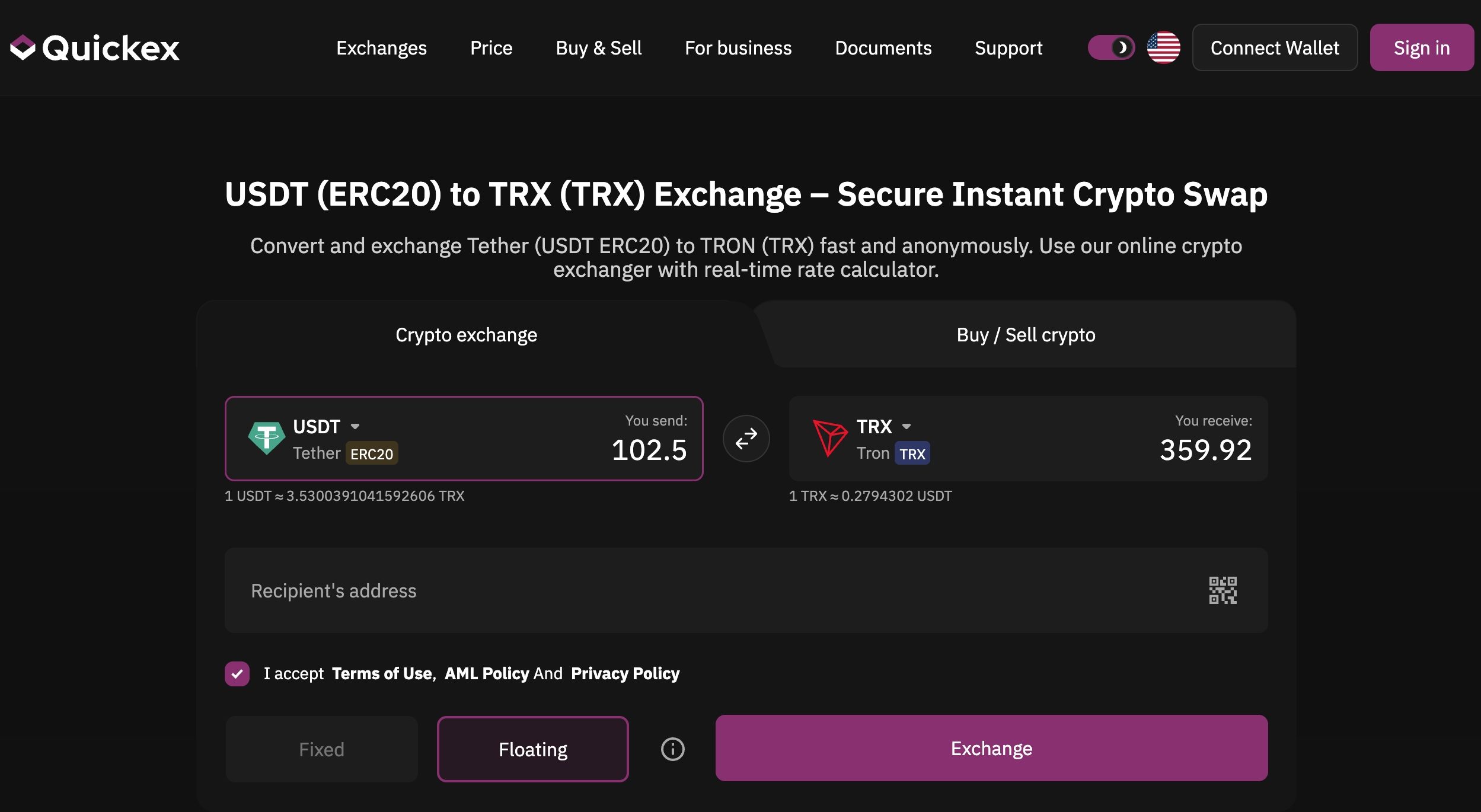
TRX is widely available on major centralized exchanges and many wallets. If you’re using Quickex as an example of an instant swap service, here’s how it works and what to watch. Here’s a basic process:
- choose the currency pair, like USDT to TRX (“Send” and “Receive”)
- enter the amount and destination address
- complete the swap
Frequently Asked Questions (FAQ)
What Is the Tron Price Prediction for 2026?
My scenario-based Tron price prediction for 2026 is:
- Bear: $0.18–$0.26
- Base: $0.26–$0.38
- Bull: $0.38–$0.55
Will TRX Reach $1 or Return to Its All-Time High?
TRX returning to its ATH (~$0.44) is plausible in a sTrong market rebound because it’s not far above current levels.
TRX reaching $1 is possible but likely requires a full bull cycle plus a narrative re-rating of Tron as global stablecoin infrastructure, not just a “legacy chain.”
How Does Tron Compare to Ethereum or Solana?
- Ethereum has the largest ecosystem and deepest DeFi base, but L1 fees can be higher; L2s are the scaling path.
- Solana is known for high throughput and consumer apps and also hosts a huge meme ecosystem.
- Tron stands out for stablecoin settlement dominance and daily activity at very low cost, especially USDT flows.
Each chain wins different categories. Tron’s “killer category” in 2026 is stablecoins.
What Role Does USDT Play in Tron’s Ecosystem?
USDT is Tron’s backbone. DeFiLlama shows USDT dominance ~98% of stablecoins on Tron, with total Tron stablecoins around $85.8B.
That means Tron’s daily usage, addresses, and transaction volume are heavily influenced by stablecoin settlement demand. If USDT usage grows, Tron tends to benefit through network activity and relevance.
Disclaimer: The material in this article is not financial or investment advice. Everything stated here reflects the author's personal view and should not be treated as a recommendation to trade or invest. We make no warranties regarding the accuracy, reliability or completeness of the information presented. Cryptocurrency markets are highly volatile and can move unpredictably. Before committing any funds, every investor, trader or crypto user should study several independent sources and check the regulations that apply in their own jurisdiction.