
Key Takeaway:
Cloud mining lets you rent hash power from a remote data center and earn a share of mined crypto, without buying or running hardware yourself. It can be legitimate, but the industry has a documented history of billions in fraud, including HashFlare and BitClub Network. Legitimate providers show verifiable data and never guarantee fixed daily returns, most contracts barely break even after fees.
What Is Cloud Mining?
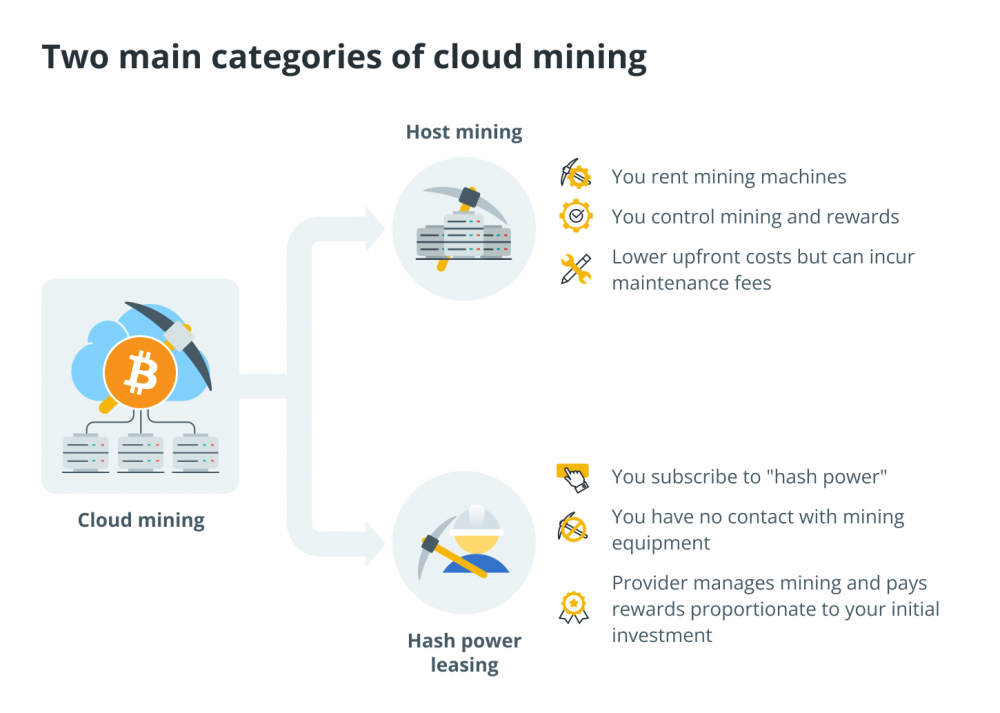
Cloud mining is a way to earn cryptocurrency mining rewards by renting computing power from a company that owns and runs the actual mining hardware, rather than buying and operating ASIC machines yourself. You pay for a slice of their hash rate, usually through a fixed-term contract, and in exchange you receive a proportional share of whatever the mining operation earns, minus fees.
The pitch is straightforward, and honestly it’s an appealing one. Traditional Bitcoin mining at any serious scale means buying expensive ASIC hardware, often five to six thousand dollars per unit for a top-tier machine, finding somewhere with cheap electricity, and dealing with the noise, heat, and constant maintenance that comes with running that hardware yourself. Cloud mining promises to strip all of that away. No hardware to buy, no data center to build, no cooling system to manage, just sign up, pick a contract, and let someone else’s rig do the work.
That simplicity is exactly why cloud mining attracts so much attention, and unfortunately it’s also exactly why the space has become such a magnet for fraud. Because you never physically see the hardware, or verify with your own eyes that any actual mining is happening, the entire model rests on trusting a company you usually can’t inspect. Legitimate cloud mining businesses genuinely exist, but the ratio of real operators to bad actors has historically been rough, and it’s worth going in with eyes open.
How Does Cloud Mining Work?
Here’s the mechanical version, using a typical provider as an example. A company builds or partners with a large-scale mining facility, industrial ASIC machines running around the clock, usually located somewhere with cheap electricity like parts of Kazakhstan, Iceland, or Texas. They then sell contracts to individual users specifying a hash rate allocation, a duration (commonly six to thirty-six months), and which cryptocurrency the contract mines toward, most often Bitcoin.
Once you buy in, the provider’s system credits your account with a proportional share of whatever that hash rate earns from mining, typically paid out daily or weekly, minus a maintenance fee and sometimes an electricity fee deducted separately. Some contracts let you withdraw earnings to an external wallet once you hit a minimum payout threshold, others reinvest earnings automatically unless you opt out. The specifics vary a lot by provider, which is part of why reading the actual contract terms matters more here than with most crypto products.
It’s worth knowing the model splits into a few different flavors, since they carry pretty different risk profiles. A fixed-contract cloud mining service, the model described above, sells a set hash rate for a set term at a set price. Hashrate marketplaces like NiceHash work differently, functioning more like an open exchange where you can buy or rent hash power short-term with more flexibility and transparency, since you’re essentially renting from a pool of independent hardware operators rather than one opaque company. And hosted mining is different again, you actually own the physical hardware, but it lives in the provider’s facility and they handle power and maintenance for a fee, which is a meaningfully more verifiable arrangement than either of the other two since the hardware is legally yours.
Cloud Mining vs. Traditional Mining: What’s the Difference?
Traditional mining, sometimes called hardware mining or home mining, means buying your own ASIC machines, plugging them in somewhere with reliable power, and running them yourself around the clock. A single top-tier unit like a Bitmain Antminer S21 XP or a Whatsminer M60 typically costs somewhere between $2,000 and $6,000, and that’s before accounting for electrical infrastructure, cooling, and the noise, which is genuinely loud enough that most people can’t run a rig in a living space.
Electricity cost is really the deciding factor for whether traditional mining makes sense at all. Industrial operations running at $0.03 to $0.05 per kilowatt-hour, the kind of rate available through hydro power in Quebec, flared gas in Texas, or geothermal in Iceland, remain genuinely profitable. Home miners paying typical residential rates of $0.10 to $0.15 per kilowatt-hour are, realistically, not going to turn a consistent profit once electricity is factored in against current mining difficulty. That gap has only widened as Bitcoin’s network hashrate pushed past 800 exahashes per second in early 2026, making the casual home-mining era largely a thing of the past.
Cloud mining flips the cost structure entirely. Instead of a large upfront hardware purchase, you pay a provider for a contract, and they absorb the hardware, electricity, and maintenance costs into their fee structure. That removes the noise, the technical setup, and the multi-thousand-dollar entry cost, but it also means you never own anything tangible, you’re trusting a company’s claims about hardware you can’t inspect, and when the contract ends, you’re left with nothing unless you renew. Traditional mining, by contrast, means the hardware is legally yours for as long as it keeps running, and you can resell it, relocate it, or repurpose it if mining stops making sense.
| Factor | Traditional Mining | Cloud Mining |
| Upfront cost | $2,000 to $6,000+ per ASIC unit, plus electrical setup | Typically $100 to $5,000 depending on contract size |
| Ownership | You own the physical hardware outright | No physical ownership, just a contractual claim on output |
| Electricity | You pay directly, ideally under $0.05/kWh to stay profitable | Bundled into the provider’s fees |
| Technical skill needed | Moderate to high, setup, cooling, troubleshooting | Minimal, mostly just choosing a contract |
| Noise and space | Significant, most home setups are impractical | None, everything runs at the provider’s facility |
| Verifiability | High, you can physically inspect and monitor your own hardware | Low, you’re trusting the provider’s reported figures |
| What happens at contract/hardware end | Hardware remains yours; can resell, relocate, or keep running | Contract expires; you walk away with nothing unless you renew |
| Flexibility to switch coins | Limited, often requires different hardware per algorithm | Limited, tied to whatever the provider’s contract specifies |
Neither model is universally better, they suit different priorities. Traditional mining rewards people with access to genuinely cheap electricity, the technical patience to manage hardware, and a preference for owning something real at the end of it. Cloud mining trades that ownership and control for convenience, at the cost of the verification problem and fraud risk covered throughout the rest of this guide.
How Do You Start Cloud Mining?
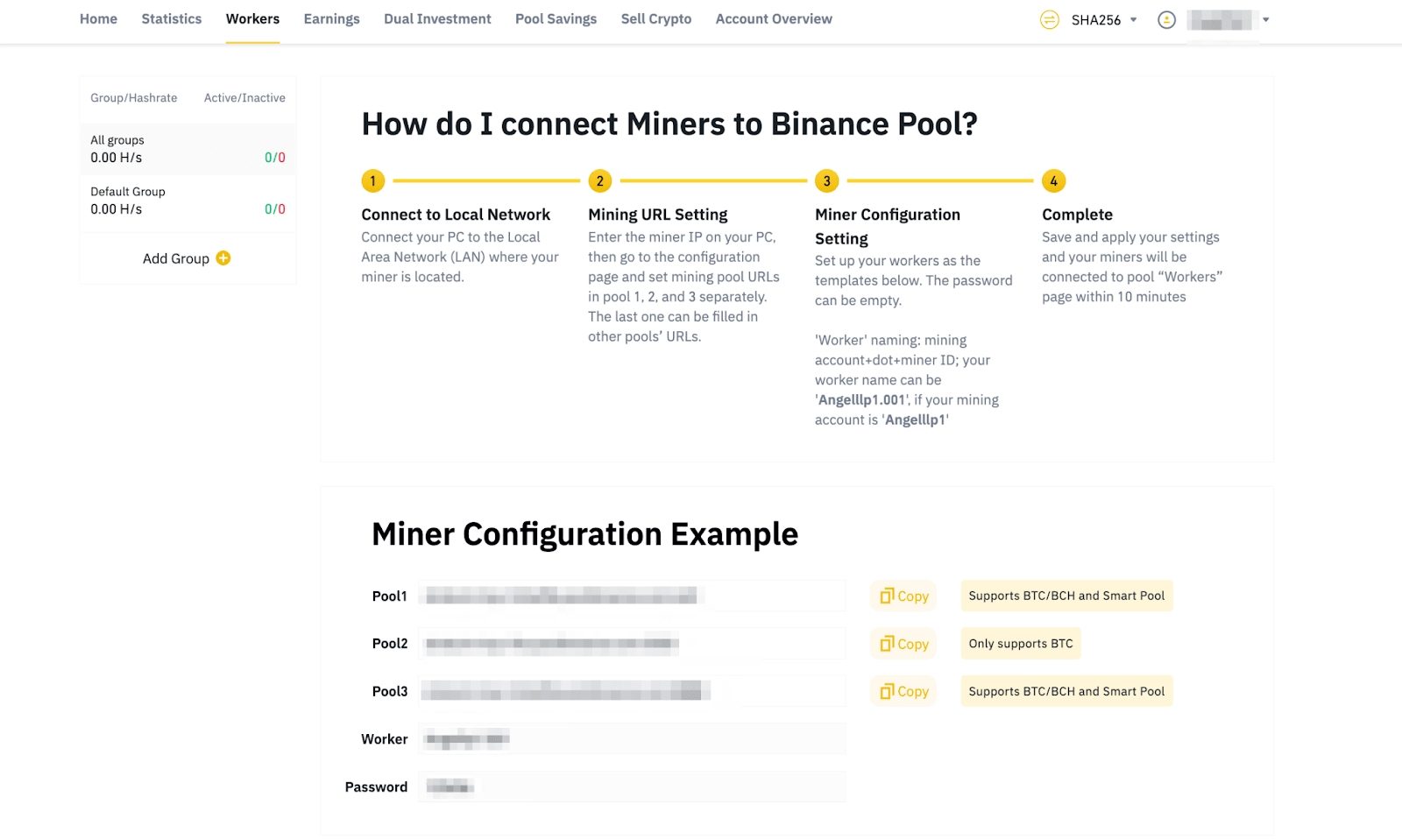
Source: Binance Pool
If you’ve weighed the risks covered throughout this guide and decided to move forward, here’s the actual process most legitimate providers follow, broken into the steps that matter.
- Step one is choosing a provider, and this deserves more time than any other step. Check whether the company publicly lists its data center locations, equipment models, and business registration, and look for independent reviews or mentions on established mining forums and analytics sites rather than testimonials on the provider’s own homepage. This is the step where most of the due-diligence checklist covered later in this guide actually gets applied.
- Step two is creating an account. Most legitimate providers require at least email verification, and increasingly, identity verification (KYC) to comply with financial regulations, especially for larger contract sizes. Be genuinely wary of any platform that skips this entirely while handling real money, since a complete absence of verification can just as easily signal a lack of regulatory oversight as it can signal convenience.
- Step three is selecting a contract. Providers typically offer a range of hash rate allocations and durations, commonly six to thirty-six months. Read the actual contract terms, not just the marketing page, specifically for how fees are calculated, what happens if mining revenue drops below operating costs, and whether early termination results in any refund. This is also where you should run the profitability math covered in the next section before committing funds.
- Step four is funding the contract, usually through a cryptocurrency deposit, sometimes through card or bank transfer with providers that support fiat on-ramps. Once payment clears, the provider allocates your hash rate and mining is supposed to begin, typically within a day or two.
- Step five is monitoring payouts. Legitimate providers show a dashboard with daily or weekly earnings, and critically, that data should be cross-referenced where possible against the mining pool the provider claims to use, as covered in the due-diligence section below. Withdraw a small test amount early, before committing to letting earnings accumulate for the full contract term, to confirm the withdrawal process actually works as described.
- Step six, ongoing, is simply tracking whether the contract is still economically worthwhile as mining difficulty rises over time. A contract that looked reasonable at signing can become a net drag well before its term ends, and there’s no shame in accepting a loss and walking away rather than continuing to fund an unprofitable position out of sunk-cost thinking.
How Do You Choose a Cloud Mining Provider?
Narrow the field using a handful of concrete criteria rather than star ratings or testimonials, which are trivially easy to fabricate. Public accountability matters most: a company answerable to securities regulators, auditors, or a verifiable business registration carries fundamentally more weight than one that only answers to itself.
Look specifically at the operating model. Fixed-contract providers sell you a defined hash rate for a defined term at a defined price, the most common structure but also the one with the least built-in transparency, since you’re trusting the provider’s own reporting. Hashrate marketplaces work more like an exchange, connecting independent hardware operators with buyers, which trades some simplicity for meaningfully better transparency. Hosted mining is different again, you actually purchase and own physical hardware that the provider houses and maintains, which gives you a legal claim to something real even if the hosting relationship goes wrong.
Fee structure is the next filter. Reputable providers separate their hash rate fee (paid upfront) from ongoing electricity or maintenance fees, and publish both clearly rather than bundling everything into one opaque number. Compare the all-in daily cost per unit of hash rate across a few providers using the calculation method from the previous section, since a lower headline contract price can still work out more expensive once fees are actually accounted for.
The table below lines up a few well-documented examples across different models, not as an endorsement of any specific one, but to illustrate how differently “cloud mining provider” can actually look depending on the structure.
| Provider | Model | Notable Verification | Worth Knowing |
| BitFuFu | Fixed-contract cloud mining | NASDAQ-listed (FUFU), SEC-filing public company | Reported roughly 26 EH/s of hash rate under management as of February 2026 |
| Bitdeer | Fixed-contract cloud mining | Publicly listed, publishes itemized hash rate and electricity fees | Reported self-mining hashrate of over 70 EH/s and total hashrate under management above 83 EH/s in mid-2026 |
| NiceHash | Hashrate marketplace | Long operating history since 2014; publishes live marketplace data | Functions as an exchange between independent hardware owners and buyers, not a single opaque operator |
| ECOS | Fixed-contract cloud mining | Registered in Armenia’s Free Economic Zone; operational since 2017 | Publishes contract terms and calculator tools directly; smaller scale than BitFuFu or Bitdeer |
| Compass Mining | Hosted mining | US-based; customers own the physical ASIC hardware | A 2022 dispute over hardware return following a hosting partner’s sanctions exposure is worth reading about before signing up |
None of these five are risk-free, Compass Mining’s documented hardware-return dispute is a reminder that even a hosted-mining model with real ownership isn’t automatically free of counterparty problems. The point of a table like this isn’t to hand you a shortcut past due diligence, it’s to show that “verifiable” comes in degrees, and comparing providers on that axis, rather than on advertised APY, is what actually separates a defensible choice from a leap of faith.
How Do You Calculate Cloud Mining Profitability?
Providers like Bitdeer and ECOS publish formal ROI calculators, but the underlying formula behind nearly all of them boils down to the same handful of steps, and it’s worth understanding it directly rather than just trusting whatever number a provider’s calculator spits out.
Start with static breakeven days, the number of days needed to recoup your upfront hash rate fee before the contract turns a genuine profit. The formula, adapted from the version Bitdeer publishes for its own contracts, is: breakeven days equals the hash rate fee divided by (hash rate amount multiplied by the daily output per unit minus the daily electricity or maintenance fee per unit). In plain terms: figure out your net daily earnings per unit of hash rate after fees, then divide your total upfront cost by that daily net figure to see how many days it takes to break even.
From there, static net revenue is calculated as: (contract duration in days minus breakeven days) multiplied by hash rate amount multiplied by daily net output, multiplied by your share ratio if the provider operates on anything less than a 100% share model. That final figure is your projected profit if current conditions, price, difficulty, and fees, held perfectly steady for the rest of the contract, which they won’t, but it’s the standard starting baseline every legitimate calculator uses before layering in more conservative assumptions.
The inputs you need to gather before running this yourself: the contract’s hash rate fee (your upfront cost), the hash rate amount you’re purchasing, the current estimated daily output per unit of hash rate at today’s network difficulty, and the provider’s stated daily electricity or maintenance fee per unit. Most providers publish the third figure directly on their contract page, and sites like WhatToMine or a provider’s own calculator can supply an independent estimate to sanity-check it against.
Two mistakes account for most of the bad math people do here. The first is calculating from a peak historical Bitcoin price rather than a conservative current or even below-current estimate, since price assumptions swing the entire calculation dramatically. The second is ignoring that mining difficulty rises over the life of a long contract, which the static formula above doesn’t account for by design, it assumes today’s conditions hold constant. For any contract longer than a few months, treat the static breakeven number as an optimistic floor, not a realistic expectation, and mentally push your real break-even point later to account for difficulty that hasn’t happened yet.
Is Cloud Mining Profitable?
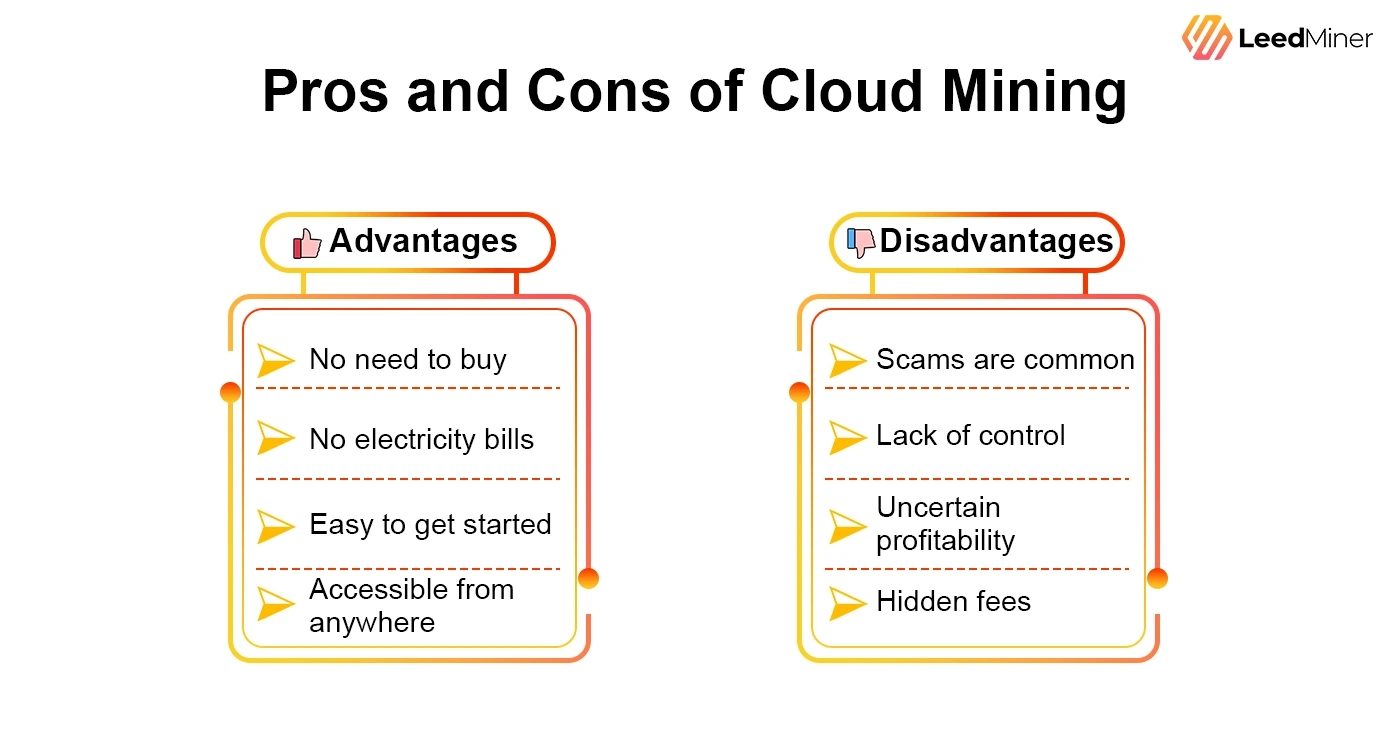
Source: Leedminer
Sometimes, but the honest answer is that most cloud mining contracts struggle to generate meaningful positive returns once fees and rising mining difficulty are factored in, even with a completely legitimate provider. Three variables drive profitability: the price of the cryptocurrency being mined, the network’s mining difficulty, and the fees the provider charges. All three tend to move against the contract holder over time.
Mining difficulty is the one people underestimate most. Bitcoin’s proof-of-work system automatically increases difficulty when blocks get found too quickly across the network, which happens as more total hash power comes online globally. That means a fixed amount of hash rate you purchased on day one earns a shrinking share of total rewards as the months go by, purely because more competing hash power keeps joining the network. Bitcoin’s total network hash rate crossed 800 exahashes per second in early 2026, an almost incomprehensible amount of computing power competing for the same block rewards, which puts the scale of that competition in perspective.
Halvings compound the problem further. Roughly every four years, Bitcoin‘s block reward, the actual amount of new BTC paid to miners for finding a block, gets cut in half. Unless the price rises enough to offset that reduction, mining revenue per unit of hash rate drops sharply overnight. A contract that looked reasonably profitable when purchased can become a loss within a year or two purely from difficulty increases and halvings, independent of anything the provider does right or wrong.
Realistically, run the math with conservative assumptions before committing anything. Estimate your expected daily payout at current difficulty and price, subtract the provider’s stated maintenance and electricity fees, and calculate how many months it would take to recoup the contract price, then compare that to the contract’s actual term length. If the break-even point sits close to or past the contract’s expiration, and difficulty is only going to keep climbing in the meantime, the math often doesn’t favor the buyer.
A simplified worked example makes this concrete. Say a one-year contract costs $1,000 for a hash rate allocation that, at today’s difficulty and Bitcoin price, would generate roughly $120 a month in gross mining revenue. After a typical maintenance fee of around $25 to $35 a month, net revenue lands closer to $85 to $95 monthly, which would take roughly 10 to 12 months to recoup the initial $1,000, right around the contract’s full term. That’s before accounting for the fact that difficulty almost certainly rises over that same year, shrinking your share of network rewards each month and pushing the real break-even point further out than the simple math suggests. This is why independent analyses of the space consistently note that even honest cloud mining contracts rarely produce a meaningfully positive return once every real cost is accounted for.
How Do You Spot a Cloud Mining Scam?
Watch for guaranteed or fixed daily, weekly, or monthly returns advertised regardless of market conditions, this is the single strongest red flag across documented cases. Real mining income moves with Bitcoin’s price, network difficulty, and electricity costs, so any platform promising a steady, predictable percentage return every single day is describing something that isn’t actually mining, it’s very likely a Ponzi scheme structured to pay early users with money collected from newer ones.
A second major tell: the platform can’t or won’t show verifiable proof of the mining operation it claims to run. Legitimate providers publish specifics, data center locations, equipment models, sometimes even live camera feeds or third-party audits of their facilities. If the only evidence of mining you’re given is a number rising on a dashboard the company itself controls, you haven’t actually verified anything, that number could be entirely fabricated and there’d be no way to tell from the outside.
Beyond those two big ones, a handful of smaller patterns show up again and again in documented scams. Heavy emphasis on referral bonuses and multi-level commission structures, rewarding users more for recruiting new depositors than the platform earns from actual mining, is a classic pyramid-scheme signature layered on top of the mining story. So is an anonymous or unverifiable team, stock photos standing in for real facility images, and a pattern where small early withdrawals process smoothly (specifically to build trust) right before larger ones get stalled behind sudden new “verification” or “tax” fees. That last pattern, being asked to pay an escalating fee just to unlock a withdrawal you already earned, is advance-fee fraud, and no legitimate platform ever operates that way.
Are There Any Legitimate Cloud Mining Options?
Source: BitFuFu
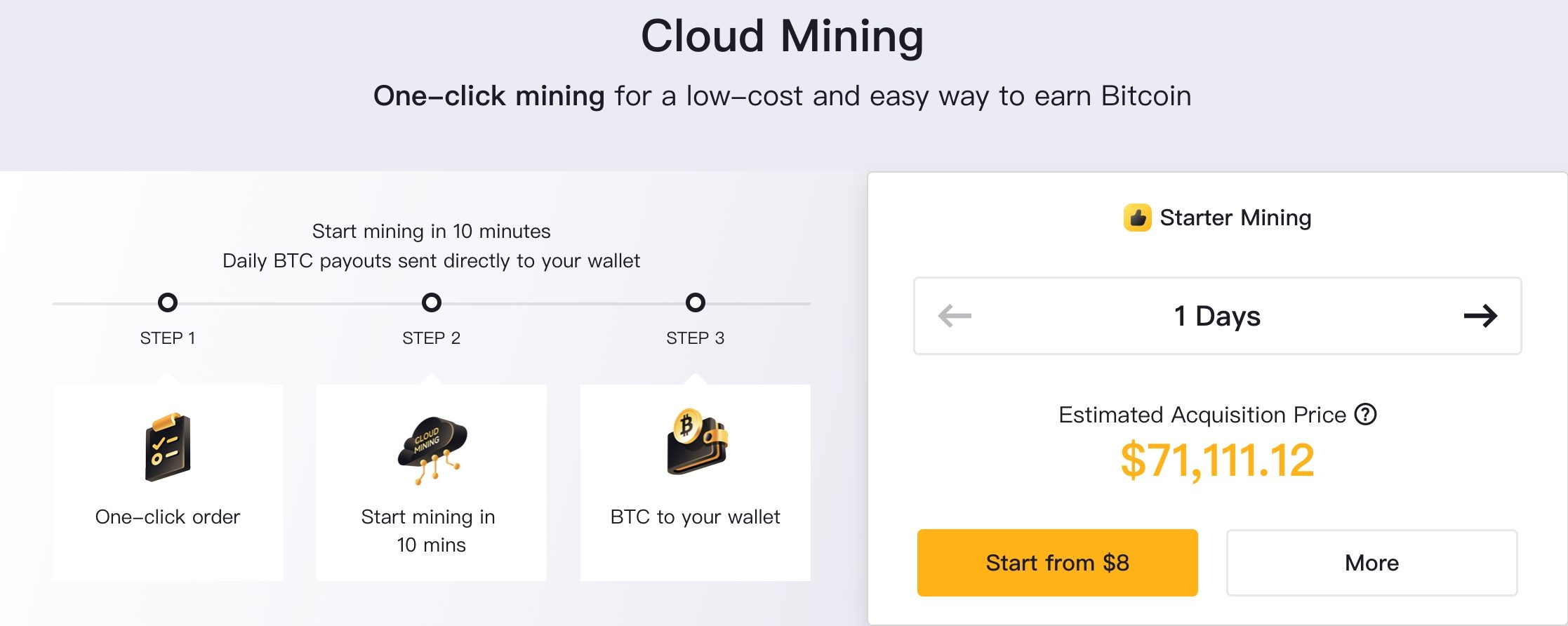
Yes, though the pool of genuinely verifiable options is much smaller than the marketing around cloud mining would suggest. BitFuFu stands out specifically because it’s a NASDAQ-listed, SEC-filing public company, which means its financials, mining operations, and hash rate figures are subject to real regulatory disclosure requirements rather than just whatever the company chooses to publish on its own website. That level of accountability is genuinely rare in this space.
NiceHash takes a fundamentally different approach worth understanding on its own terms. Rather than selling opaque fixed contracts, it operates as a hash-power marketplace, essentially a live exchange connecting people who own mining hardware with people who want to rent hash power short-term. That structure is inherently more transparent and flexible than a black-box contract, though it does require more active involvement and monitoring from users than a passive fixed contract would.
A handful of other operators, including ECOS, which operates from Armenia’s Free Economic Zone with a reputation for relative transparency, occupy a middle tier: not proven frauds, but also not carrying the level of independent verification that a publicly traded company like BitFuFu provides. For any provider outside the clearly-verified tier, the burden of proof genuinely sits with you before committing meaningful money, not with taking their marketing at face value.
Cloud Mining vs. Other Ways to Get Crypto Exposure
For most people, cloud mining compares unfavorably against simpler, more transparent ways to get exposure to crypto, and it’s worth being honest about that upfront rather than after the fact. Buying and holding Bitcoin directly carries no counterparty risk beyond the exchange or wallet you use, no fee erosion from a mining contract, and no dependency on a third party’s honesty about hardware that you’ll never see.
Staking, for cryptocurrencies that support it, offers a genuinely comparable passive-income structure with dramatically better verifiability. When you stake ETH or SOL through a reputable validator, the rewards, the lock-up terms, and the underlying mechanics are all visible on-chain and independently verifiable by anyone, a transparency level that fixed-contract cloud mining simply cannot match by design. Dollar-cost averaging into spot Bitcoin or Ethereum, or using regulated products like spot Bitcoin ETFs, sidesteps the entire mining-fraud risk category altogether while still providing price exposure to the underlying asset.
It’s worth laying the tradeoffs out side by side, since the comparison is really about verifiability more than raw potential return. Direct ownership of Bitcoin or Ethereum means your holdings live in a wallet you control, visible on a public blockchain, with zero dependency on any third party continuing to operate honestly after you’ve paid them. Staking adds a modest counterparty risk, mainly around validator uptime and slashing conditions, but the reward mechanics themselves are transparent and auditable by design, not something you’re asked to simply trust. Cloud mining sits at the opposite end of that spectrum: maximum trust required, minimum independent verification available, and a track record that gives good reason for skepticism even when a provider turns out to be legitimate.
None of this means cloud mining can never make sense for anyone. For a small, disciplined allocation, capped meaningfully below what you’d risk in other crypto positions, through a genuinely verified provider like BitFuFu, it can function as one small piece of a diversified approach. It’s the combination of an opaque business model, a documented history of billions in fraud, and structurally declining returns from mining difficulty that makes it a poor default choice for most people’s primary crypto strategy.
What Should You Check Before Signing a Cloud Mining Contract?
Start with the mining pool. Nearly every legitimate mining operation, cloud-based or otherwise, mines through a named, publicly visible pool like Foundry USA, AntPool, or F2Pool rather than some private, unnamed backend. Reputable pools publish their own hash rate and payout statistics independently of any individual provider, which means you can cross-reference a cloud mining company’s claimed hash rate against what the pool itself reports, a check nobody selling a fake operation can fake convincingly, since it requires actually controlling real hardware connected to a real pool.
Next, look for a verifiable business registration in a jurisdiction that actually regulates financial or investment activity, Singapore, the UAE, Switzerland, and parts of the US are common examples among providers that take compliance seriously. A company incorporated in an obscure jurisdiction with no public regulatory footprint, paired with an anonymous or unverifiable founding team, is a combination that shows up constantly in post-mortem reports on failed cloud mining platforms. Reverse-image-search any team photos and facility images too, stock photography standing in for real people or real data centers is a shockingly common and easy-to-catch tell.
Read the contract terms specifically for how termination and non-payment scenarios are handled. Most legitimate providers disclose upfront that if mining revenue falls below maintenance costs, a contract can be terminated early without a refund, that’s an honest, if unwelcome, disclosure of real economic risk. A provider that promises payouts will continue regardless of mining economics is making a promise the underlying business model can’t actually support.
Finally, test the withdrawal process early and with a small amount before ever committing a larger sum. Scam operators frequently let small early withdrawals go through smoothly, specifically to build confidence, then introduce sudden new “verification,” “tax,” or “unlocking” fees the moment a larger withdrawal gets requested. If you’re ever asked to pay an escalating fee just to access money you already earned, stop immediately and treat that as confirmation, not a solvable obstacle, since no legitimate platform requires payment to release funds that are already yours.
Where Can You Buy or Exchange Crypto?
If you decide cloud mining or any other crypto strategy isn’t for you, or you just want to acquire crypto directly instead, there are two broad paths: centralized exchanges that require identity verification, and no-KYC swap services that convert one crypto directly into another without an account. Which fits depends mostly on whether you’re buying with fiat for the first time or already hold crypto and want to move between assets.
Quickex is a solid example of that second category, an instant swap platform that’s been operating since 2018, supporting well over 100 cryptocurrencies including Bitcoin, Ethereum, USDT, and a long list of altcoins. No account is required to swap.
Users can choose between a fixed rate, which locks in the exact amount you’ll receive before sending funds, or a floating rate that tracks the live market and typically carries a lower fee. Quickex charges 1% on fixed-rate swaps and 0.5% on floating-rate swaps, and most conversions complete within roughly 5 to 10 minutes once the incoming payment is confirmed.
Once you’re holding something, a no-KYC swap becomes a genuinely quick way to move between assets like BTC to USDT, ETH, or USDC without re-verifying your identity every time, whether that’s to diversify out of a cloud mining payout or simply rebalance a portfolio.
Frequently Asked Questions
Is cloud mining worth it in 2026?
For most people, no, cloud mining rarely generates meaningful returns after fees and rising mining difficulty, and the industry carries a documented history of large-scale fraud.
The economics work against contract holders by design: difficulty rises as more hash power joins the network, halvings periodically cut mining rewards in half, and provider fees eat further into whatever’s left. A small allocation through a verified, publicly accountable provider can make sense for some users, but it shouldn’t be treated as a primary or reliable income strategy.
How does cloud mining work without owning hardware?
You pay a provider for a share of hash power from mining equipment they own and operate, and receive a proportional share of mining rewards in return.
The provider runs large-scale ASIC hardware in a data center, and your contract represents a claim on a slice of that hardware’s output rather than physical ownership of any machine. Payouts are typically distributed daily or weekly, minus maintenance and electricity fees the provider deducts before crediting your account.
What is the biggest red flag in a cloud mining platform?
A guaranteed fixed daily or monthly return regardless of market conditions is the single strongest warning sign.
Real mining revenue fluctuates with cryptocurrency price, network difficulty, and electricity costs, so no legitimate operation can promise a fixed, predictable percentage return every day. Platforms advertising this kind of guarantee are typically running a Ponzi structure, paying earlier users with deposits from newer ones rather than actual mining income.
Can you lose money with cloud mining even on a legitimate platform?
Yes, even honest providers can produce a net loss once fees, mining difficulty increases, and cryptocurrency price movements are factored in over the contract term.
A contract that looks profitable at signing can become unprofitable within months if network difficulty rises faster than the price of the mined coin, since your fixed hash rate share shrinks relative to the growing total network. Always calculate a conservative break-even scenario before purchasing, using current fees and a realistic assumption about rising difficulty, rather than trusting a provider’s advertised return estimates.
Is free cloud mining real?
Almost never, legitimate cloud mining requires real infrastructure costs that a provider has to recoup somehow, so genuinely free mining with no catch is a major red flag.
Free cloud mining offers are typically designed to collect personal data, lure users into paying hidden withdrawal fees later, or distribute malware disguised as a mining app. Real mining requires specialized ASIC hardware and industrial electricity costs that don’t disappear just because a platform calls itself free.
What’s the difference between cloud mining and hosted mining?
In cloud mining you rent someone else’s hash power with no physical ownership, while in hosted mining you own the actual hardware, which the provider houses and maintains for a fee.
Hosted mining is generally more verifiable, since the hardware legally belongs to you and can theoretically be inspected, shipped elsewhere, or sold. Cloud mining contracts offer no such physical claim, which is part of why the model has proven so much easier to run as an outright fraud.
Disclaimer: The material in this article is not financial or investment advice. Everything stated here reflects the author's personal view and should not be treated as a recommendation to trade or invest. We make no warranties regarding the accuracy, reliability or completeness of the information presented. Cryptocurrency markets are highly volatile and can move unpredictably. Before committing any funds, every investor, trader or crypto user should study several independent sources and check the regulations that apply in their own jurisdiction.