

Grid trading has emerged as a popular automated approach in cryptocurrency markets, allowing participants to capitalize on price fluctuations without constant monitoring. This method involves setting up a series of buy and sell orders at predefined intervals around a base price, forming a “grid” that executes trades as the asset moves. In 2025, with volatile conditions persisting across major coins like Bitcoin and Ethereum, grid trading explained as a strategy continues to attract both novice and experienced users seeking consistent returns in ranging markets. Platforms such as Bitunix and WunderTrading have highlighted its integration with bots, making it accessible for automated execution. This article examines the fundamentals, mechanics, strategies, and practical applications of grid trading in crypto, providing a comprehensive overview for effective implementation.
Core Concepts Behind Grid Trading
Grid trading meaning refers to a systematic trading technique where orders are placed at regular price levels above and below a chosen midpoint. When the market price hits these levels, buys occur on the lower end and sell on the upper, aiming to profit from oscillations within a range. In this trading, this is particularly useful due to the 24/7 nature of markets and frequent sideways movements.
The setup typically includes parameters like grid interval, number of grids, and investment amount. For instance, if Bitcoin trades around $60,000, grids might be set every $500, with buys below and sells above. As prices fluctuate, the system accumulates assets low and offloads high, generating incremental gains. Recent trends in 2025 emphasize dynamic adjustments, where AI helps optimize intervals based on volatility. This automation reduces emotional decisions, a common pitfall in manual trading.
Comparing Grid Trading to Other Strategies
To contextualize trading within the broader crypto landscape, consider this table outlining key differences from alternative methods popular in 2025. It highlights suitability for various market conditions and risk profiles.
| Strategy | Description | Best Market Conditions | Risk Level | Potential Returns | Example Platforms |
| Grid Trading | Automated buys/sells at fixed intervals | Sideways/ranging | Medium | Steady, incremental | Pionex, Bybit |
| Scalping | High-frequency trades for small profits | High volatility | High | Quick but small | Binance, OKX |
| Trend Following | Riding momentum in one direction | Trending (up/down) | Medium-High | Variable, potentially large | TradingView bots |
| Arbitrage | Exploiting price differences across exchanges | Inefficient markets | Low | Consistent but low | Bitunix, custom bots |
| DCA (Dollar-Cost Averaging) | Regular buys regardless of price | Long-term holds | Low | Average over time | Coinrule, Crypto.com |
This comparison shows grid trading’s strength in non-trending phases, where others might falter. Data from 2025 indicates grid bots outperforming in stable periods, with average yields around 5-15% monthly on platforms like Coinrule.
Mechanics of Grid Trading
How does grid trading work in practice? The process begins with selecting an asset and defining a price range. Software or bots then place limit orders across the grid. As the price dips to a buy level, an order executes, and when it rebounds to a sell level, another triggers, locking in profit.
In crypto strategy, two main types exist: spot grids for holding assets and futures grids for leveraged positions. Future grid trading amplifies potential gains but increases liquidation risks in sharp moves. Parameters include upper/lower bounds, grid density, and take-profit/stop-loss settings. For example, a $50,000-$70,000 Bitcoin grid with 20 levels might yield multiple cycles in a month. Automation via bots ensures round-the-clock operation, with 2025 advancements incorporating trend detection to pause in breakouts.
Adjustments are key; tight grids suit low-volatility pairs like stablecoins, while wider ones fit altcoins. Fees on exchanges impact net profits, so low-cost platforms are preferred.
Implementing Effective Strategies
What is a grid trading strategy in detail? It revolves around range-bound assets, but adaptations exist for trending markets. A basic approach sets symmetric grids, buying low and selling high repeatedly. Advanced versions use asymmetric grids, favoring buys in bulls or sells in bears.
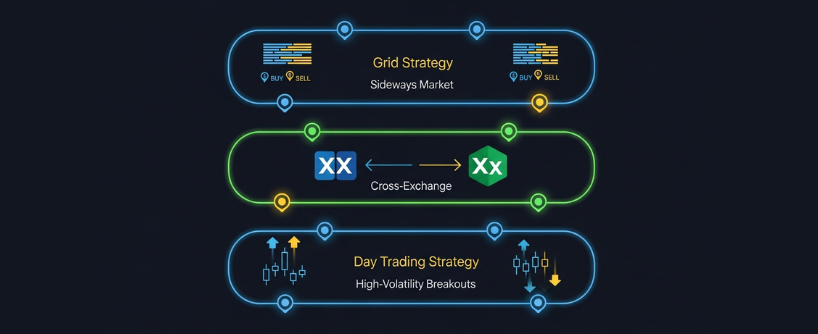
In 2025, hybrid strategies blend grids with indicators like RSI for entry timing. For crypto, pairing with volatility measures ensures grids align with expected swings. Backtesting on historical data, available on tools like XS or arXiv models, refines parameters. Risk management involves allocating only 5-10% of capital per grid to weather drawdowns.
Platforms like Pionex offer built-in bots with zero fees, automating the process. Users set ranges based on support/resistance levels, monitoring via dashboards.
Advantages and Drawbacks in Grid Trading
Grid trading offers several benefits, but challenges persist. Here’s a marked list detailing pros and cons based on 2025 practices.
- Automation Efficiency: Runs 24/7 without manual intervention, ideal for busy participants.
- Profit in Ranges: Excels in sideways markets, capturing small fluctuations repeatedly.
- Customizable Risk: Adjustable grids allow control over exposure and potential losses.
- Compounding Gains: Reinvests profits, potentially growing capital over time.
- Volatility Harnessing: Turns market noise into opportunities, unlike hold strategies.
- Platform Integration: Easy setup on exchanges with bots, reducing learning curves.
On the downside:
- Breakout Vulnerabilities: Loses in strong trends if price escapes the grid.
- Capital Tie-Up: Requires locked funds for orders, limiting liquidity.
- Fee Accumulation: Multiple trades can erode profits on high-commission platforms.
- Over-Optimization Risks: Poor parameter choices lead to underperformance.
- Market Dependency: Less effective in low-volatility or extreme conditions.
Balancing these through diversification – running multiple grids on different assets – mitigates issues.
Trends Shaping Grid Trading in 2025
In 2025, trading evolves with AI and machine learning, predicting optimal ranges and adjusting dynamically. Bots on platforms like Scand incorporate advanced features, such as sentiment analysis from social media. DeFi integrations allow grids on decentralized exchanges, adding yield farming layers.
Regulatory shifts influence adoption, with clearer guidelines boosting institutional use. Community discussions on X highlight bots like those from Crypto Aces or Martingaler, comparing grids to martingale for volatility handling. Future grid trading focuses on sustainability, with eco-friendly bots on energy-efficient chains.
Practical Setup and Tools
Starting involves choosing an exchange with grid bots, like OKX or Cryptohopper. Fund the account, select an asset, and configure the grid. For seamless entry, Quickex provides efficient crypto exchanges with competitive rates and intuitive interfaces, supporting various pairs for quick funding without complications.

Monitor performance weekly, tweaking based on metrics like profit factor. Educational resources from CoinEx or BitDegree aid beginners.
Potential Risks and Mitigation
Risks include unlimited downside in futures without stops, or grid exhaustion in prolonged trends. Mitigation strategies encompass setting wide ranges, using trailing stops, and diversifying across pairs. In 2025, tools like dynamic grids from FMZQuant adapt to trends, shifting focus to longs in uptrends.
Security remains paramount; use reputable platforms and enable 2FA.
Summing Up Grid Trading’s Value
Grid trading integrates with broader ecosystems, enhancing liquidity on DEXs or complementing staking. As markets mature, its role in portfolio management grows, offering passive income streams. Innovations like Cerebro AI’s bots on XPR Network exemplify automation’s future.
Trading stands as a robust tool in crypto, blending automation with strategic depth for ranging markets. From basic setups to advanced AI-driven versions in 2025, it empowers users to navigate volatility effectively. Implement with care, leveraging platforms and tools for optimal results, and it can form a cornerstone of diversified strategies.