
Monero (XMR) remains one of the few cryptocurrencies whose mining has not fallen fully under the control of industrial farms. As of December 2025, the network is still optimized for regular processors, and this factor largely defines what XMR mining will look like in 2026. Home computers, gaming PCs, and idle server-grade processors continue to find their place in the Monero network.
For profitable exchange of Monero to other cryptocurrencies, use Quickex. The exchange has been pleasing crypto users with favorable rates since 2018.
How Monero Mining Works Heading Into 2026
The architecture of the Monero network differs noticeably from most popular cryptocurrencies and directly affects the mining process.
XMR is mined using the RandomX algorithm. The algorithm was designed specifically for CPUs and actively uses processor cache, system memory, and standard instruction sets. As a result, attempts to create efficient ASICs for Monero lose economic sense, and the gap between home machines and large installations remains limited.
By the end of 2025, the Monero team had not announced any algorithm changes. RandomX remains the foundation of the network and, based on current signals, will retain this role in 2026.
Special attention should be given to the 2025 incident involving the Qubic pool. At a certain point, the pool concentrated an excessively large share of the network hashrate, which led to a short-term blockchain reorganization and the rollback of several blocks. The consequences were limited, but the situation showed that even with a CPU-oriented algorithm, network stability directly depends on miner behavior and how hashrate is distributed across pools.
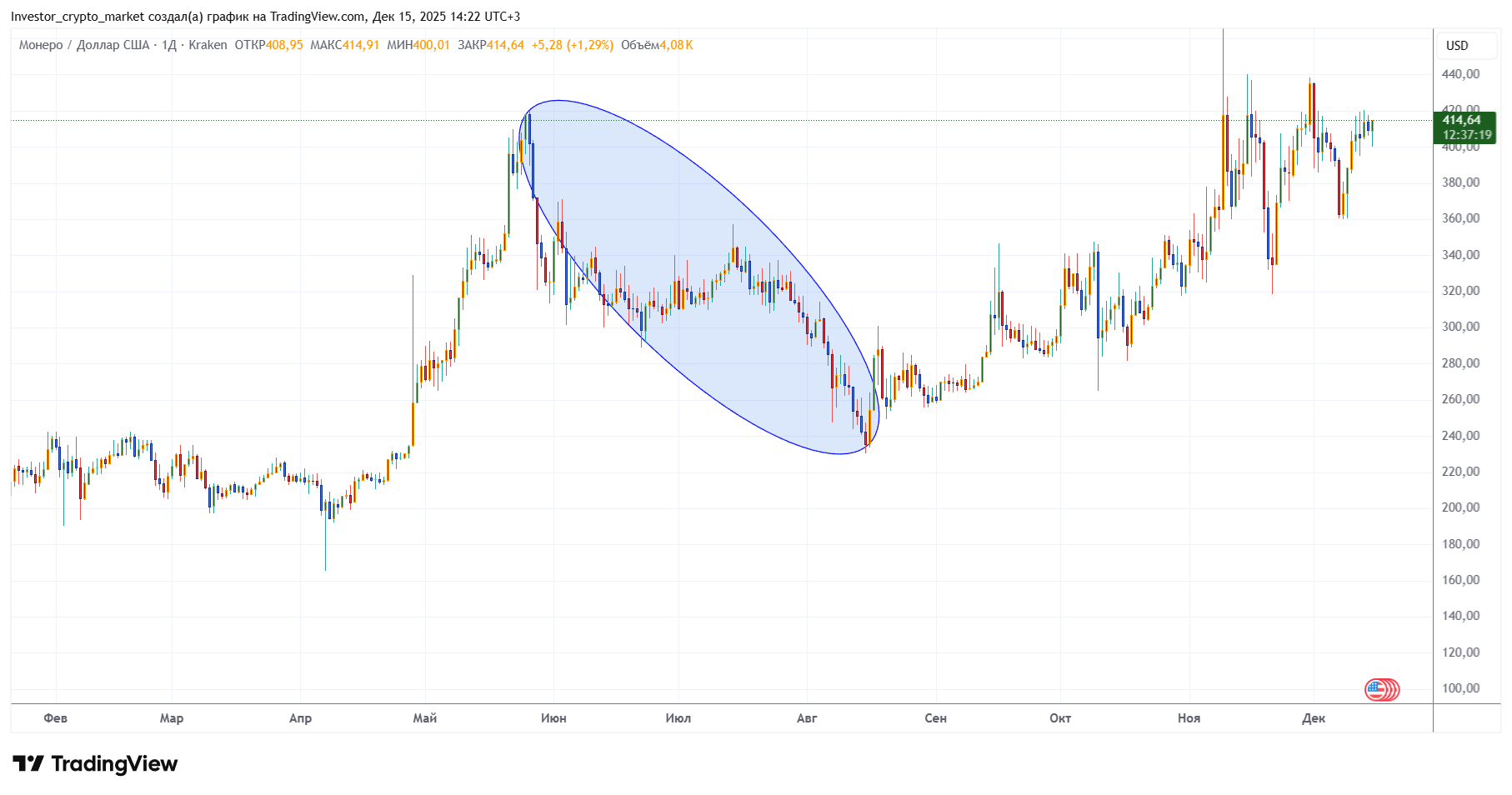
XMR price reaction to pressure from the Qubic mining pool. Chart: TradingView
Hardware for Mining XMR
Hardware affects not only hashrate but also how comfortably mining fits into everyday system use.
CPU Mining
The processor remains the key tool for mining Monero. Multi-core CPUs with large L3 cache and AES-NI support perform best. In practice, AMD Ryzen and EPYC processors are most commonly used, along with Intel Core i7, i9, and server-grade Xeon CPUs.
Even a standard desktop computer with a modern processor can mine XMR steadily without complex infrastructure or additional equipment.
GPU Mining
Graphics cards can technically mine Monero, but they are noticeably less energy efficient than CPUs. GPUs are rarely used, mainly when a graphics card is idle or involved in testing setups.
Laptops and Mobile Devices
Laptops can handle mining only with careful tuning and constant temperature monitoring. Smartphones are used mainly for experiments and learning how RandomX works and offer no practical profitability.
Solo Mining and Mining via Pools
After choosing hardware, the next decision concerns the mining format.
Solo mining makes sense only with a high total hashrate. Block rewards are distributed randomly, and waiting times can stretch for months.
Mining through pools makes income more stable and predictable. That is why most miners work via pools, while keeping an eye on ensuring that no single pool gains an excessive share of the network hashrate.
Active Monero Mining Pools
By the end of 2025, a stable set of pools had formed that are actively used for mining XMR.
- SupportXMR operates under the PPLNS scheme with a fee of around 0,6%.
- NanoPool charges a fee of about 1%.
- HashVault maintains a fee of roughly 0,9%.
- MoneroOcean, c3pool, and P2Pool operate with zero fees.
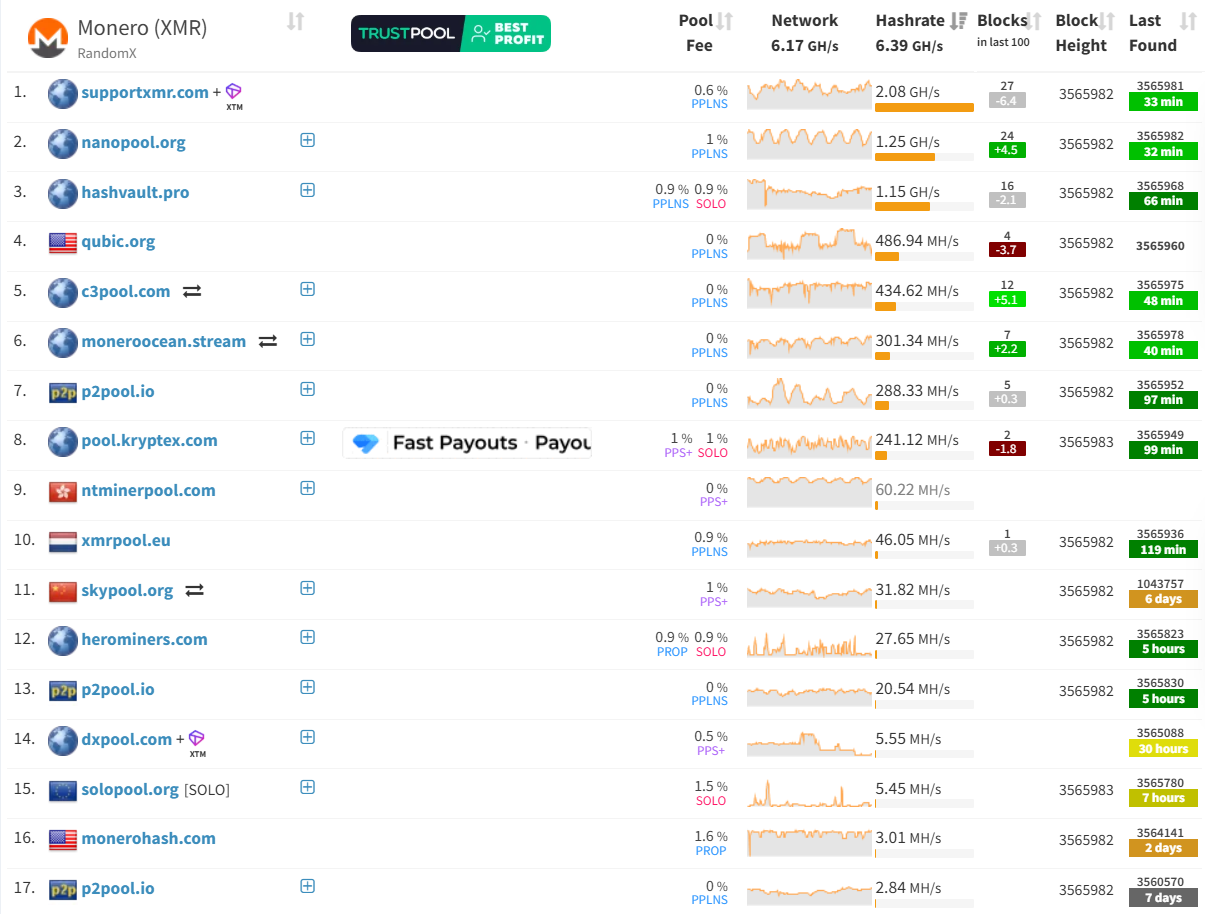
Monero hashrate distribution by pools. Source: miningpoolstats
Due to this distribution, the average pool fee across the Monero network stays within the 0–1% range and rarely becomes a decisive factor when choosing a pool. Payout stability and a pool’s share of total hashrate matter far more.
Mining Software
The software side of Monero mining has long been established and rarely becomes a subject of debate.
XMRig remains the de facto standard for Monero mining. The project is regularly updated, runs reliably across platforms, and allows flexible control over CPU load.
Step-by-Step Guide to Mining Monero
Step 1. Create a Wallet
An XMR wallet is required to start. Monero GUI Wallet and Monero CLI Wallet are considered the most reliable options. The seed phrase should be written down manually and stored offline.
Step 2. Choose a Pool
A pool with a moderate share of the network hashrate and a solid reputation reduces risks and makes payouts more predictable.
Step 3. Install the Miner
XMRig should be downloaded only from official sources. Antivirus software often reacts to miners, so exclusions usually have to be configured manually.
Step 4. Configure and Start
The configuration specifies the pool address, wallet address, and CPU parameters. After launch, it is advisable to monitor temperature and stability for several hours.
Receiving Rewards and Using XMR
Once the minimum payout threshold is reached, the pool sends XMR to the wallet. Further actions depend on the chosen strategy.
Some miners exchange their coins for other assets. For this, they use services that allow them to quickly exchange cryptocurrencies without registration and unnecessary technical steps. One such service is Quickex, focused on simple and fast exchanges.
Power Consumption and Optimization
The RandomX algorithm places a heavy load on the CPU and system memory, which means XMR mining power consumption depends directly on system settings.
To reduce load, miners typically lower CPU voltage and frequency and limit the number of active threads. This approach reduces temperature, noise, and hardware wear without a noticeable loss of hashrate.
On home computers, such optimization is often critical.
XMR Mining Profitability in 2026
By the end of 2025, Monero mining is rarely seen as a source of quick profit. More often, it is about gradual accumulation. Final results depend on XMR price, network difficulty, and electricity costs.
Risks and Limitations
Hardware wear, rising network difficulty, and hashrate concentration remain key risks. The events of 2025 showed that Monero’s resilience largely depends on decisions made by miners themselves.
FAQ
What is cryptocurrency mining?
Cryptocurrency mining is the process of using computer hardware to validate transactions and add new blocks to a blockchain. In return, miners earn block rewards (newly minted coins) and transaction fees. Mining secures proof-of-work (PoW) networks like Bitcoin, Monero, Litecoin, and Dogecoin by making it computationally expensive to tamper with the ledger. Different coins require different hardware: Bitcoin uses specialised ASIC machines, while Monero is designed to be mined with regular CPUs — making it one of the most accessible coins for home miners.
Does crypto mining really pay? Is it profitable in 2026?
It depends on three factors: what you mine, your hardware, and your electricity cost.
Electricity — the #1 variable
- US average (2026): ~$0.17/kWh residential (varies by state — as low as $0.08 in Louisiana, as high as $0.35+ in Hawaii and California)
- EU average (2026): ~€0.22–€0.28/kWh (cheaper in Nordics at ~€0.08–€0.12; expensive in Germany/Ireland at €0.30+)
- Breakeven for Bitcoin mining: most modern ASICs (Antminer S21, Whatsminer M60) require electricity below ~$0.08–$0.10/kWh to be profitable at BTC ~$66,500. At $0.17/kWh (US average), solo BTC mining is unprofitable for most home miners without subsidised power
For home miners in 2026, Monero (CPU) and Kaspa (ASIC) offer the best entry points. Bitcoin mining is profitable only at industrial electricity rates. Ethereum cannot be mined at all since The Merge (September 2022). Always use a profitability calculator (WhatToMine, CoinWarz, MinerStat) with your actual hardware specs and local electricity rate before investing in equipment.
Is DOGE mining real? Is it still profitable?
Yes — Dogecoin mining is real, but it works differently than most people expect. DOGE uses the Scrypt algorithm (same as Litecoin) and requires ASIC hardware — you cannot mine DOGE with a regular CPU or GPU in 2026.
Since 2014, Dogecoin has been merge-mined with Litecoin, meaning miners who mine LTC automatically receive DOGE rewards at the same time, at no additional electricity cost. This makes standalone DOGE mining impractical — most DOGE is produced as a byproduct of Litecoin mining.
- Block reward: 10,000 DOGE per block (~$870 at current prices)
- Block time: ~1 minute
- Supply: ~5 billion new DOGE per year (no cap)
- Profitability: marginal as a standalone operation — merge-mining with LTC is the only practical approach. A top-tier Scrypt ASIC (Bitmain Antminer L9) earns ~$8–$15/day combined LTC+DOGE before electricity
For most individuals, buying DOGE directly is more cost-effective than mining it — mining equipment costs $2,000–$10,000+, runs 24/7, generates heat and noise, and has a 12–18 month ROI at best.
How do I start crypto mining? (Beginner steps)
Here’s a practical step-by-step for getting started in 2026:
- Choose your coin: Monero (CPU-friendly, ASIC-resistant) is the best starting point for beginners. Bitcoin and Kaspa require expensive ASICs. Ethereum is no longer mineable.
- Get hardware: For Monero, any modern CPU works (AMD Ryzen 7/9 recommended). For Bitcoin/Kaspa/LTC, you’ll need an ASIC miner ($2K–$8K+).
- Install mining software: XMRig (Monero), CGMiner or BFGMiner (Bitcoin ASICs), lolMiner or TeamRedMiner (GPU-mineable alts).
- Join a mining pool: Solo mining is impractical for most coins. Pools combine hashrate and split rewards proportionally. Popular pools: P2Pool or MoneroOcean (XMR), F2Pool or Foundry (BTC), Litecoinpool (LTC+DOGE).
- Set up a wallet: you need a wallet address to receive payouts. For Monero, use the official GUI wallet or Feather Wallet.
- Calculate profitability first: plug your hardware, hashrate, and electricity cost into WhatToMine or MinerStat before powering anything on.
How can I start cloud mining?
Cloud mining lets you rent mining hashrate from a remote data centre without buying, hosting, or maintaining hardware. You pay a contract fee (fixed or variable) and receive a share of the mined coins.
Critical warning: the cloud mining industry is rife with scams. The vast majority of cloud mining sites that advertise “guaranteed returns” are Ponzi schemes. Legitimate services exist but are rare and offer modest margins.
- More reputable options (2026): NiceHash (hashrate marketplace — you buy/sell hashrate, not a traditional cloud contract), Bitdeer (NASDAQ-listed, offers hosted mining and cloud contracts), Hive OS (mining management platform with marketplace features). Genesis Mining, once a leader, suspended new Bitcoin contracts in most regions.
- Red flags to avoid: guaranteed fixed daily returns (no legitimate miner can guarantee this), anonymous team, no verifiable data-centre address, multi-level referral programs, unrealistically high ROI claims (e.g., “200% in 30 days”).
Honest reality: after contract fees, maintenance charges, and market volatility, most cloud mining contracts return less than simply buying the coin directly. Cloud mining makes sense only if you specifically want mining exposure without hardware management — and only through a publicly verifiable, audited provider.
What do I do with mined crypto?
Once you’ve mined Monero (or any other coin), you have several options:
- Hold (HODL): keep the coins in your wallet if you believe the price will rise.
- Swap for another asset: if you want BTC, ETH, stablecoins, or any other crypto, you can exchange your mined coins instantly on Quickex — no KYC, no registration, live rate, and funds go directly to your wallet. This is especially useful for Monero miners, since XMR is delisted from many centralised exchanges due to privacy regulations — Quickex supports XMR swaps without restrictions.
- Convert to fiat: sell on an exchange that supports your coin and withdraw to a bank account.
Disclaimer: The material in this article is not financial or investment advice. Everything stated here reflects the author's personal view and should not be treated as a recommendation to trade or invest. We make no warranties regarding the accuracy, reliability or completeness of the information presented. Cryptocurrency markets are highly volatile and can move unpredictably. Before committing any funds, every investor, trader or crypto user should study several independent sources and check the regulations that apply in their own jurisdiction.