
The “tariff war” launched by U.S. President Donald Trump continues. Its next turn will occur on August 7, 2025. On this day, a number of duties on exports to the United States will come into force.
The changes could put pressure on the entire financial market, including the crypto industry. Here’s what exactly to expect on August 7.
What will happen on August 7
On August 7, 2025, a fine-tuned package of “reciprocal” tariffs against more than 60 countries takes effect in the U.S., along with a separate regime for the EU. The legal basis for the step is a presidential July 31 executive order. You can review the tariffs proposed by the administration here.
The rules proposed by Trump include some accommodations. For example, goods that suppliers manage to ship before 00:01 on August 7 may pass under the previous rates.
At the same time, the drafters proposed penalties for those who attempt to circumvent the tariffs. An additional surcharge of +40% is provided for violators.
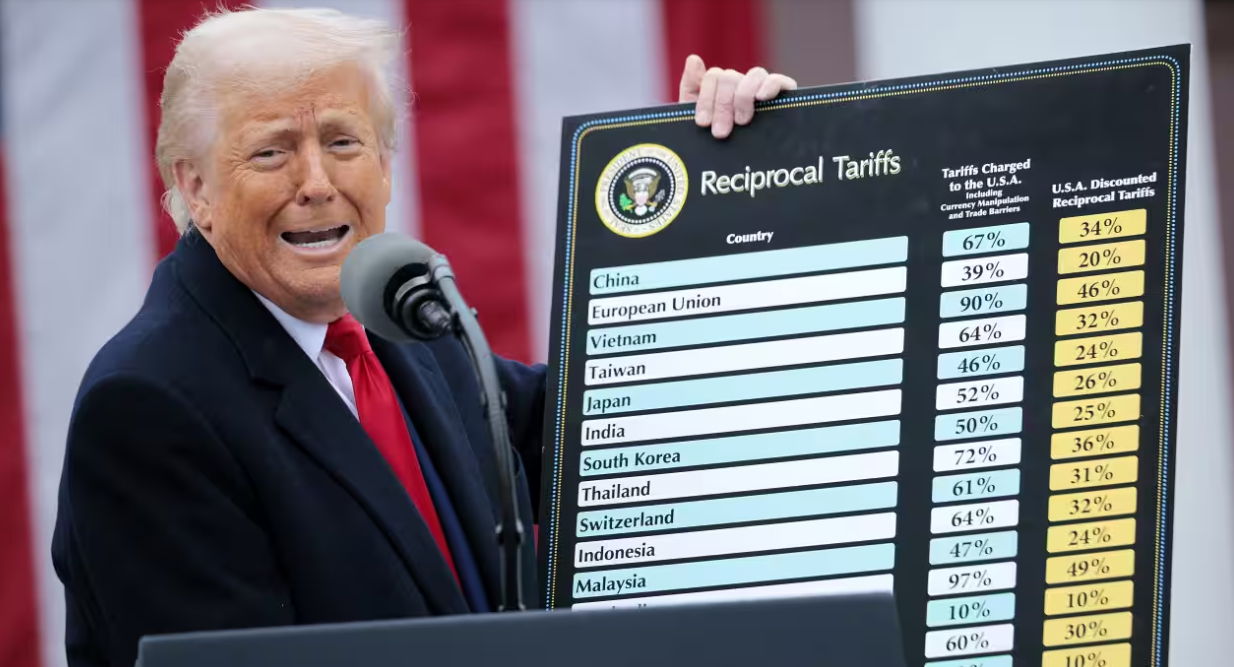
Trump shows the list of countries for which special tariffs have been prepared during “U.S. Liberation Day.” Source: SBS
Special terms were bargained for the European Union. A “15% cap” applies to the EU. Here’s how the scheme works: if the base rate on an EU good is below 15%, the U.S. “brings it up” to 15%; if it is higher, it stays as is. All the details of the negotiations are in Reuters’ piece on the U.S.–EU deal.
Be among the first to learn how crypto reacts to the introduction of Trump’s new tariffs. Track prices of your favorite cryptocurrencies on Quickex.
Which tariffs will take effect
Tariffs for the EU and 68 countries will take effect. Here are a few examples:
- EU: the 15% rule.
- Switzerland: 39%.
- Serbia: 35%.
- India: 25%.
- Taiwan, Vietnam: 20%.
- The Philippines, Indonesia, Thailand, Malaysia, Pakistan: +%.
- South Korea, Turkey, Israel: 15%.
Why Trump started the “tariff war”
Trump claims he is driven by a desire to achieve fairness. In reality, behind the U.S. leader’s bold statements and the “tariff war” he initiated lie several ideas:
Reciprocity and the deficit. The starting point is the April 2 order on “reciprocal tariffs.” It is based on IEEPA (emergency powers for decisions in foreign economic policy). The idea: level market access through symmetrical rates.
Non-equivalent access. The White House pointed out differing tariff/non-tariff barriers among partners and “non-market practices.” Tariffs, in Trump’s view, will make the market fairer.
Stages of escalation
Tension around Trump’s “tariff war” grew gradually. Here is the timeline:
- April: the launch of “reciprocal” tariffs and clarifications. The first was the April 2 order, then the Trump administration proposed a modification.
- June 3: a tariff review for metal imports. Rates were raised to 50%.
- July: the U.S. managed to reach a number of arrangements, including with some key partners.
- July 31: a separate adjustment on Canada. The new proposal set tariffs up to 35% for the “northern neighbor.”
Who the U.S. has already reached agreements with
- European Union. A cap of 15% has been set for almost all categories.
- Japan. A base rate of 15% plus an investment package of ~$550 billion. Tokyo emphasizes the conditional nature of the investments.
- South Korea. 15% announced, but Seoul reported no final written text and is preparing support measures. In this case, the documents remain to be signed.
- Indonesia. A 19% tariff.
- The Philippines. A 19% tariff. There are exemptions for the agro-industrial complex.
- United Kingdom. A 10% tariff.
- With Mexico, on July 31 the United States reached an agreement on a 90-day deferral.
What this means for the financial market and crypto
Trump’s new tariffs could lead to another bout of inflation in the U.S. The fact is that during the July 31 meeting, Fed Chair Jerome Powell refused to cut the key interest rate largely because of the negative pressure of tariffs on the U.S. economy.
Another turn of the “tariff war” could lead to a decline in the crypto market, as many investors will lose faith in a swift Fed pivot to rate cuts. At the time of writing, the odds of such an outcome are estimated at more than 80%. But after August 7, the situation may change.
In any case, against the backdrop of the new tariffs, markets will face heightened volatility.
Conclusions
The Fed fears that Trump’s tariffs will fuel inflation. The American president, for his part, claims there is nothing wrong with his initiatives. Despite Trump’s upbeat statements, markets are highly sensitive to his tariff decisions.
The entry into force of the new levy rules on August 7, 2025 could accelerate inflation in the country. In that case, the Fed will not dare to cut rates in September, which would be extremely negative for the crypto market.
Earlier, the Quickex editorial team wrote about how August CPI data could affect Bitcoin.