
2025 has turned out to be a difficult year for privacy-focused cryptocurrencies. News about attacks on such projects appears regularly, and trading platforms are abandoning this class of assets one after another.
The Quickex editorial team decided to find out exactly how the attack works, who is behind it, and how it might end.
Track Monero’s price with Quickex
What’s Wrong With Anonymous Cryptocurrencies
Anonymity is a core principle that the creator of the first cryptocurrency, Bitcoin, Satoshi Nakamoto, embedded in the project. He wanted to give people tools that would allow them to conduct financial transactions without banks and in complete privacy.
Unfortunately, Bitcoin turned out to be a pseudo-anonymous cryptocurrency. If someone correlates a person’s identity with a wallet address, they gain access to all data about that person’s transactions. Remember, information about all transactions is stored on the blockchain. As long as the network remains decentralized—and for that, no one must gain 51% of the hashrate—falsifying records is impossible.
Pseudo-anonymity did not satisfy many members of the crypto community. That’s why coins with an enhanced level of privacy, such as Monero, appeared on the market. Regulators, as you might guess, are not happy with this. Authorities want to bring crypto users out of the shadows. Anonymous cryptocurrencies complicate the already difficult process of monitoring and tracking crypto operations. Therefore, regulators have an incentive to get rid of such projects.
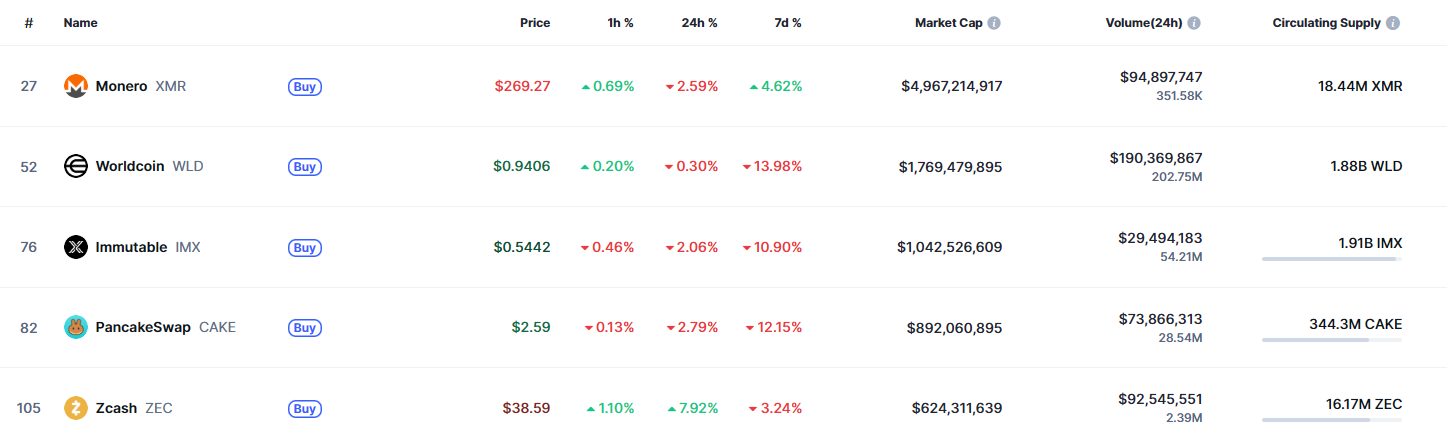
Top-5 privacy-oriented cryptocurrencies. Source: CoinMarketCap
How Privacy Coins Are Being Pushed Out of the Market
The situation began to escalate gradually. First, against the backdrop of the introduction of regulatory requirements in Europe, centralized crypto exchanges that wanted to retain access to the European audience began to abandon privacy coins. For example, in February 2024, the largest crypto exchange Binance delisted Monero; in October 2024 — Kraken. The first trading platform claimed the coin abruptly stopped meeting its standards and cut off access for its entire audience, while the second disabled XMR only for European users.
Centralized exchanges are understandable. Their teams do not want to quarrel with regulators. One could say such platforms simply have no other choice.
In 2025, the situation intensified. First, members of the crypto community began complaining about difficulties when using platforms that offered exchanging Monero for other tokens. For example, EigenWallet came under a DDOS attack. Then talk began about problems at the P2P platform Bisq, which accounted for about 70% of the entire decentralized BTC → XMR exchange market.
The TradeOgre platform also stopped operating. It was the only crypto exchange where Monero could be exchanged without KYC. At the same time, funds remained in wallets—so this was not a hack, an exit scam, and so on. However, this particular project’s story may have taken such a turn due to the vendor’s problems with the police—at least, as written on Bitcointalk.
These platforms share one important factor: they allowed Monero to be exchanged regardless of the origin of the coins. In other words, the platforms did not impose any requirements on the “purity” of the cryptocurrency.
In the first half of August 2025, reports appeared online that the mining pool Quibic had seized control of 51% of the Monero network. Evidence of the takeover was the rewritten blocks.
Amid these problems, XMR’s price collapsed by almost 45%. Other anonymous cryptocurrencies, as members of a class that has been implicitly put under the gun, also began to decline in value.
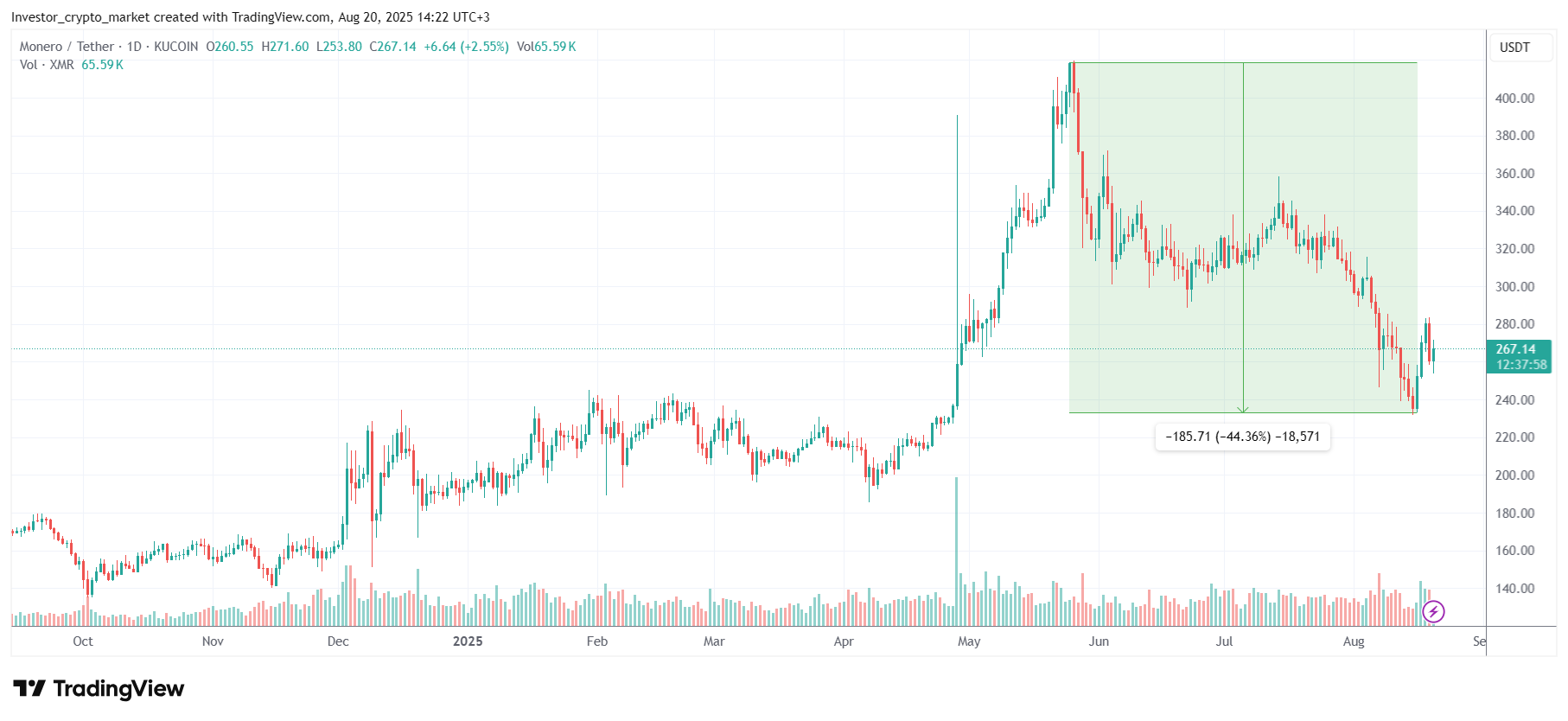
XMR Chart. Source: TradingView
Reality or Psychological Pressure
Immediately after the reports that Quibic had seized control of Monero, members of the crypto community began posting refutations. Network users accused the pool’s team of falsifying data. Quibic representatives, in turn, began to claim that it was the Monero team publishing unreliable information to present what happened in a better light.
On August 17, the founder of Quibic confirmed that his team had not captured 51% of the Monero network. He noted that independent audits found the pool’s real hashrate to be much lower—about 34%. At the same time, the Quibic founder claims that this was enough to seize control over Monero. Therefore, he proposed renaming the 51% attack to a 34% attack.
Members of the crypto community decided that all of Quibic’s actions were simply an attempt to instill fear in cryptocurrency investors. Why the mining pool team might need this is unknown, given that the main parties interested in squeezing privacy coins out of the market are regulators.
Consequences
The result of such an attack was a sharp decline in market interest in privacy-focused cryptocurrencies. The prices of such coins also suffered. For example, Monero, at the time of writing this review, is trading at $270. As recently as May, the coin could be bought for $418.
Another notable representative of the group—the cryptocurrency Zcash—is trading at $38. Back in December 2024, it could be bought for $78.
The number of trading platforms that work with anonymous cryptocurrencies has also decreased.
Final Thoughts
The strongest interest in driving privacy coins off the market comes from regulators. At the same time, we lack solid proof that governments themselves are behind the full-scale attack on this asset class.
Quibic’s admission suggests the attack was more psychological in nature, since the pool never actually reached 51% of Monero’s hashrate, according to its founder. However, the altered blocks still indicate that someone was able to tamper with records.
The loud statements from Quibic, the refusal of major exchanges to deal with privacy coins, and the shutdown of many platforms actively used by traders are gradually making this class of assets toxic. Thus, as long as large-scale pressure continues, privacy-focused cryptocurrencies remain at risk.
You can quickly exchange cryptocurrency at the best rate on Quickex.