
In mid-2026, Ethereum DeFi continues to anchor the decentralised finance ecosystem, with the network and its Layer 2 solutions hosting over $43 billion in DeFi TVL on Ethereum mainnet alone and significantly more when including scaling chains. Major protocols such as Aave, Uniswap, and Lido drive activity, while institutional interest in real-world asset tokenisation and liquid staking pushes the sector toward new highs. What began as experimental lending pools has matured into a robust financial infrastructure offering lending, trading, yield generation, and asset management without traditional intermediaries.
But here’s the thing: Ethereum DeFi in 2026 delivers impressive opportunities alongside meaningful complexities. Gas optimisation on Layer 2s has improved accessibility, yet users still face smart contract risks, yield volatility, and the challenge of navigating an ever-expanding ecosystem. Understanding the current landscape — from leading protocols to practical entry strategies — has become essential for anyone seeking to participate effectively.
This comprehensive guide explores Ethereum DeFi in 2026. Readers will gain clear insights into how the ecosystem functions today, step-by-step instructions for safe participation, real-world yield examples, protocol comparisons, and key risks. By the end, both newcomers and experienced users should feel confident making informed decisions in one of crypto’s most dynamic environments.
Why Ethereum Remains the Heart of DeFi in 2026
Ethereum’s first-mover advantage, robust security track record, and vibrant developer community keep it at the centre of decentralised finance. Even as Layer 2 networks handle the bulk of daily transactions, Ethereum mainnet serves as the secure settlement layer. Interestingly enough, total value locked across Ethereum DeFi has shown resilience, with institutional inflows into tokenised assets and staking derivatives supporting steady growth.
What’s more, the integration of real-world assets has attracted traditional capital. BlackRock’s on-chain experiments and similar moves from other players signal broader acceptance. For everyday users, this translates into deeper liquidity, more sophisticated tools, and opportunities to earn competitive yields while maintaining self-custody.
Key Components of Ethereum DeFi
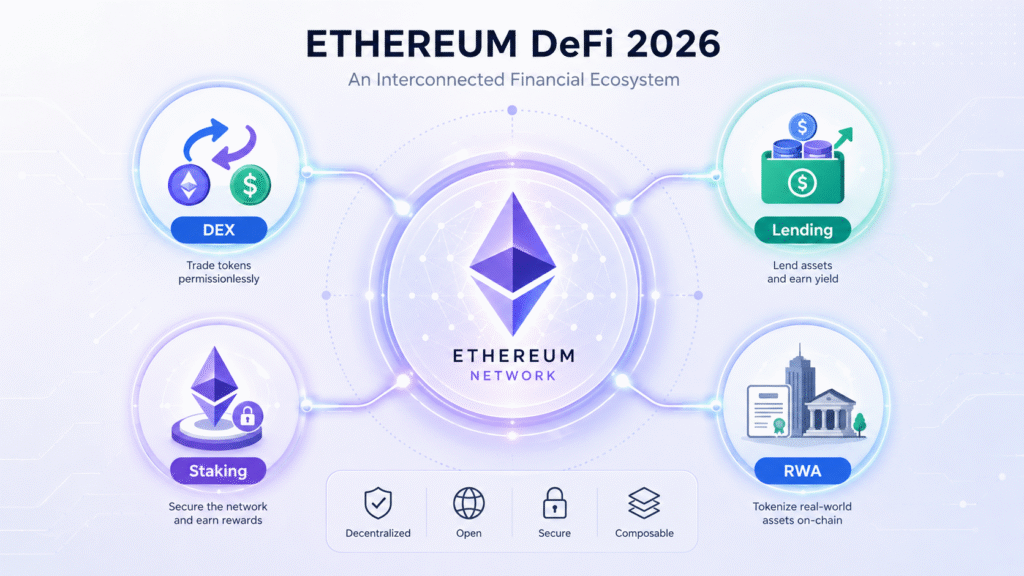
Ethereum DeFi encompasses several core building blocks:
- Decentralised Exchanges (DEXs): Platforms for peer-to-pool token swaps with high transparency.
- Lending and Borrowing Protocols: Users supply assets to earn interest or borrow against collateral.
- Liquid Staking and Yield Strategies: Tools that allow ETH holders to earn staking rewards while keeping assets productive in DeFi protocols.
- Derivatives and Options Platforms: Advanced instruments for hedging and speculation.
- Asset Management and Aggregators: Solutions that optimise yields across multiple protocols.
These components work together through composability — one of Ethereum DeFi’s greatest strengths. A user can stake ETH, use the liquid token as collateral for a loan, and then provide liquidity elsewhere, all within the same ecosystem.
Top Ethereum DeFi Protocols and Platforms in 2026
Aave leads lending with substantial TVL and innovative features like flash loans. Uniswap dominates spot trading volume through efficient automated market makers. Lido remains the go-to for liquid staking, while EigenLayer powers restaking innovation. Other notable players include Morpho for optimised lending rates and Curve for stablecoin swaps.
As covered in our guide to DeFi staking, many users combine these protocols for enhanced returns.
Step-by-Step: Getting Started with Ethereum DeFi
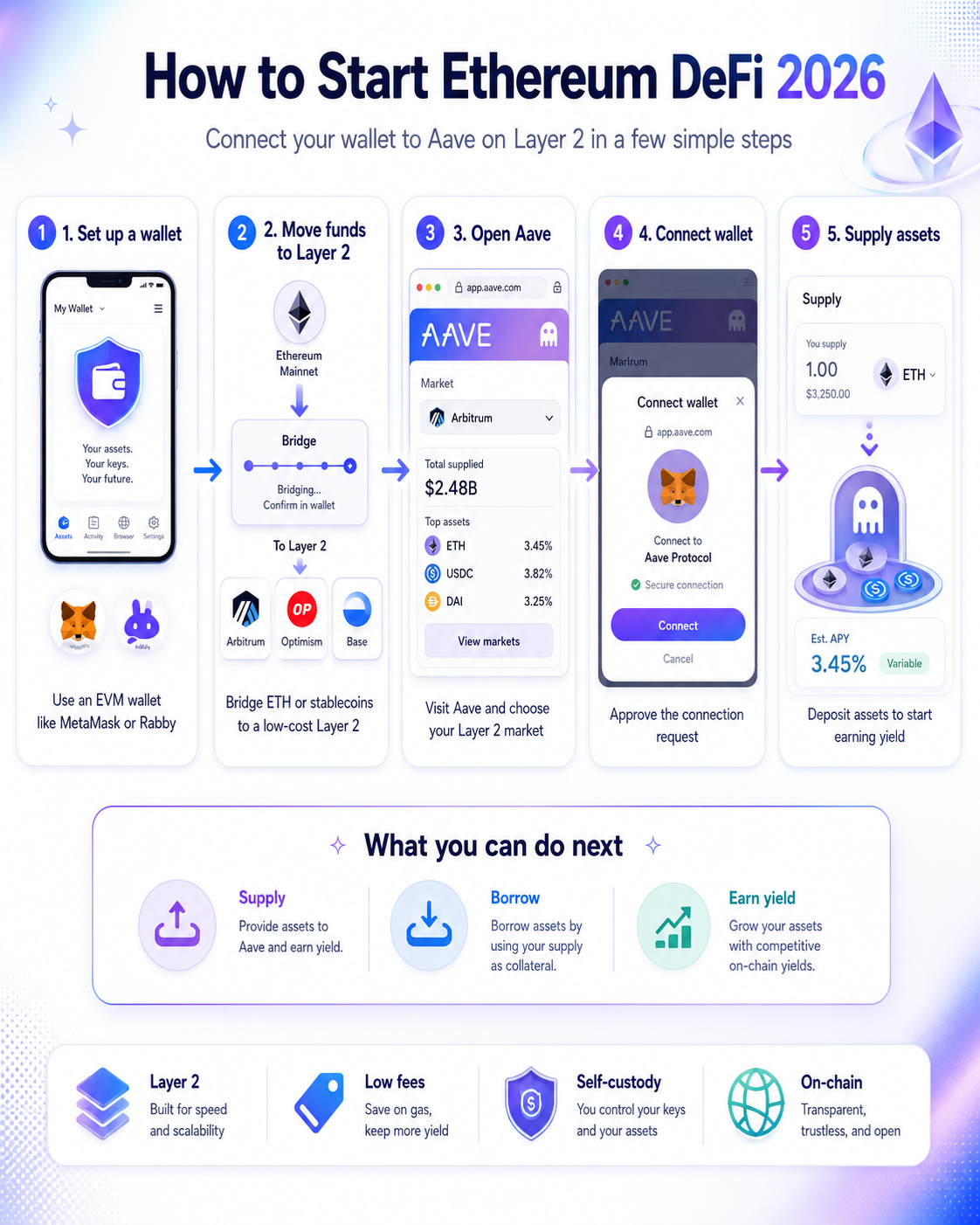
- Set up a non-custodial wallet such as MetaMask and secure it properly.
- Acquire ETH for gas fees and the desired starting asset.
- Bridge funds to a Layer 2 network if seeking lower costs.
- Connect the wallet to a chosen protocol (for example, Aave or Uniswap).
- Approve and execute the transaction — supply liquidity, swap tokens, or stake assets.
- Monitor positions using portfolio trackers like DeFiLlama or Zapper.
- Withdraw or adjust strategies as market conditions change.
Always begin with modest amounts to familiarise yourself with the interface and confirmations.
Yield Opportunities and Real-World Calculations
Yields in Ethereum DeFi vary by protocol and market conditions. In mid-2026, stablecoin lending on Aave might offer 4–7 % APY, while providing liquidity on Uniswap for popular pairs can deliver 5–15 % including fees, depending on volume and impermanent loss. Liquid staking on Lido typically provides around 3–4 % base yield, with restaking adding potential upside.
Practical example: A user with $10,000 in USDC supplying to Aave at 5.5 % APY would earn roughly $550 annually before fees. Deploying staked ETH into additional strategies could push total returns toward 6–9 %, though with increased exposure to smart contract and market risks.
Layer 2 Solutions: Scaling Ethereum DeFi
Layer 2 networks have transformed Ethereum DeFi by slashing fees and boosting transaction speed. Arbitrum, Optimism, and Base host significant portions of activity, offering near-identical security with much better economics. Users often bridge assets once and operate primarily on these chains for everyday DeFi interactions.
This shift has made Ethereum DeFi accessible to a wider audience, particularly for frequent trading or smaller positions.
Risks and Common Myths in Ethereum DeFi
Common Myths
- “Ethereum DeFi is completely trustless and risk-free.” Smart contracts can contain bugs.
- “Highest APY always equals the best choice.” Temporary incentives often hide risks.
- “Layer 2s are just as secure as mainnet.” They inherit security but introduce new bridging considerations.
Key risks include smart contract vulnerabilities, impermanent loss, liquidation during volatility, and regulatory uncertainty around certain activities. Diversification and regular due diligence help mitigate these.
Comparison of Leading Ethereum DeFi Protocols
| Protocol | Category | Approx. TVL (2026) | Typical Yield Range | Key Strength | Notable Risk |
| Aave | Lending | $20B+ | 4–8% | Flash loans & multi-chain | Liquidation risk |
| Uniswap | DEX | $8–12B | Variable (fees) | Highest trading volume | Impermanent loss |
| Lido | Liquid Staking | $18–25B | 3–4.5% | Liquidity & adoption | Centralisation concerns |
| EigenLayer | Restaking | $10–14B | 4–8% | Additional yield layers | Compounded slashing risk |
| Curve | Stable Swaps | Multi-billion | 2–6% | Low-slippage stables | Peg stability |
Pros of Ethereum DeFi
- High composability and innovation
- Strong liquidity on major pairs
- Transparent on-chain activity
Cons
- Gas costs on mainnet
- Smart contract and market risks
- Complexity for beginners
Common Mistakes to Avoid in 2026
Many users overlook impermanent loss when providing liquidity, fail to monitor collateral health in lending positions, or chase unsustainable yields on new protocols. Another frequent error is neglecting network fees when calculating net returns or bridging assets without checking bridge security history.
What’s Next for Ethereum DeFi
The coming year points toward deeper real-world asset integration, improved cross-L2 interoperability, and more institutional-grade tools. As scaling solutions mature, Ethereum DeFi is expected to capture even larger shares of global financial activity while addressing current friction points.
Frequently Asked Questions
Is Ethereum DeFi safe for beginners in 2026?
It can be with proper research, small starting amounts, and use of established protocols. Layer 2s make it more affordable than ever.
How much capital do I need to start with Ethereum DeFi?
As little as a few hundred dollars works on Layer 2s, though larger amounts help offset gas and spread costs for better efficiency.
What are the best yields in Ethereum DeFi right now?
Lending stablecoins and liquid staking often provide steady returns, while liquidity provision and restaking can deliver higher but more variable yields.
Do I need to use Layer 2 for Ethereum DeFi?
For most users yes — mainnet fees make small transactions uneconomical, while Layer 2s offer similar experience at a fraction of the cost.
How do I avoid liquidation in lending protocols?
Maintain healthy collateral ratios, monitor positions regularly, and avoid over-leveraging during volatile periods.
Are there tax implications for Ethereum DeFi activity?
Rewards, trading gains, and certain DeFi actions are typically taxable events in most jurisdictions — accurate record-keeping is important.
What role do RWAs play in Ethereum DeFi?
Tokenised real-world assets bring traditional finance yields on-chain and attract institutional capital, expanding overall liquidity.
Can I lose money in Ethereum DeFi even if protocols are secure?
Yes — through market volatility, impermanent loss, or poor strategy choices, even without hacks.
How does Ethereum DeFi compare to other chains?
It offers unmatched security and liquidity depth, though newer chains may provide higher yields at the cost of higher risk.
Should I stake ETH directly or use DeFi strategies?
Many users prefer liquid staking derivatives for the ability to keep assets productive across multiple DeFi applications.
Conclusion
Ethereum DeFi in 2026 stands as a mature yet innovative ecosystem that offers genuine financial sovereignty and yield potential. With strong liquidity, continuous development, and growing institutional participation, it provides practical tools for users worldwide. Success comes down to education, risk management, and thoughtful strategy selection.
For those moving assets into and out of Ethereum DeFi positions, non-custodial options can offer a seamless experience while maintaining control.
Check related articles on DeFi staking strategies (placeholder) and institutional adoption trends (placeholder) for deeper context. Starting small and scaling with experience remains the most sustainable path in this evolving space.
Disclaimer: The material in this article is not financial or investment advice. Everything stated here reflects the author's personal view and should not be treated as a recommendation to trade or invest. We make no warranties regarding the accuracy, reliability or completeness of the information presented. Cryptocurrency markets are highly volatile and can move unpredictably. Before committing any funds, every investor, trader or crypto user should study several independent sources and check the regulations that apply in their own jurisdiction.