

Have you ever looked at your Bitcoin wallet and thought, “This is great, but why isn’t it doing anything?”
For the longest time, that was just the reality of being a Bitcoiner. You bought your coins, moved them to a cold storage hardware wallet, and then you waited. You watched as the Ethereum crowd built a massive playground of lending, borrowing, and yield-farming protocols. Bitcoin was the pristine “digital gold,” but it was essentially a pet rock. A very valuable pet rock, sure, but a static one.
Well, things have changed dramatically. The sleeping giant of the crypto world has finally woken up, and a massive wave of innovation is flooding the network. We are officially in the era where your Bitcoin can actually work for you. But diving into this new world can be incredibly confusing.
If you’re scratching your head wondering what is Bitcoin defi, you are definitely not alone. In this ultimate guide, we are going to break down exactly what this movement is, how it actually works behind the scenes, the platforms you need to know about, and most importantly, how you can start earning yield on the world’s most secure decentralized network.
Key takeaways:
- The Shift: Bitcoin is evolving from a passive “store of value” into an active, yield-generating asset.
- The Problem it Solves: Historically, Bitcoin’s code was too simple to support complex smart contracts.
- The Solution: Layer-2 networks (like Stacks, Rootstock, and Lightning) and new protocols are bringing smart contract functionality to Bitcoin without altering its base-layer security.
- The Opportunities: You can now lend, borrow, trade, and even restake your BTC to earn passive income.
- The Risks: While base-layer Bitcoin is the most secure network on earth, defi on Bitcoin involves new smart contracts, bridges, and experimental tech. Proceed with caution.
Chapter 1: The Basics
Before we get into the weeds of how to make money, we need to set the foundation.
So, what is Bitcoin defi exactly?
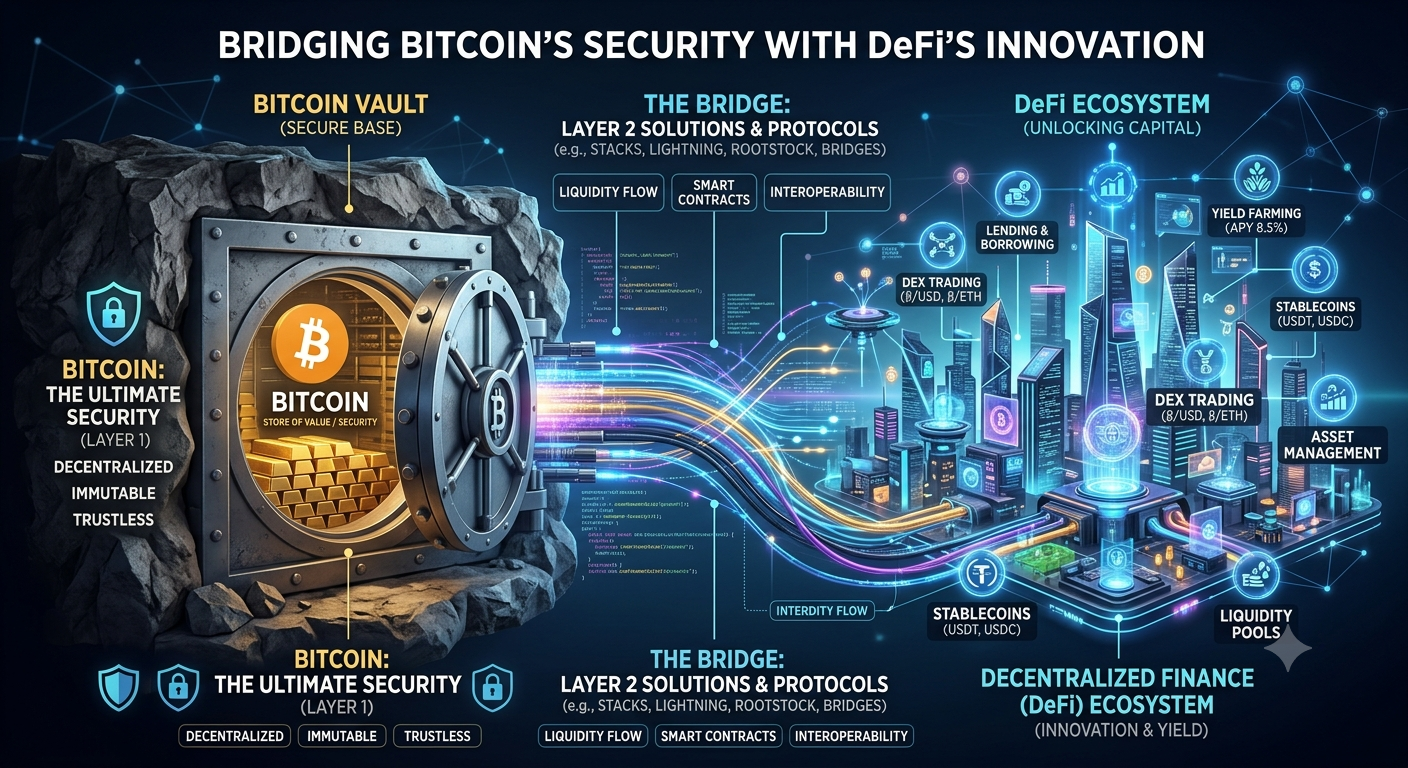
To put it simply, Bitcoin defi (Decentralized Finance) refers to the ecosystem of financial applications being built directly on top of, or deeply integrated with, the Bitcoin blockchain.
Unlike traditional finance, which relies on banks and middlemen to approve loans or facilitate trades, DeFi uses automated lines of code called “smart contracts.” If you meet the conditions of the code, the transaction executes automatically. No manager, no credit check, no banking hours.
Until recently, this was a luxury reserved for networks like Ethereum or Solana. But today, developers have figured out how to bring these automated financial tools to Bitcoin.
When people search for defi Bitcoin, they are looking for the holy grail of crypto: combining the unmatched security and liquidity of Bitcoin with the financial flexibility and yield opportunities of decentralized finance.
Chapter 2: The Technical Hurdle
You might be wondering: if Bitcoin was the first cryptocurrency, why is BTC defi lagging years behind Ethereum?
It wasn’t an accident; it was a deliberate design choice by Satoshi Nakamoto.
Bitcoin’s base programming language (Script) is intentionally “Turing-incomplete.” In plain English, this means it is severely limited in what it can do. It was designed to do one thing perfectly: track who owns which coins and prevent anyone from spending the same coin twice.
Ethereum, on the other hand, was built to be a world computer. It can run endless loops of complex logic, which makes it perfect for smart contracts but also vastly more vulnerable to hacks and exploits.
Bitcoin’s developers sacrificed flexibility for ultimate security. For a long time, the consensus was that putting complex DeFi applications on Bitcoin was either impossible or dangerously irresponsible.
The Turning Point: Taproot and Layer 2s
The game changed with a major network upgrade called Taproot in late 2021, followed by the explosion of the Ordinals protocol in 2023. These events proved that the Bitcoin network could handle more complex data and logic than previously thought.
But the real heroes of defi on Bitcoin are “Layer 2” (L2) networks.
Think of the main Bitcoin network (Layer 1) as the Supreme Court. It is slow, deliberate, and final. You don’t take a minor traffic ticket to the Supreme Court. You handle it in a local court (Layer 2).
Layer 2 networks sit on top of Bitcoin. They handle all the complex smart contracts, fast trades, and yield calculations off the main chain, and then periodically “settle” the final receipts back on the ultra-secure Bitcoin Layer 1. This allows us to have our cake and eat it too: the speed and flexibility of DeFi, backed by the impenetrable security of Bitcoin.
Chapter 3: The Architecture of BTC DeFi
To truly understand how to navigate this space, you need to know the major players. The ecosystem of defi Bitcoin isn’t monolithic; it’s a bustling metropolis of different networks, each with its own approach to solving the smart contract problem.
Here are the heavyweights you need to know:
1. Stacks (STX)
Stacks is arguably the most famous Bitcoin Layer 2 focused on smart contracts. Instead of trying to force Bitcoin to change, Stacks runs parallel to it. It uses a unique consensus mechanism called “Proof of Transfer” (PoX).
Through Stacks, developers can write smart contracts that can actually read the state of the Bitcoin blockchain. This allows for the creation of decentralized applications (dApps) that settle on Bitcoin. When you interact with Stacks, you’re interacting with a system designed specifically to make Bitcoin a productive asset.
2. Rootstock (RSK)
If you already know how to use Ethereum, Rootstock will feel incredibly familiar. RSK is a “sidechain” that is connected to Bitcoin via a two-way peg. The magic of RSK is that it is EVM-compatible (Ethereum Virtual Machine).
This means developers can copy and paste their existing Ethereum DeFi applications directly onto RSK, but instead of using ETH for gas, they use “Smart Bitcoin” (RBTC), which is pegged 1:1 with actual BTC. It bridges the gap between Ethereum’s developer tools and Bitcoin’s liquidity.
3. The Lightning Network
While mostly known for instant, cheap payments (buying coffee with crypto), Lightning is evolving. With the introduction of the Taproot Asset Protocol, developers are beginning to issue stablecoins and other digital assets directly on the Lightning Network, turning it into a high-speed highway for financial routing.
4. BitVM and Restaking (Babylon)
BitVM allows for complex, Turing-complete smart contracts to be verified on Bitcoin without actually changing Bitcoin’s rules. Meanwhile, protocols like Babylon are introducing “restaking.” Imagine taking your idle BTC and lending its economic security to other, smaller blockchains in exchange for yield. It’s a massive narrative pushing Bitcoin defi into the mainstream.
Quick Reference: The Bitcoin L2 Landscape
| Network / Protocol | Primary Focus | Best For | Technical Approach |
| Stacks (STX) | Smart Contracts & dApps | Yield farming, decentralized lending | Proof of Transfer (PoX) Layer 2 |
| Rootstock (RSK) | Ethereum Compatibility | Bringing EVM devs to Bitcoin | Sidechain with 1:1 BTC peg |
| Lightning | Speed & Scalability | Micropayments, Stablecoin routing | State channels L2 |
| Babylon | Security sharing | Earning yield via “restaking” | Trustless native staking |
Chapter 4: What Can You Actually Do With DeFi on Bitcoin?
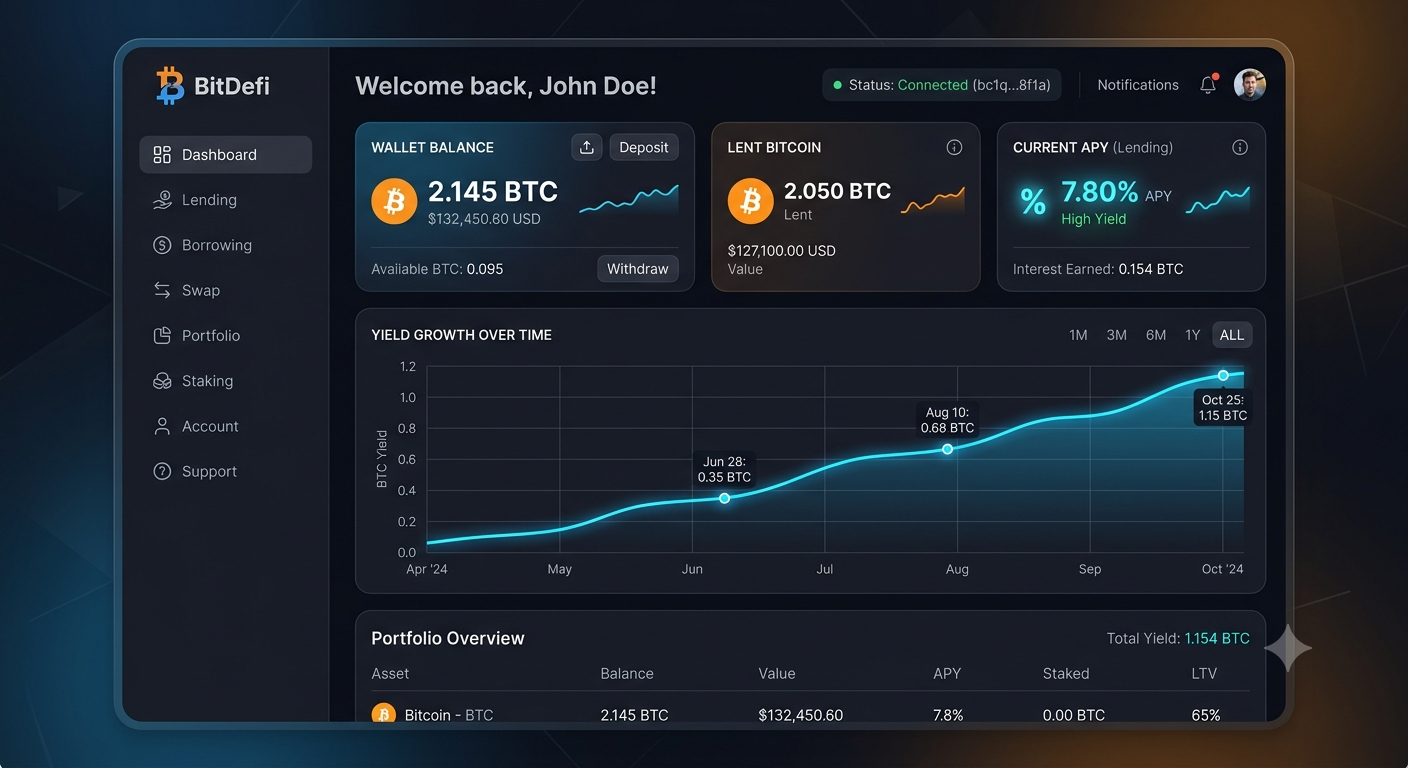
Okay, enough theory. Let’s talk about practical application. If you have some BTC sitting in a wallet, what are the actual use cases available to you today?
1. Earning Passive Yield (Lending)
This is the gateway drug to BTC defi. Just like you can put cash in a traditional bank savings account to earn a tiny amount of interest, you can supply your Bitcoin to decentralized lending protocols.
Platforms like Sovryn (on Rootstock) or Zest Protocol (on Stacks) allow you to deposit your BTC into a smart contract pool. Other users borrow from that pool and pay interest. The protocol automatically distributes that interest back to you. The beauty? No banks taking a 90% cut of the profits.
2. Borrowing Against Your Bitcoin
Let’s say you need cash to buy a car, pay taxes, or invest in a business, but you fundamentally refuse to sell your coins because you believe the Bitcoin price will go up.
In traditional finance, selling triggers a taxable event and you lose exposure to the asset. In Bitcoin defi, you can lock your BTC in a smart contract as collateral and borrow a stablecoin (like USDC or a native Bitcoin stablecoin) against it. You get the cash you need, you avoid capital gains taxes, and you keep your Bitcoin. Once you pay back the loan, your BTC is unlocked. Learn more about token unlocks.
3. Decentralized Trading (DEXs)
Historically, if you wanted to trade Bitcoin for another asset, you had to use a centralized exchange like Binance or Coinbase. That means giving up custody of your keys (“Not your keys, not your coins”).
Now, Decentralized Exchanges (DEXs) like Quickex allow you to swap assets, like ETH to USDT directly from the main page. You interact with a smart contract, trade your assets peer-to-peer, and maintain total control over your funds at all times.
4. Bitcoin-Backed Stablecoins
Volatility is the enemy of everyday commerce. Defi on Bitcoin has introduced stablecoins that are cryptographically backed by Bitcoin. Protocols allow you to mint a stablecoin that is pegged to the US Dollar by over-collateralizing it with BTC. It creates a censorship-resistant digital dollar that inherits the security profile of the Bitcoin network.
Chapter 5: Bitcoin DeFi vs. Ethereum DeFi
If you are coming from the Ethereum or Solana ecosystems, you might be looking at this and thinking, “We’ve had this stuff for years. Why should I care about doing it on Bitcoin?”
It’s a fair question. Let’s look at a realistic comparison.
The Ethereum Advantage:
Ethereum is still the undisputed king of DeFi volume, liquidity, and user experience. The tooling is better, the wallets are more intuitive, and the sheer number of applications is staggering. If you want high-speed, highly experimental, complex financial lego blocks, Ethereum (and its L2s like Arbitrum and Optimism) is where you go.
The Bitcoin Advantage:
So why bother with defi Bitcoin? Three words: Security, Liquidity, and Ideology. Bitcoin is the most decentralized, battle-tested, and secure computing network in human history. It has survived state-level attacks and regulatory scrutiny that would crush other chains. Furthermore, it holds over 50% of the entire crypto market’s wealth.
Ethereum DeFi is built on an asset (ETH) that changes its monetary policy. Bitcoin DeFi is built on an asset with an immutable, mathematically guaranteed supply cap of 21 million. For large institutional players and hardcore maximalists, building on anything other than Bitcoin introduces unacceptable base-layer risk.
| Feature | Ethereum DeFi | Bitcoin DeFi |
| Base Asset | ETH (Deflationary/Inflationary based on use) | BTC (Hard cap 21M, absolute scarcity) |
| Smart Contracts | Native (Layer 1) | Requires Layer 2s or Sidechains |
| User Experience | Highly polished, massive wallet support | Improving rapidly, but still clunky in spots |
| Security Ethos | Fast innovation, higher exploit risk | Slow innovation, conservative, ultra-secure |
| Total Value Locked | Hundreds of billions | Rapidly growing from a lower base |
Chapter 6: Step-by-Step – How to Get Started
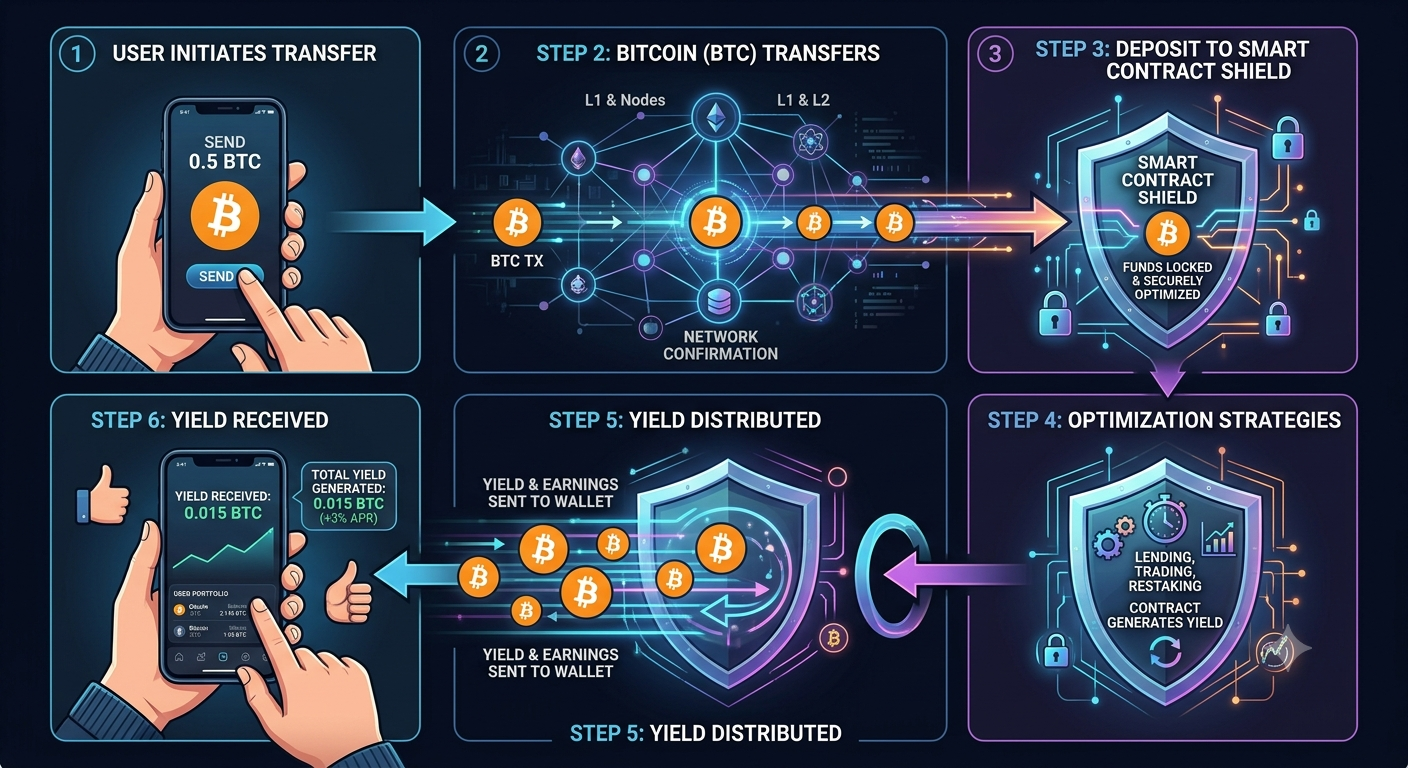
Alright, you understand the why and the what. Now let’s talk about the how. If you want to dip your toes into the world of Bitcoin defi, here is a safe, realistic roadmap for a beginner.
Step 1: Secure a Compatible Web3 Wallet
Your old-school Bitcoin hardware wallet or exchange account won’t work for interacting with dApps. You need a Web3 wallet that can bridge the gap.
- Action: Download a wallet like Leather or Xverse. These are specifically designed for the Bitcoin ecosystem (Ordinals, Stacks, L2s).
- Security check: Write down your 12-24 word seed phrase on physical paper. Never store it digitally.
Step 2: Fund Your Wallet
You will need some Bitcoin to start.
- Action: Transfer a small amount of BTC from your exchange (like Kraken or Coinbase) to your new Leather or Xverse wallet.
Step 3: Choose Your Ecosystem
Decide if you want to play on Stacks or Rootstock (RSK) first. For this example, let’s look at Stacks, as it has a very vibrant native community.
- Action: To do anything on the Stacks network, you will need a small amount of STX tokens to pay for “gas” (transaction fees), just like you need ETH on Ethereum. You can buy STX on an exchange and send it to your wallet.
Step 4: Interact with a Protocol
Let’s say you want to earn a yield on your assets.
- Action: Go to a platform like ALEX (a major decentralized exchange on Stacks). Connect your Web3 wallet to the site.
- Execute: You can swap some of your assets for a yield-bearing token, or provide liquidity to a trading pool to start earning trading fees and protocol rewards.
A Crucial Tip: The UX in BTC defi is getting better every day, but it still requires patience. Bitcoin blocks take about 10 minutes to mine. L2s are faster, but bridging assets between Layer 1 and Layer 2 can sometimes take time. Don’t panic if a transaction doesn’t confirm in 3 seconds.
Chapter 7: Risks and Red Flags
I would be doing you a massive disservice if I painted this as a flawless, risk-free utopia. You are putting your money on the frontier of financial technology. There are dragons here.
While the base Bitcoin layer is incredibly safe, defi on Bitcoin introduces new vectors for things to go wrong.
1. Smart Contract Risk
When you put your Bitcoin into a decentralized lending pool, you are trusting the code of that L2 network or protocol. If a developer made a mistake, or left a loophole in the smart contract code, hackers will find it. If the contract gets drained, your Bitcoin is gone. There is no customer service hotline to call to reverse the transaction.
2. Bridging Risks
Right now, to use your BTC on a network like Rootstock or even Ethereum (as Wrapped Bitcoin / WBTC), you have to “bridge” it. You lock your real Bitcoin in a digital vault on the main network, and the L2 mints a synthetic version for you to play with.
Bridges are historically the most vulnerable points in crypto. If the bridge holding the real Bitcoin gets hacked, the synthetic Bitcoin you hold on the L2 becomes worthless instantly.
3. Regulatory Uncertainty
Governments are still trying to figure out how to classify decentralized finance. While Bitcoin itself is widely recognized as a commodity, the protocols built on top of it might eventually face scrutiny from entities like the SEC, which could impact liquidity or platform access depending on your jurisdiction.
How to protect yourself:
- Never put your entire stack into DeFi. Keep the majority of your wealth in cold storage.
- Only use protocols that have been publicly audited by reputable blockchain security firms.
- Diversify. Don’t put all your “working” Bitcoin into one single platform.
Chapter 8: The Future
As we look at the landscape, the momentum behind Bitcoin defi is staggering. We are witnessing a massive shift in developer talent migrating from other chains back to Bitcoin.
Why? Because the infrastructure is finally ready.
Over the next few years, we can expect the lines between Layer 1 and Layer 2 to blur for the end user. You won’t need to manually bridge assets or manage multiple gas tokens. Wallet software will handle the complex routing in the background. You’ll simply open an app, press “Earn Yield,” and the cryptography will do the rest securely.
Furthermore, the integration of traditional finance (TradFi) with Bitcoin DeFi is inevitable. As Wall Street gets more comfortable with spot Bitcoin ETFs, their next logical step is wanting yield on those assets. The protocols being built today are laying the rails for institutional capital tomorrow.
Conclusion
The era of Bitcoin solely being a passive store of value is over.
By answering the question of what is Bitcoin defi, developers have unlocked a universe of possibilities for the world’s most trusted digital asset. Whether you are looking to lend your crypto for passive income, borrow against your stack to avoid taxes, or trade in a completely decentralized manner, the tools now exist to do it.
It requires a bit of learning, a solid Web3 wallet, and an understanding of the risks involved. But for those willing to learn the ropes, the opportunity to generate yield on the hardest money ever created is an opportunity that is incredibly hard to ignore.
The sleeping giant is awake. It’s time to decide how you’re going to interact with it.
Frequently Asked Questions
Is Bitcoin DeFi safe?
The base Bitcoin network is incredibly secure, but DeFi applications and Layer-2 networks built on top of it carry smart contract and bridging risks. It is riskier than simply holding Bitcoin in a hardware wallet. Always use audited platforms and never invest more than you can afford to lose.
Do I need to buy a different coin to use DeFi on Bitcoin?
It depends on the platform. Some networks, like Stacks, require their native token (STX) to pay for transaction fees. Others, like Rootstock, use a pegged version of Bitcoin (RBTC) for fees, keeping you entirely within the Bitcoin ecosystem.
How is this different from Wrapped Bitcoin (WBTC) on Ethereum?
WBTC relies on a centralized custodian (a company) to hold the real Bitcoin while issuing tokens on Ethereum. Native BTC defi aims to minimize or eliminate centralized custodians, using decentralized bridges and Layer-2s directly anchored to the Bitcoin blockchain.
Can I do this from my Ledger or Trezor hardware wallet?
Direct interaction with dApps from cold storage is difficult, but many Web3 wallets (like Leather or Xverse) allow you to connect your hardware wallet for an added layer of security when signing transactions.
How much yield can I realistically make?
Yields fluctuate wildly based on market demand, liquidity, and the specific protocol. They can range anywhere from 2% APY for conservative lending to much higher double-digit percentages for riskier liquidity provision or yield farming.
Disclaimer: The material in this article is not financial or investment advice. Everything stated here reflects the author's personal view and should not be treated as a recommendation to trade or invest. We make no warranties regarding the accuracy, reliability or completeness of the information presented. Cryptocurrency markets are highly volatile and can move unpredictably. Before committing any funds, every investor, trader or crypto user should study several independent sources and check the regulations that apply in their own jurisdiction.